Henry L. Stimson Quotes
Other nations would follow Japan's example unless the Nationalist government changed the picture of various Chinese factions cutting each other's throats and tearing each other to pieces...
In the 1920s and 1930s China was in chaos. Chiang Kai-shek and his Nationalists were officially the government but there was extensive corruption and local “leaders” who fought for control of territories and resources. Chinese were slaughtering each other daily not unlike Bosnia in the 1990s. The Japanese had moved into Manchuria using the pretext that they were saving China by bringing order and security. (In reality they were trying to control additional territory to populate with their rapidly expanding population.) The U.S. opposed the Japanese aggression but privately warned the Chinese Nationalists that they had better get control of the nation. The Nationalists never did. The Japanese expanded into much more of China beginning WWII in Asia. The Nationalists and the communists joined forces to fight the Japanese and after the war, the communists won the allegiance of most of the people. The Chinese government was finally unified, but under the communists.
Henry L. Stimson, 1867-1950, U. S. Secretary of State (Republican), U. S. Secretary of War, Governor General, Philippine Islands, Statement to the Nationalist Chinese Leadership, 1932, Quoted in Lloyd C. Gardner, Economic Aspects of New Deal Diplomacy, 1964
Sourced by: Eigen's Political and Historical Quotations

In World War II, all the Chinese political organizations united to fight the Japanese invaders. The Communists however did most of the fighting and took the heaviest casualties. He proposed turning on their weakened allies and that was accepted by Chiang Kai-shek, the Nationalist leader. They attacked the Communists under Mao and Cho En Lai and forced them to flee across the country in the “Long March”. The Nationalists and their warlords were hated by the majority of the Chinese, especially the peasants who provided help and support to the Communists while they made their escape. They then regrouped and attacked the Nationalists in the Chinese Revolution and this time Chiang Kai-shek, Bai Chongxi and the other Chinese Leaders fled. With few people to help them, they had to flee to Taiwan, and the Communists took over China. Some historians believe that it was Chiang Kai-shek’s strategy all along to hold his soldiers back and let the Communists bear the casualties with the intention of turning on then when the Japanese were expelled. Others claim that Chiang’s relatively unaggressive military action against the Japanese reflected his typical conservatism and avoidance of risk and there was no intention to attack the Communists after the war and the alliance was made in good faith. Note that the leading Muslims in China (where they are a significant minority) were allied with the Chinese Christians against the Communists. Bai Chongxi had a special Muslim newspaper which regularly published religious quoted from the Koran and the Hadith purporting to support and justify Chiang Kai-shek, a Christian, as the rightful leader of China. This was another example of Islam being hijacked for a narrow political purpose. Also, note his use of the word “bandits”. This is a huge insult in the Chinese language culture. So of course the Nationalists used it to refer to the Communists—See {613286} .

Before American entry into the War with Japan, Chiang Kai-shek and the Soongs maintained that they were fighting the Japanese but it was not generally true. They were fighting Mao and his Communists while Mao was fighting the Japanese. By 1942, under pressure from the United States and Russia, the Nationalists and Communists agreed to a truce so that they could both fight against Japan. Based on the promises made to President Roosevelt by Madam Chiang, the Soongs, and Chiang himself, there was an expectation of extensive military attacks against the Japanese. The U. S. then sent a large amount of military aid to Chiang Kai-shek, but there did not appear to be any significant attacks against the Japanese other than those mounted by the Communists. Magruder, General Marshall’s emissary to Chiang Kai-shek was instructed to investigate. When the war ended, Chiang Kai-shek used the assets he was saving in to attack Mao and his communists just as he had done before the truce. Magruder had been right. However, just as Chiang could not defeat the militarily inferior Communists before the truce, he could not do so after. Soon Mao turned the tables and drove Chiang Kai-shek and his Nationalists out of Mainland China. President Roosevelt had brilliantly judged the ability of England, Russia, and Yugoslavia to fight the Germans, but as this quotation and {641677} shows, he listened to the wrong people. He had been sold a “bill of goods” by the China Lobby, the Soongs and Chiang Kai-shek.


The problems of Iraq regarding internecine ethnic struggles have not changed in 60 years. See {586486} for another example.
In 1945 a message was sent to Joseph Stalin from the Japanese purportedly authorized by the Emperor asking the Russians to receive a peace envoy to discuss possible terms for a Japanese surrender. A prince of the imperial household was proposed as the emissary. The allies had already agreed and announced that unconditional surrender was the only alternative, but Stalin and the Russian Foreign Office thought that there might be some advantage gained to have the meeting. However there was one problem that the Japanese had never considered. When Stalin told Truman of the initiative, Truman agreed that no one should meet him.
The Kuomintang nationalists under Chiang Kai-Shek tried to stay in power in China, but their corruption and incompetency at government lost them the support of most of the Chinese. The Chinese communists took over the government. The Nationalists then invaded the offshore island of Taiwan but claimed to be the rightful government of all of China. For many years they controlled the Chinese seat in the UN and they refused to recognize the fact that they had failed to gain the loyalty of the Chinese people.


American official foreign policy had been officially isolationist—to not get involved in the squabbles and fights of other nations. Angell however pointed out that even before WWII, America had formally been involved in 6 foreign wars and used military incursions on foreign soil on almost 100 occasions.


In both the First and Second World Wars the Western nations had a multilateral defense pact which did little good in the face of German aggression.


Boggs was working on some compromise positions that could be taken by the party at the 1968 Democratic National Convention to provide the anti war wing of the party with something. The President found out and met with Congressman Boggs.
Although Emperor Hirohito had the status of a God, and his Prime Minister and Chief of the Military testified that they had never disobeyed the Emperor {587278}, there was a thorough attempt to whitewash the Emperor’s role—{587279}. Few Japanese, even years later would suggest that Hirohito might bear some personal responsibility. The Mayor was one of the few who made the statement of the obvious. He received 181 death threats and he was shot shortly thereafter by a right wing supporter of the Emperor’s.

With the successful Chinese Communist Revolution, the Nationalists were driven off the mainland of China and occupied the island of Formosa (Taiwan) and had a small garrison of soldier on two tiny islands off the Chinese Coast, Quemoy and Matsu. The communist Chinese government wanted control of all three of the Nationalist held islands. It became a campaign issue or whether or not the United States should go to war to protect the two tiny islands from the communists even though there were no civilians on them and they had virtually no value other than symbolic. Nixon, took the position that the Chinese Communists must be stopped as they had world conquest as their objective. Philosophically, many Communists of the time, following Marxist theory, actually believed that Capitalism would crumble and communism would take its place. In that sense many felt that the world would be communist. China, as we now know, was more concerned with counterrevolution by the nationalists, expansionism and growth of Vietnam (her ancient enemy), the rise of Japan, border wars with India, and constant threats from Russia and China had no military plans for world conquest.

The non-communist forces of China were always struggling with each other for power. Attempts by non-communist reformers were defeated by autocrats, warlords, major landlords, and various religions organizations and denominations which were all fighting each other.
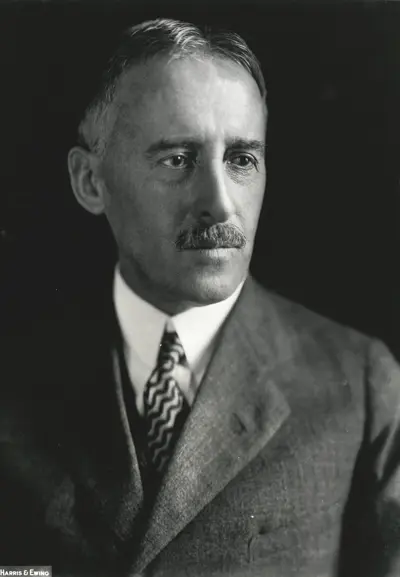
Henry Lewis Stimson was an American statesman, lawyer, and Republican Party politician. Over his long career, he emerged as a leading figure in U.S. foreign policy by serving in both Republican and Democratic administrations. He served as Secretary of War (1911–1913) under President William Howard Taft, Secretary of State (1929–1933) under President Herbert Hoover, and Secretary of War (1940–1945) under Presidents Franklin D. Roosevelt and Harry S. Truman.
