Richard Nixon Quotes
Now what do the Chinese Communists want? They don’t want Quemoy and Matsu. They don’t want just Formosa. They want the world.
With the successful Chinese Communist Revolution, the Nationalists were driven off the mainland of China and occupied the island of Formosa (Taiwan) and had a small garrison of soldier on two tiny islands off the Chinese Coast, Quemoy and Matsu. The communist Chinese government wanted control of all three of the Nationalist held islands. It became a campaign issue or whether or not the United States should go to war to protect the two tiny islands from the communists even though there were no civilians on them and they had virtually no value other than symbolic. Nixon, took the position that the Chinese Communists must be stopped as they had world conquest as their objective. Philosophically, many Communists of the time, following Marxist theory, actually believed that Capitalism would crumble and communism would take its place. In that sense many felt that the world would be communist. China, as we now know, was more concerned with counterrevolution by the nationalists, expansionism and growth of Vietnam (her ancient enemy), the rise of Japan, border wars with India, and constant threats from Russia and China had no military plans for world conquest.
Richard M. Nixon, 1913-1994, 37th President of the United States (Republican, CA), Presidential Campaign Debate Against John F. Kennedy, 1960
Sourced by: Eigen's Political and Historical Quotations

The Kuomintang nationalists under Chiang Kai-Shek tried to stay in power in China, but their corruption and incompetency at government lost them the support of most of the Chinese. The Chinese communists took over the government. The Nationalists then invaded the offshore island of Taiwan but claimed to be the rightful government of all of China. For many years they controlled the Chinese seat in the UN and they refused to recognize the fact that they had failed to gain the loyalty of the Chinese people.
The Communists under Mao won the Civil War easily as the Nationalists were not only corrupt and very unpopular, but they were not very interested in the welfare of the Chinese peasants. Further Chiang was a ruthless dictator. At the time there was great pressure for America to support any faction that was anti Communist regardless of how bad they were themselves. Davies and others who thought that we should have communications with the Communists who would soon control China, were viciously attacked by Senator McCarthy who accused Davies of “loosing China” and the Senator and some other Americans thought that the Nationalists could win the Civil War. We now know that they never had a chance, but at the time they did a very good job of promoting their cause and capability in the United States and especially in Washington. None the less, in the Red Scare, Davies was fired, only to thereafter be awarded the highest civilian award in the nation in recognition of his great and patriotic work.

This was only 6 years after the Russian Revolution. Communist Russia had extended its influence to much of the world without firing a shot. To many, communism looked like the future. The Russian inability to make communism work economically in the next 70 years destroyed most of its influence.


At the time, the Red Scare was prevalent and many Americans were terrified of communists. It was a very effective political tactic to imply that an opponent was a communist or communist sympathizer. For another harsh smear of Stevenson, see {619523}.

The Scientific Project that developed the Atomic Bomb. He was a strong advocate for disarmament and that was being debated at the United Nations. He was critical of Bernard Baruch’s tactics but it soon was clear to almost all that the Russians were not interested in a serious UN supervised disarmament. Oppenheimer was profoundly disappointed when it was clear that disarmament was being blocked by the Russians and their veto. After that he didn’t trust the Russians, and concentrated on trying have US policies that would not goad the Russians into an arms race. This quotation is particularly important because in an effort to discredit his views on nuclear policy some politicians accused him of being a security risk with the innuendo that he was a communist and even a Russian agent.

When Nixon and Kissinger went to China in the midst of the cold war, there are many American right-wingers who objected and thought that it was a betrayal of America’s fundamental principles At the same time, the extreme left wing, hard line Communists objected for the exact same reasons to China allowing the visit. This quotation is an excellent example of the latter.

After the economic & power collapse of the Soviet Union, the United States was the only remaining superpower. Givern Russia's diminshed capability and many Americans still carrying resentments about the Cold War, America's foreign policy and diplomacy did not treat Russia as if they were a very important power in the world. Puten greatly resented the fact that Russia was no longer considered or treated like a world power, Russia had a nuclear arsenal and a total delivery system what was in the same destructive potential class as the United States. There were many Russiabs who had similar resentments and Putin sert out to adopt policieis and practices that would force the United States and the other nations to consider them with more dignity, respect and consdideration. This was a typical statement of the period when he was "stoking the fires of Russian resentment.

During the Cold War and afterwards many Americans attributed the problems we were having with the Soviet Union emenated from the fact that they were Communists, and our focus was anti-communism. Kennen, however argued that it was not Communism that was the cause of the Aggression of the Soviet Union. It was an extension of the Russian Culture. After the Soviet Union collapsed, and Communism was rejected by the Russians, we still had a great deal of Russian aggression and Foreign Policy problems with Russia. Kennan was right. It was the Russian culture, history, values and traditions that were the primary cause of most of the problems with Russia.


Indeed, many of the countries went communist as Kennan predicted.

The British suspected that the Turks of Anatolia were complicit with Bolshevism

Patton was a great fighting general, but a disaster at civilian and public relations. At a time when the American and British governments were arguing that their involvement in world war two was for the benefit and protection of mankind, Patton made public statements like this one.

who worked with the Communists. The Communists were to Flip-flop again when Russia needed arms and assistance to fight Hitler when the pact broke down. See {595773}


Vladimir Lenin
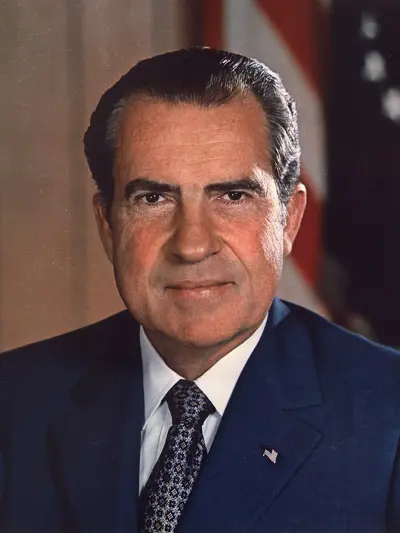
Richard Milhous Nixon was the 37th president of the United States, serving from 1969 to 1974. A member of the Republican Party, Nixon previously served as the 36th vice president from 1953 to 1961, having risen to national prominence as a representative and senator from California. After five years in the White House that saw the conclusion to the U.S. involvement in the Vietnam War, détente with the Soviet Union and China, and the establishment of the Environmental Protection Agency, he became the only president to resign from the office, following the Watergate scandal.
