Archibald Cary Coolidge Quotes
… the Communists, who take their inspiration if not their orders from Moscow, are now a recognized party or faction in every country, and in several constitute a danger to the existing order.
This was only 6 years after the Russian Revolution. Communist Russia had extended its influence to much of the world without firing a shot. To many, communism looked like the future. The Russian inability to make communism work economically in the next 70 years destroyed most of its influence.
Archibald Cary Coolidge, 1866–1928, Historian, Political Scientist & Diplomat, Editor-in-chief of Foreign Affairs, “Ten Years of War and Peace”, Foreign Affairs, September 1923
Sourced by: Eigen's Political and Historical Quotations

who worked with the Communists. The Communists were to Flip-flop again when Russia needed arms and assistance to fight Hitler when the pact broke down. See {595773}

During the Cold War and afterwards many Americans attributed the problems we were having with the Soviet Union emenated from the fact that they were Communists, and our focus was anti-communism. Kennen, however argued that it was not Communism that was the cause of the Aggression of the Soviet Union. It was an extension of the Russian Culture. After the Soviet Union collapsed, and Communism was rejected by the Russians, we still had a great deal of Russian aggression and Foreign Policy problems with Russia. Kennan was right. It was the Russian culture, history, values and traditions that were the primary cause of most of the problems with Russia.


Vladimir Lenin


After the 1917 Russian Revolution many of the Western Countries sent troops to Russia where they aided the Whites against the Reds. When the Red Bolsheviks prevailed, there were many attempts to diplomatically and economically undermine the Communist government. This caused a unity among different Russian factions. Sforza urged leaving them alone and letting the Bolsheviks fail by their own ideology. Most Western nations and the United States did not agree with him.


WWII had come while most of the world was still recovering from the Great Depression. Communists, the world over, were expecting a major revolution in America, Britain and most industrial nations. However, continuation of Theodore Roosevelt’s reforms, the Franklin Roosevelt’s New Deal, the strong American wartime economy, Eleanor Roosevelt’s human rights accomplishments at the UN, the Marshall Plan and Truman’s support of non-communist governments in Europe, and the Labor Party coming to power in Great Britain produced an atmosphere of progress and hope, which provided an alternative to a proletarian revolution and communism. The Cold War then was the only road for international communism.

Truman had to deal with Stalin for many years and over time he became more and more soured on the Russians. See {626411} for his view 22 years later,

In 1921 an Paul E. De Mott, an American Quaker famine relief worker in Germany was arrested as a "Bolshevik" and murdered without trial. American correspondents heard about the crime and asked for a statement from the chief American diplomat in Germany.

Advocating a revolution against the Karenski provisional government: Vladimir Lenin

When Nixon and Kissinger went to China in the midst of the cold war, there are many American right-wingers who objected and thought that it was a betrayal of America’s fundamental principles At the same time, the extreme left wing, hard line Communists objected for the exact same reasons to China allowing the visit. This quotation is an excellent example of the latter.


This is an example of what made the Cold War so difficult. The Italian Communists had great misgivings about the Russian version of Communism that tended to abuse human rights and try and control other countries. However, when the Russian Communists were under world attacks by the West, as with their incursion into Hungary, he urged that all the Communists stick together and defend the Russians even for policies that they thought wrong. On the West side, the same thing occurred. The United States tolerated and supported a number of terribly oppressive dictatorships that were virulently anti-Communist. Polarization was the international norm.

Lenin, Uritsky, and other Bolshevik leaders were attacked in 1918. Lenin was wounded but Utrtsky died, and this triggered the attacks on the other Russian factions by the Bolsheviks known as the “Red Terror.”

With the successful Chinese Communist Revolution, the Nationalists were driven off the mainland of China and occupied the island of Formosa (Taiwan) and had a small garrison of soldier on two tiny islands off the Chinese Coast, Quemoy and Matsu. The communist Chinese government wanted control of all three of the Nationalist held islands. It became a campaign issue or whether or not the United States should go to war to protect the two tiny islands from the communists even though there were no civilians on them and they had virtually no value other than symbolic. Nixon, took the position that the Chinese Communists must be stopped as they had world conquest as their objective. Philosophically, many Communists of the time, following Marxist theory, actually believed that Capitalism would crumble and communism would take its place. In that sense many felt that the world would be communist. China, as we now know, was more concerned with counterrevolution by the nationalists, expansionism and growth of Vietnam (her ancient enemy), the rise of Japan, border wars with India, and constant threats from Russia and China had no military plans for world conquest.


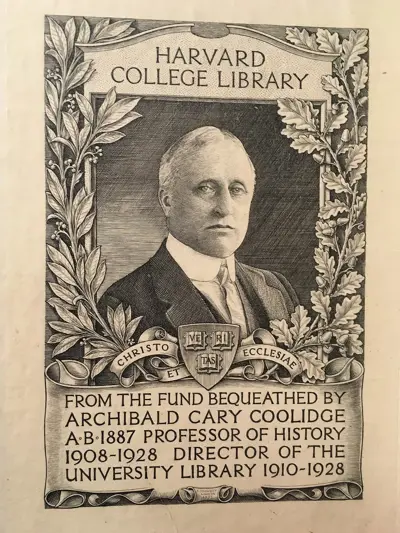
Archibald Cary Coolidge was an American educator and diplomat. He was a Professor of History at Harvard College from 1908 and the first Director of the Harvard University Library from 1910 until his death. Coolidge was also a scholar in international affairs, a planner of the Widener Library, a member of the United States Foreign Service, and editor-in-chief of the policy journal Foreign Affairs.
