Harold Wilson Quotes
Now for the first time … we had… reached the situation where a newly-elected Government with a mandate from the people was being told, not so much by the Governor of the Bank of England, but by the international speculators that the policies on which we fought the election could not be implemented, that the Government was to be forced into the adoption of Tory policies to which it was fundamentally opposed. He had to admit that was what his argument meant, because of the sheer compulsion of the economic dictation of those who exercised decisive economic power.
In 1964, after the newly elected Labour Government announced its new policies and budget, the financiers and speculators who control the international money markets thought the new budget and policies ill-advised. The made their concerns known to the Governor of the Bank of England who in turn recommended to the new Prime Minister that he cut the budget drastically and adopt a new more conservative set of economic policies. The Prime Minister was shocked that a non-elected small group of men—mostly not even British, were trying to reverse a set of policies that the voters in a democracy had elected. However, he was more shocked when he discovered that if he didn’t “obey” the financiers could act in concert, attack the British Pound, dramatically increase the interest rates the government would have to pay to borrow short term money, and ruin the British economy. Wilson had to comply. In America we refer to this situation more delicately by saying that “the markets will not react well to one proposal or another”. Our politicians intimidate themselves. The only way a democracy can really have control over its own policies and budgets, is to not be in debt to anyone.
Harold Wilson, 1916–1995, British Prime Minister (Labor), The Labour Government
Sourced by: Eigen's Political and Historical Quotations


See {617208} his grandfather’s related statement.

There was a financial crisis in the country and the world when highly risky home mortgage loans defaulted leaving investors and speculators in mortgage-backed securities in a poor position. The investors had been reaping very high interest rates for their risky investments, but this was the first time that this form of risky investment had failed. The investors, of course were looking for a bailout from government. When the Bush administration failed to bail out investment bank, Lehman, there was a panic and the banking system of the country and much of the world froze up. Bush and his Secretary reversed their bailout of speculators policy and provided various assistants and bailouts to the very bankers and other investors who had caused the economic meltdown. The policy was continued by the Obama administration although the bailouts were just as distasteful to Obama as they were to Bush, but most economists agree that the two presidents very distasteful and unpopular bailout actions probably saved the nation from a massive depression. After being bailed out by the taxpayers, the Bankers then paid themselves exorbitant bonuses while the results of their management put 10 percent of the country out of work.

The last sentence echoes a quotation of Napoleon. See {630664} .


See {583710} for his grandchild’s variation.


1st Viscount Bolingbroke. See {627799} for the origin of the bias against merchants and money men. It also represents a rigidity of class structure that characterized England until very recently. The landed gentry were the first class citizens. Usually titles went with the land. In America, someone who would be successful as a merchant or a banker could achieve the highest of social status and political influence. This was not true in England where a merchant that was far more wealthy than a landed lord was not accepted by the aristocracy.

This was written in the 3rd year of the Great Depression which was worldwide. The political and economic leadership in the world had been very passive with the exception of FDR in the United States whose pump priming and relief methods were just beginning to take effect.

Executed by the English for his part in the Easter Uprising. Connolly was a socialist advocate as well as a republican. He was one of the first revolutionaries to understand that military occupation was only a part of forces that kept a nation subservient to another. However, attempts to break those economic ties have almost always led to economic ruination.


FDR was then a candidate for the Democratic Vice Presidential Nomination. This statement shocked some of the conservative French and British delegates and officials such as Ramsay MacDonald, Georges Bonnet, and Neville Chamberlain, but economist John Maynard Keynes strongly approved of Roosevelt Roosevelt’s statements. At issue was whether or not the major currency powers should confer frequently and set the international currency exchange rates or should the rates float and be determined at any point by the free market in currency. FDR held the latter view which was opposed to the positions of the conservative banker-oriented delegates from the European counties, However Roosevelt’s statement was considered “harsh” and “vituperative” by the conservatives and the entire conference collapsed over them. FDR admitted that perhaps he had been too strong and blunt in his language. An irony of this quotation is that 80 years later the positions of liberals and conservatives had both flip-flopped. It became the conservatives who adopted the FDR free market for currency exchange while many liberals called for government intervention and agreement on exchange rates to prevent instability.


During this crises, the taxpayers of America had to bail out most of the largest banks in the country whose profligate investment strategy had squandered their depositors and other customers money as a result of the spiral to reap higher and higher profits until they collapsed with the executives making millions in bonuses when their banks were losing money. They put millions of people out of work, and their greedy policies crashed the housing market and then the same banks evicted millions of families when the banks foreclosed on their mortgages with thousands of bank officers committing felonies in the foreclosure processes. This was to Blankfiein and many of the other leading bankers, “God’s Work”.
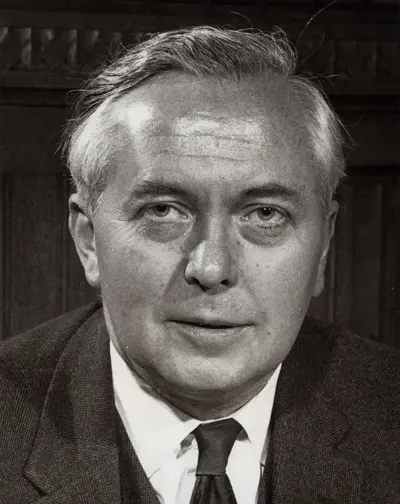
James Harold Wilson, Baron Wilson of Rievaulx, KG, OBE, PC, FRS, FSS was Prime Minister of the United Kingdom twice, from October 1964 to June 1970, and again from March 1974 to April 1976. Wilson was the Leader of the Labour Party from 1963 to 1976, and was a Member of Parliament (MP) from 1945 to 1983.
