James Connolly Quotes
If you remove the English army to-morrow and hoist the green flag over Dublin Castle, unless you set about the organization of the Socialist Republic your efforts would be in vain. England would still rule you. She would rule you through her capitalists, through her landlords, through her financiers, through the whole array of commercial and individualist institutions she has planted in this country and watered with the tears of our mothers and the blood of our martyrs.
Executed by the English for his part in the Easter Uprising. Connolly was a socialist advocate as well as a republican. He was one of the first revolutionaries to understand that military occupation was only a part of forces that kept a nation subservient to another. However, attempts to break those economic ties have almost always led to economic ruination.
James Connolly, 1868-1916, Founder, Irish Socialist Republican Party, Military Commander of Republican Forces in Dublin, Irish Founder of the Irish Socialist Republican Party, Co-Founder Industrial Workers of the World (IWW), “Socialism and Nationalism,” Shan Van Vocht, January 1897
Sourced by: Eigen's Political and Historical Quotations


At this point in the convoluted history of Irish-English politics, the majority of the Irish upper class and members of Parliament were large landholders whose estates had been accumulated and legalized under English

Stamp was a banker and the 2nd richest man in England at the time. Yet he warned about aspects of banking that needed reform and regulation.


The violent IRA logic had always been a little tortured. At the time, the claim was that the British were not wanted in Ireland but were there only by force of arms. However, the British administration of Ireland at the time was not forceful or violent at all. Few others had the freedom and democracy of Ireland as a part of Great Britain. De Valera’s logic was that if the British in Ireland were subjected to violent, terrorist attacks, they would respond with force of arms, and thus show that they held Ireland by force. Most of the Catholics of Ireland preferred independence while most of the Protestants preferred the relationship with England.


The first quotation was made shortly after the launching of The Clarion in 1891. The newspaper was relatively successful but while England moved more to the left, socialism was not embraced by Englishmen. Later, Blachford concluded that the conversion would not likely take place soon.


Jefferson was the leader of the Republican faction of the nation against the Federalists who had passed the leadership from Washington to John Adams. Adams was somewhat pompous and strove for respect, titles, pomp and circumstance preferring “His Excellency” to “Mr President.” The Federalists strove for stability and order above all. Jefferson itemized the different subgroups and interest groups of the American population who supported the Federalist and a government that was close to the British system, It was a classic split with the wealthy, established, and conservative forces lined up against change and completing the transition to a radically new form of government. The respect the electorate had for Washington kept the Federalists in power for the first three Presidential Elections, but now Jefferson had Adams as the face of Federalism—a much easier target than George Washington. Despite all the power—religious, economic, financial, and governmental—all lined up against the Democratic Republicans, Jefferson over the next four years took his case to the people, who in 1800 voted against the Federalists so overwhelmingly, that the Federalist Party was wiped out in America and Jefferson and his followers dominated American politics for the next two Presidential elections.


At the time, this was not popular with many socialists who had given up on the lack of fairness and equity of the capitalistic system. A century later, most politicians and political philosophers had given up on socialism ever meeting Bauer’s test, and Capitalism was well ensconced in Western Democracies.


He was addressing the Conservatives of Ulster, the Northern Ireland province that was the center of the Orangemen movement of Irish Protestants who were fighting to retain 'Protestant Ascendency' -- which was the social, political and cultural domination of the Protestants (the minority) over the Catholics (the majority). This was best achieved by keeping Ireland a part of Great Britain as opposed to having Ireland as a separate, independent country.


3rd Earl Russell of Kingston. He favored and argued for a middle ground of a capitalistic socialism or a socialized capitalism, which is what most democracies became.


In 1964, after the newly elected Labour Government announced its new policies and budget, the financiers and speculators who control the international money markets thought the new budget and policies ill-advised. The made their concerns known to the Governor of the Bank of England who in turn recommended to the new Prime Minister that he cut the budget drastically and adopt a new more conservative set of economic policies. The Prime Minister was shocked that a non-elected small group of men—mostly not even British, were trying to reverse a set of policies that the voters in a democracy had elected. However, he was more shocked when he discovered that if he didn’t “obey” the financiers could act in concert, attack the British Pound, dramatically increase the interest rates the government would have to pay to borrow short term money, and ruin the British economy. Wilson had to comply. In America we refer to this situation more delicately by saying that “the markets will not react well to one proposal or another”. Our politicians intimidate themselves. The only way a democracy can really have control over its own policies and budgets, is to not be in debt to anyone.
The Diggers were a religious-economic movement that even today would be considered very radical. They advocated the right of the poor to go onto public lands and farm them—thus the name “Diggers.” Beyond their opposition to the private ownership of land to the exclusion of the poor, Winstanley and the Diggers promulgated another very modern doctrine: That the poor should take the responsibility and have the right to determinine how the society should provide for the poor. A version of this became one of the Mottos of the Poverty Program of 1964. See {616966}.
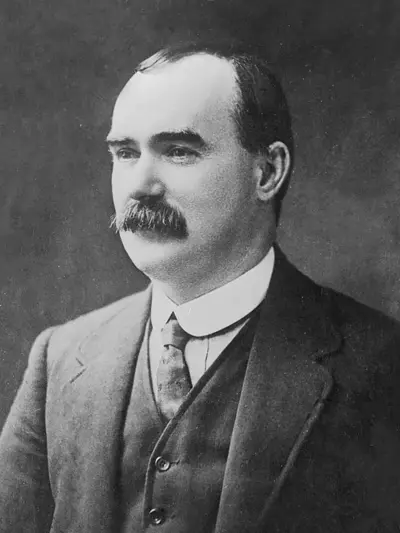
James Connolly was an Irish republican, socialist and trade union leader. Born in the Cowgate area of Edinburgh, Scotland, to Irish parents Connolly left school for working life at the age of 11, and became involved in socialist politics in the 1880s.
