George W. Bush Quotes
It’s not the government’s job to bail out speculators.
There was a financial crisis in the country and the world when highly risky home mortgage loans defaulted leaving investors and speculators in mortgage-backed securities in a poor position. The investors had been reaping very high interest rates for their risky investments, but this was the first time that this form of risky investment had failed. The investors, of course were looking for a bailout from government. When the Bush administration failed to bail out investment bank, Lehman, there was a panic and the banking system of the country and much of the world froze up. Bush and his Secretary reversed their bailout of speculators policy and provided various assistants and bailouts to the very bankers and other investors who had caused the economic meltdown. The policy was continued by the Obama administration although the bailouts were just as distasteful to Obama as they were to Bush, but most economists agree that the two presidents very distasteful and unpopular bailout actions probably saved the nation from a massive depression. After being bailed out by the taxpayers, the Bankers then paid themselves exorbitant bonuses while the results of their management put 10 percent of the country out of work.
George W. Bush, 43rd President of the United States, Son of President George W. Bush, Press Statement, August 31, 2007
Sourced by: Eigen's Political and Historical Quotations


Born thought that her agency was responsible for regulating the new esoteric financial products—derivatives including credit default swaps—for otherwise there would be no regulation at all of financial products that could dwarf the stock and bond market. Summers persuaded her to back off. When the Meltdown of 2008 hit, the huge derivative exposure of the large banks and some insurance companies was so great that it was one of the major causes for the meltdown of the entire banking system. Summers, normally a great economist not only called this one wrong, but later, along with most other government and private economists ignored a very explicit warning—See {637168}, {637986}, and {620038}.


There have always been economic and political ideologues. However in the George W. Bush administration ideological purity was a key criterion for appointment, and many appointments were made of ideologues who had no experience and had accomplished little previously. This quotation was a criticism of the unfettered free market ideology of so many of the Bush appointees. Critics like Bernstein saw this ideological focus as opposed to pragmatism, as responsible for the poor economic record of the Bush administration. Apologists for Bush and conservative economic ideology attribute the economic problems to cycles over which the administration and government had little control.


While Stockman and some others believe that the Meltdown of 2008 would have “run its course” if the government didn’t bail out financial institutions, the very conservative Republican Secretary of the Treasure Paulson and the Chairman of the Federal Reserve told President Bush, Congress, and incoming President Obama that if there was not a quick bailout, the economy of the nation would crash with a depression resulting as bad if not worse of the Hoover Depression of 1929. Bush and Obama and the majority of Congress agreed and took action to avoid that. There is no way of knowing whether they were right or Stockman was. However, the people with the responsibility of governing and safeguarding the nation clearly did not want to take a chance that the advocates of no action might be wrong.


Keynes was suggesting a small transfer tax on securities and other financial instruments. For investors, such a tax would not be a significant burden, but it would discourage pure speculation. Generally every one likes that idea except the speculators. They in turn, play off one nation or jurisdiction against the others by threatening to take their stock and bond markets to other nations which do not have such a tax. That has worked for almost a century in avoiding such a tax in the United States which is the center for both world investment and speculation.


The result was regulation of the banks and the creation of the SEC to regulate the stock market, However, over the years, the regulations were not able to keep up with the sophisticated development of new forms of investments and financial instruments and the financial industry were able to speculate with other people’s money in ways that FDR and his reformers never imagined. Finally, even the regulation that did exist was weakened by the policies of the George W. Bush administration and the combination brought about the Great Recession of 2008 where the profits from excess speculation were privatized and the losses, socialized with the taxpayer and the American worker bearing the brunt while most of the speculators were bailed out and made more money than ever. The Obama administration tried to reform the situation, but was unable to put an end to the legal speculation with other people’s money or of having institutions that were “too big to fail.”


While Murphy may have believe this, his company would profit immensely of Chrysler would fail. 28 years later it was General Motors that required the bailout that was much larger than the Chrysler one. The GM executives had gotten over their philosophical objections.

When the Meltdown hit America, the crisis drew attention to the fiscal solvency and stability of banks in most of the world. The Irish banks were much more overextended than those of most counties and when that came to light there was a bank panic in Ireland. Ahern and the Irish Dail (parliament) decided to bail out the Irish bank at a very great cost to the rest of the Irish economy and people. He believed if Lehman Brothers had been bailed out, as America did with other institutions, the Irish bank bubble would not have burst. It is not known whether he actually meant to use the word “testicles” or he made a gaff intending to use the word “tentacles”. Both have relevant meaning in the situation with a significant shade of difference in meaning between the two.

U. S. Treasury Secretary Larry Summers called Rajan a “Luddite” for this view, but what Rajan observed and predicted was exactly what happened in the Meltdown of 2008 which led to the Great Recession. Rajan was one of the few economists to call this right. Several, invested their own money assuming a crash and made billions. Most, like Summers and the Federal Reserve Chairmen in retrospect admitted that they missed the signs and didn’t connect the dots. See {637168}, {637987}, and {620038}
If the economy is strong voters will often ignore of forgive leadership failures. But not in a poor economy.


In 1964, after the newly elected Labour Government announced its new policies and budget, the financiers and speculators who control the international money markets thought the new budget and policies ill-advised. The made their concerns known to the Governor of the Bank of England who in turn recommended to the new Prime Minister that he cut the budget drastically and adopt a new more conservative set of economic policies. The Prime Minister was shocked that a non-elected small group of men—mostly not even British, were trying to reverse a set of policies that the voters in a democracy had elected. However, he was more shocked when he discovered that if he didn’t “obey” the financiers could act in concert, attack the British Pound, dramatically increase the interest rates the government would have to pay to borrow short term money, and ruin the British economy. Wilson had to comply. In America we refer to this situation more delicately by saying that “the markets will not react well to one proposal or another”. Our politicians intimidate themselves. The only way a democracy can really have control over its own policies and budgets, is to not be in debt to anyone.

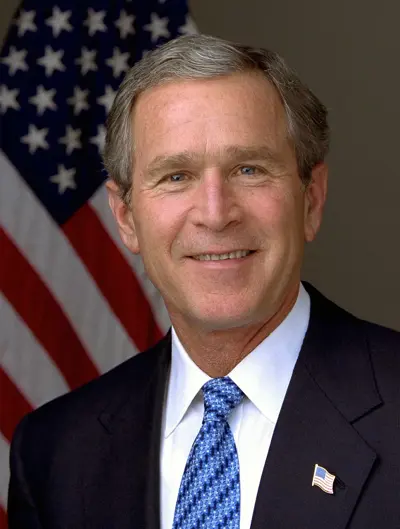
George Walker Bush is an American politician and businessman who served as the 43rd president of the United States from 2001 to 2009. A member of the Republican Party, Bush previously served as the 46th governor of Texas from 1995 to 2000. He was born into the Bush family; his father, George H. W. Bush, was the 41st president of the United States from 1989 to 1993.
