Muhammad Quotes
No prophet or apostle will come after me and no new faith will be born .
This statement has made Muslims resistant to subsequent religions and poor conversion prospects.
Muhammad, 571-632, Prophet and Founder of Islam, Last Sermon, 632
Sourced by: Eigen's Political and Historical Quotations


In an orthodox Muslim nation, freedom of religion as a right is impossible.
Al-Maarri’s quotations are not only meaningful in their own right, but they illustrate the openness and free thinking that was allowed in the early days of Islam before about 1100. If anyone wrote such things today in most Islamic countries he would at least be jailed if not executed for blasphemy. And if any Christian in Europe made the same statement, he would have been excommunicated at least if not tortured and murdered.


Essentially such a rigid conviction of unbelievers was common with both Protestants and Catholics in the middle of the second millennium, but Christian theology evolved and forgiveness and repentance became major factors. Islam did not so modernize so even in the 21st century a disbeliever deserved nothing from Muslims because Allah would never forgive them and they would be consigned to hell. So this Sura and {584363} made fundamentalist Muslim terrorists particularly willing to kill non-believers.
In 2005 an Egyptian writer, Usama Anwar Ukasha, criticized one of the Prophet’s companion’s role for causing dissention and divisiveness in Islamic history. Some called for his legal punishment for slandering a holy figure (see {588714}) and a law case was brought to force him to divorce his wife—so that she would not be “contaminated by his heretical thoughts. Al-Bana argued for freedom of thought and speech on such subjects. His view was particularly important since he was the brother of Hassan Al-Bana, the founder of the Muslim Brotherhood, a powerful fundamentalist organization. Note that Al-Bana’s call for intellectual freedom does not go so far as to say that it should be legal to criticize The Prophet Muhammad and it illustrates how far even modern Islam has to go to meet reasonable standards of freedom of thought and speech.

One of the great historical religious puzzles is how Islam evolved from its origin of respect for other religions, to one where a large number of Islamic leaders preach that not only is Islam the only true religion but all other religions are enemies of Islam, and the preaching of hatred for Christians, Jews, Bhai, Budhists and other religions.

This is actually a very widespread belief amongst many Muslims. Even sophisticated national leaders do not appreciate that other religions have adherents who feel just as passionately about their own religion. See {588668} for another example where Muslim leaders believe that if Jewish Kings David and Solomon came back to life they would worship Islam.
This quotation helps to explain the religious revelry in military achievements in Islam.
Theological & Legal Expert
Ethnic cleansing was a basic component of early Islam. The contemporary seeming hysteria over American troops in Arab nations, has in addition to the usual problems of soldiers from another land this background. The same is true about the presence of Israel. From some points of view, the presence of Christians and Jew in the Middle East is wrong per se because it undermines the work and intention of the Prophet.
In an orthodox Muslim nation, freedom of speech as a right is impossible.
The “People of the Book” are the Jews and the Christians who believe in the Old Testament book of God which Muslims recognize. Others who would not accept Islam would be killed, but if Jews and Christians are submissive and fell so, they may pay a special additional tax, the Jizyah.
Since Muslims try and convert others, one who changes religion and becomes a Muslim is exempt. The death penalty is reserved for Muslims who leave the religion.
This Sunnah of the Prophet is seen by many Shi’a Muslims as a call to renounce unjust governments and leaders. This is different from the view held by most Sunni Muslims that rulers are to be obeyed even if they are not always just. See {590245}.
Innovator in this sense refers to one who innovates within Islam—who tries to change or reform the religion departing from the original message of the Prophet.
This quotation which prohibits suicide is used by many Muslims to show that suicide bombers are anti-Islamic.
This volume roughly is to Islam what the Gospels are to Christianity. To most Muslims The Sunnah is a collection of holy material on the life of Mohammed. It is not of the force or importance as the Koran, but it is revered. This quotation is in the third person and does not have the Prophet’s exact words.


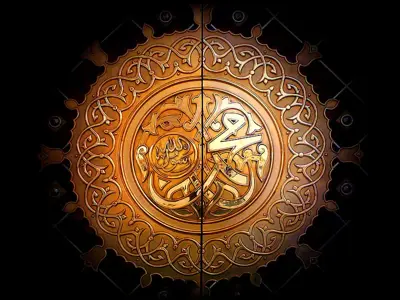
Muhammad was an Arab religious, social, and political leader and the founder of Islam. According to Islamic doctrine, he was a prophet, sent to preach and confirm the monotheistic teachings of Adam, Abraham, Moses, Jesus, and other prophets. He is believed to be the final prophet of God in all the main branches of Islam, though some modern denominations diverge from this belief. Muhammad united Arabia into a single Muslim polity, with the Quran as well as his teachings and practices forming the basis of Islamic religious belief.
