Muhammad Quotes
O ye who believe!...do not kill yourselves, for truly Allah has been to you Most Merciful. If any do that in rancor and injustice, soon shall We cast him into the Fire...
This quotation which prohibits suicide is used by many Muslims to show that suicide bombers are anti-Islamic.
Muhammad, 571-632, Prophet and Founder of Islam, Koran, Sura 4:29-30
Sourced by: Eigen's Political and Historical Quotations

This Hadith is said to represent the view of the Prophet, Muhammad. In Islam its authority is second only to the Koran itself. This quotation is given by many Muslim Imams to illustrate that suicide of any kind is contrary to Islam. Therefore these imams condemn suicide bombing as un-Islamic. Others—the terrorists—obviously disagree.

This verse has been one of the bases of Muslim theocratic states like Iran’s claim to legitimacy. The word “govern” is sometimes translated as “judge.” In the context of the 6th century, there were no separation of powers as we know them and judging, governing and legislating were melded.


Of the five greatest Muslim crimes, two of them, the third and the fourth are committed by every suicide bomber. Terrorists and their apologists who justify suicide bombing argue that in defensive of Islam these crimes are no longer crimes. Most modern Muslim theologians believe that the course the suicide bomber murders his own species and commit suicide he is acting completely contrary to Islam. This is one of the classic sports between modern interpretations of Islam and the radical fundamentalists.
Terrorism is not new to Islam. It was proscribed by the Prophet when fighting the “enemies of Allah.” There are those who believe that he was not advocating terrorism as we know that term today. Instead they believe that he meant that they should scare and intimidate the enemies of God, and the sura does not explicitly promote or sanction the murder of innocent civilians. They would interpret this quotation to mean “Attack the military enemies of God so severely that they well fear you and be intimidated.” Others see the quotation as an explicit endorsement of terrorism. What better than beheading or exploding random members of a society that is opposing Islam and Allah in order to “strike terror into the hearts of the enemies of Allah.”
Gordon himself was killed shortly thereafter by the Madhi’s followers at the siege of Khartoum. Ahmed died soon thereafter. Although Ahmed was an extreme religious fanatic, and a skillful leader, he was not a terrorist.


Essentially such a rigid conviction of unbelievers was common with both Protestants and Catholics in the middle of the second millennium, but Christian theology evolved and forgiveness and repentance became major factors. Islam did not so modernize so even in the 21st century a disbeliever deserved nothing from Muslims because Allah would never forgive them and they would be consigned to hell. So this Sura and {584363} made fundamentalist Muslim terrorists particularly willing to kill non-believers.
For many extremists Muslims, this sura calls for the torture or killing of the enemies of Islam. For the more moderate Muslims, the penalty of opposing Islam should be expulsion or banishment. The further modern complication of this sura is the definition of “making war with Allah.” To some extremists, it is writing or publishing anything contrary to their view of Islam; it is occupying any Islamic nation or warring with that nation even though the basis of the war might have nothing to do with religion; it is bringing a Bible into an Islamic nations; it is allowing alcohol to be sold and served; it is opposing their discriminatory customs and laws; it is pressuring them not to stone adulteresses.

This quotation has been used to illustrate a number of points. First is illustrates the fundamentalist Islamic view, not terribly different from a fundamentalist Christian view, that God punishes man for his sins be producing natural disasters. Second that the foreign policy of America is sinful per se. However, what is interesting is that Sallah is an Israeli citizen who not only heads a movement opposed to Israel but like any other Israeli citizen has a freedom of the press the is unknown in any Islamic country. Sallah and his Muslim coreligionists living in Israel, together with the Muslims living in the hated West, are the only Muslims in the world who have total freedom of speech, thought, expression and conscience.
In an orthodox Muslim nation, freedom of religion as a right is impossible.
The “People of the Book” are the Jews and the Christians who believe in the Old Testament book of God which Muslims recognize. Others who would not accept Islam would be killed, but if Jews and Christians are submissive and fell so, they may pay a special additional tax, the Jizyah.
Innovator in this sense refers to one who innovates within Islam—who tries to change or reform the religion departing from the original message of the Prophet.
This stricture would seem to prohibit the suicide bomber and other terrorists who kill civilians. However, the terrorists and those who support them observe that this quotation is not from the Koran and other passages of the Koran override this instruction in many contexts. Most American Muslims hold with this view of the Prophet’s and morally oppose indiscriminate terrorism in all cases. This volume roughly is to Islam what the Gospels are to Christianity. To most Muslims The Sunnah is a collection of holy material on the life of Mohammed. It is not of the force or importance as the Koran, but it is revered.
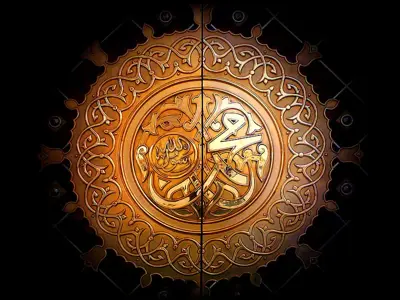
Muhammad was an Arab religious, social, and political leader and the founder of Islam. According to Islamic doctrine, he was a prophet, sent to preach and confirm the monotheistic teachings of Adam, Abraham, Moses, Jesus, and other prophets. He is believed to be the final prophet of God in all the main branches of Islam, though some modern denominations diverge from this belief. Muhammad united Arabia into a single Muslim polity, with the Quran as well as his teachings and practices forming the basis of Islamic religious belief.
