Muhammad Quotes
The greatest crimes are to associate another with God, to vex your father and mother, to murder your own species, to commit suicide, and to swear to lie.
Of the five greatest Muslim crimes, two of them, the third and the fourth are committed by every suicide bomber. Terrorists and their apologists who justify suicide bombing argue that in defensive of Islam these crimes are no longer crimes. Most modern Muslim theologians believe that the course the suicide bomber murders his own species and commit suicide he is acting completely contrary to Islam. This is one of the classic sports between modern interpretations of Islam and the radical fundamentalists.
Muhammad, 571-632, Prophet and Founder of Islam, Quoted in Allama Abdullah Al-Mamun Al-Suehrawardy, The Sayings of Muhammad, 1938
Sourced by: Eigen's Political and Historical Quotations

This quotation which prohibits suicide is used by many Muslims to show that suicide bombers are anti-Islamic.

This Hadith is said to represent the view of the Prophet, Muhammad. In Islam its authority is second only to the Koran itself. This quotation is given by many Muslim Imams to illustrate that suicide of any kind is contrary to Islam. Therefore these imams condemn suicide bombing as un-Islamic. Others—the terrorists—obviously disagree.

It is this verse that for some Muslims justifies terrorism against non-Muslims. See {584354} for a specific example. There are similar provisions in the Old Testament which a few extremely conservative Jews and Christians have used to advocate for blasphemy being a capital crime. Note that if an unbeliever repents and becomes a Muslim, he should be spared.

These suras are ones that for some fundamentalist extremists justified the killing of Iraqis Muslims who worked with the British, Americans or other Coalition forces in the Iraq war or even politicians who cooperated with the coalition.
The implication of this sura is that it is permissible to kill non-Muslims but not Muslims. The same is true of slavery. Another prescription of this sura is that a Muslim should never kill another Muslim, so while this sura is very discriminatory and in that sense reprehensible, it does call into question the Islamic terrorist practice of the late 20th and early 21st century of killing fellow Muslims who might vote, serve in an official role or cooperate with non-believers. And it definitely to the Western mind prohibits the kind of Islamic sectarian violent practice of Sunni Muslims and Shiite Muslims torturing and butchering each other—a practice that has continued since the two groups fought over who was the rightful successor to Muhammad. The religious rationale for that murderous behavior is that each Islamic group sees the other as apostate and therefore no longer real Muslims.


This quotation is one of history’s great examples of the classic problem of quotes taken out of context. The Blog was dealing with the potential reactions if Islamic terrorists set off a nuclear device or a radioactive dirty bomb in the United States. Lowry was reporting that in the event of a retaliation there was then a considerable amount of sentiment for attacking Mecca, the holy city of Islam. However, the Arab press picked up Lowry’s quote and Muslims throughout the world were told that the Editor of a prestigious American Journal admitted that there was much American public sentiment for a nuclear attack on Islam’s holiest city. By the time this “fact” was spread by word of mouth, a huge proportion of Muslims the world over truly believed that America was indeed out to destroy Islam. The fact that the “sentiment” was only in the context of a hypothetical retaliation for a first nuclear strike was totally lost by the time it reached most Muslims.

This is a common perception of many Islamic authorities—that the ancient Jews and early Christians would have clearly become Muslims had they but been exposed to the teaching of the Prophet. As egocentric as this sounds, Martin Luther believed that all reasonable Jews would become Christians.

Shoebat was a former PLO member and recalls this from his own childhood.
This stricture would seem to prohibit the suicide bomber and other terrorists who kill civilians. However, the terrorists and those who support them observe that this quotation is not from the Koran and other passages of the Koran override this instruction in many contexts. Most American Muslims hold with this view of the Prophet’s and morally oppose indiscriminate terrorism in all cases. This volume roughly is to Islam what the Gospels are to Christianity. To most Muslims The Sunnah is a collection of holy material on the life of Mohammed. It is not of the force or importance as the Koran, but it is revered.

It was a custom for suicide bombers in the Middle East to write or video record last words to loved ones.
Munir was a strong advocate for civilian control over the military and as exposed many military atrocities and disappearances. He was poisoned on a Garuda Airlines flight to Holland where he was exposing more of the human rights violations of the Indonesian Military.
This statement of the Prophet is often quoted by Yusuf al-Qaradawi and other moderate, modernist Islamic clerics and leaders urging people to eschew terrorism and Muslim fundamentalist extremism.

Most political cartoons offend. The problem for the Yale Press was that if they did not print the cartoons, the violence and intimidation of the most extreme Muslims will have been rewarded as a strategy. If they printed, some people will be injured and killed in the likely rioting. If rioting did not occur spontaneously, it would be whipped up by the extremists. A Hobsen’s choice for publishers the world over that is exactly what the most extreme Muslims have planned.

The reason he claimed that Governor Taseer was a blasphemer was that the governor opposed death penalty for saying or writing anything that was heresy or blasphemy as interpreted be fundamentalist Muslims. The Governor knew he was taking a risk. See {620970} .
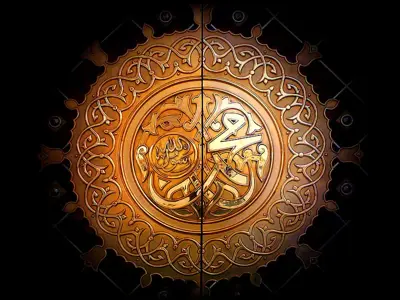
Muhammad was an Arab religious, social, and political leader and the founder of Islam. According to Islamic doctrine, he was a prophet, sent to preach and confirm the monotheistic teachings of Adam, Abraham, Moses, Jesus, and other prophets. He is believed to be the final prophet of God in all the main branches of Islam, though some modern denominations diverge from this belief. Muhammad united Arabia into a single Muslim polity, with the Quran as well as his teachings and practices forming the basis of Islamic religious belief.
