Rich Lowry Quotes
There's lots of sentiment for nuking Mecca.
This quotation is one of history’s great examples of the classic problem of quotes taken out of context. The Blog was dealing with the potential reactions if Islamic terrorists set off a nuclear device or a radioactive dirty bomb in the United States. Lowry was reporting that in the event of a retaliation there was then a considerable amount of sentiment for attacking Mecca, the holy city of Islam. However, the Arab press picked up Lowry’s quote and Muslims throughout the world were told that the Editor of a prestigious American Journal admitted that there was much American public sentiment for a nuclear attack on Islam’s holiest city. By the time this “fact” was spread by word of mouth, a huge proportion of Muslims the world over truly believed that America was indeed out to destroy Islam. The fact that the “sentiment” was only in the context of a hypothetical retaliation for a first nuclear strike was totally lost by the time it reached most Muslims.
Rich Lowry, Editor of National Review, National Review Web Log, 2002
Sourced by: Eigen's Political and Historical Quotations


It is this verse that for some Muslims justifies terrorism against non-Muslims. See {584354} for a specific example. There are similar provisions in the Old Testament which a few extremely conservative Jews and Christians have used to advocate for blasphemy being a capital crime. Note that if an unbeliever repents and becomes a Muslim, he should be spared.


This quotation illustrates that the Muslim conquest and attempt to destroy and desecrate the symbols of other religions was not limited to Christianity—it was ALL other religions. In that sense, Christianity and Islam of the period were very similar at the time—intolerance to the point of murder and destruction of any “heathen” religion.
The reason he claimed that Governor Taseer was a blasphemer was that the governor opposed death penalty for saying or writing anything that was heresy or blasphemy as interpreted be fundamentalist Muslims. The Governor knew he was taking a risk. See {620970} .

A Kafir is a non-Muslim. This statement is a distortion of a number of passages of the Koran.

Nigeria was about equally divided into Muslims who dominated the North and Christians and Animists who dominated the South. The former were intent on making Sharia—Islamic Law—the law of the nation and the latter were equally passionate to avoid it. Muslim protests got very violent including murdering innocent civilians; the Christians threatened to retaliate.


He drove a rented SUV into a crowd at a Dining Hall at the University of North Carolina from which he had recently graduated. He was an Iranian-born American citizen who had perceived that American policies and practices abroad led to the death on many Muslims. His interpretation of the Koran agrees with most of the radical, extremist, theologians, but does not comport with the interpretation of moderate Muslim religious thinkers. In 2008, he was convicted and sentenced to 33 years of prison.

A publicity seeking fundamentalist Christian minister in Florida had publicly burned a Koran to the moral condemnation of the President and most other government leaders, as well as clergy of all faiths. However, after the President of Afghanistan condemned the act, there were attacks on a United Nations compound in that country and a number of innocent people were killed and two beheaded. Yet most Muslim clerics were reluctant to morally condemn the murders while they were vociferous in castigating the Koran burning. Some were intimidated and feared that they would be attacked if they criticized the Islamic fundamentalism that advocated the murders and terrorism.


Voltaire had little respect for any organized religion, but found Islam particularly barbaric and absurd. However he was also very negative about Christianity. See {621191} . The Ottoman Empire, centered in Turkey, then controlled all the Islamic countries of the Middle East. Europeans then often referred to all Muslims as “Turks.”

Sirhindi is a very important Muslim Imam and is credited with breathing new life and energy into the 2nd millennium of Islam. An irony of this quotation is that Sufi’s are often characterized as “moderate” Muslims. The quotation is extremely important in that there are some who attribute the anti-Semitism of the Muslims to the dispute over the State of Israel. However, it was the anti-Semitism that caused the problems with Israel. This quotation is from the 17th century—more than 300 years before Israel was established and over 200 years before the Zionist movement even thought about recovering Palestine for the Jews. Islamic anti-Semitism and anti-Christianity began in the Prophet’s lifetime and continued thereafter. It is as vicious today as it was 500 years ago, except for the fact that there is now an Islamic Reformation that despite the Koran’s statements regarding non-believers, they have a more modern view of the world and the people within it. Islamic cultures like Indonesia and Turkey do not have the same degree of anti-Semitism as Pakistan and the Arab Countries.


He was convicted and jailed for inciting violence. After serving a few years, he was deported to Jamaica. He then went to Africa to preach and was expelled from several countries there.


Darwish’s father, a Colonel in the Egyptian Army, was assigned by Nasser to Direct the Intelligence Operations for the Palestinian Terrorists in Gaza. After many Israelis were killed, the Israeli Defense forces targeted the Colonel and killed him. Nasser’s concept of revenge was to kill any Jews, anywhere, not the Jewish soldiers who had retaliated against his soldiers.
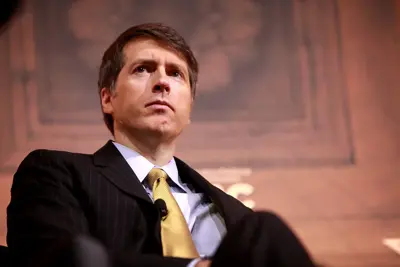
Richard Lowry (/ˈlaʊri/; born 1968) is an American writer who is the editor of National Review, an American conservative news and opinion magazine. Lowry became editor of National Review in 1997 when selected by its founder, William F. Buckley, Jr., to lead the magazine. Lowry is also a syndicated columnist, author, and political analyst who is a frequent guest on NBC News and Meet the Press. His most recent book, The Case for Nationalism: How It Made Us Powerful, United, and Free, was released in 2019.
