Robert Browning Quotes
God's justice, tardy though it prove perchance, Rests never on the track until it reach Delinquency.
Browning, Robert. "Cenciaja." Pacchiarotto and How He Worked in Distemper: with Other Poems. Smith, Elder, & Co., 1876, p. 165.


As a slave holder himself, this was a dramatic statement. Slavery was immoral, God’s justice will not be on the white slave owners side, a slave revolt or other event could occur and change things radically. One great puzzlement of American history has been why Jefferson, who wrote so eloquently against slavery and predicted the disaster that would come. would himself keep his slaves and never free them as George Washington did. Some argue that he was so broke financially, that he could not afford to free them.


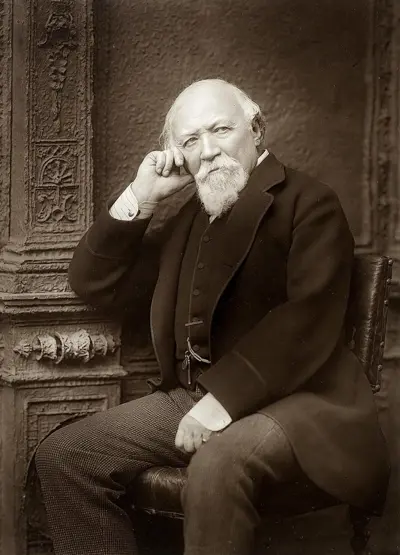
Robert Browning was an English poet and playwright whose dramatic monologues put him among the foremost Victorian poets. His poems are noted for irony, characterization, dark humour, social commentary, historical settings and challenging vocabulary and syntax. His career began well, but shrank for a time. The long poems Pauline (1833) and Paracelsus (1835) were acclaimed, but in 1840 Sordello was seen as wilfully obscure. His renown took over a decade to return, by which time he had moved from Shelleyan forms to a more personal style. In 1846 Browning married the older poet Elizabeth Barrett and went to live in Italy. By her death in 1861 he had published the collection Men and Women (1855). His Dramatis Personae (1864) and book-length epic poem The Ring and the Book (1868-1869) made him a leading British poet. He continued to write prolifically, but his reputation today rests mainly on his middle period. By his death in 1889, he was seen as a sage and philosopher-poet who had fed into Victorian social and political discourse. Societies for studying his work formed in his lifetime and survived in Britain and the United States into the 20th century.
