Nat Turner Quotes
… my master, who belonged to the church, and other religious persons who visited the house, and whom I often saw at prayers, noticing the singularity of my manners, I suppose, and my uncommon intelligence for a child, remarked I had too much sense to be raised – and if I was, I would never be of any service to any one – as a slave.
In 1831 a slave preacher, Nat Turner, led a rebellion in North Carolina killing over 50 white men. Even though Turner and the rebels were captured and executed, whites throughout the South, took vengeance on any slaves they could find.
Nat Turner, 1800–1831, Slave and Slave Revolt Leader, The Confessions of Nat Turner, The Leader of the Late Insurrections, in Southampton, Va. As fully and voluntarily made to Thomas R. Gray, 1831
Sourced by: Eigen's Political and Historical Quotations


This law required the treatment of Blacks as whites were then treated with respect to indentured servitude—a limit of 10 years after which the person would be free. However, this law was poorly enforced. The “General Court” was the name for the legislature of the Rhode Island colony.


The mental conditioning and brainwashing that was forced upon slaves in the American Chattel Slavery system was a major factor in the poor intellectual, analytical, emotional, and egocentric and moral development of Black slaves.


The President often referred to this statement as an example of his wife’s acumen. She had been born to a Southern plantation and inherited the land and the slaves. Her view, and his, were typical of the Southern point of view in early America.

Many free Negroes of the day did not have the paperwork, education, , sophistication, or access to attorneys that could prove that they were free. Scheming Southerner slave owners would go north find poor ignorant free blacks and swear that they ran away from their plantation. If the victim could not prove the contrary, he was enslaved, transported South and usually sold.


Contrast this view with that of Union General Ulysses S. Grant.


Incredibly, the judges received a higher fee if they found that an accused Negro was a fugitive slave and must be returned, than if he found that it was a case of mistaken identity or the laws of the northern state allowed mandated freedom. Despite the bias, the moral issue was so profound that many Northern judges refused to return fugitive slaves, even after the Fugitive Slave Act.
This fear was great among many who were abolitionists as potentially there might be mass slaughter of all Southern whites.

Christian had just briefed the President about the riots in many cities after the assassination of Martin Luther King. Christian had expressed surprise that the Blacks were so violent.
In early New England the General Court served as both a legislature and a judiciary before separation of powers was introduced. 5 years later the Court banned importing African slaves at all. While slavery was not common in Rhode Island, the laws was not seriously enforced on those who would defy them. It does represent a public anti-slavery sentiment that existed in Early America. It would take 200 years for Rhode Island to finally eliminate all forms of slavery.

Under the previous Republican administrations, virulent and overt racists were not generally appointed especially as they were generally then Democrats. However, when Woodrow Wilson was elected president, he not only appointed many overt racists but he himself may have been one of the most racist Presidents every to inhabit the white House. He fired almost all the Blacks who held positions in the Federal government.
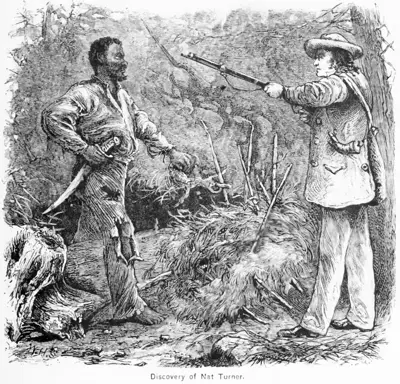
Nat Turner was an African-American enslaved preacher who led the four-day rebellion of enslaved and free black people in Southampton County, Virginia, in 1831. Born into slavery on October 2, 1800, in Southampton County, Virginia, a plantation area with more blacks than whites, Turner was recorded as "Nat" by Benjamin Turner, the man who enslaved him and his family. When Benjamin Turner died in 1810, under then current laws which made human enslavement legal, Nat was inherited as property by Benjamin's son Samuel Turner. For most of his life, he was known as "Nat", but after the 1831 rebellion, he was widely referred to as "Nat Turner". Turner knew little about the background of his father, who was believed to have escaped from slavery when Turner was a young boy. Turner spent his entire life in Southampton County.
