James F. Amos Quotes
Memorial bracelets memorializing prisoners of war, missing in action, killed in action, and those who died of wounds or injuries sustained in a combat theater are authorized.
Amos, James F. "MARADMIN 611/11: Wear of Honor/Memorial Bracelets in Uniform." United States Marine Corps, 19 Oct. 2011.


While the Abenaki Indians were vicious warriors and committed many atrocities on their raids of upper NY State, they treated their prisoners extremely well.

There has always been some confusion in the case of the Wars in Afghanistan and Iraq. The Geneva and Hague conventions are very clear when prisoners are official members of an state’s armed force with uniforms, insignia and ranks. It is also clear with respect to civilians. But the combatants of the insurgent and terrorist forces fall in between, and international law is less clear. The George W. Bush administration at first took the position that the captured combatants were not captured soldiers and were therefore not entitled to the treatment due that status. But the military regulations made no distinction as to how prisoners in combat should be treated. It is a very gray area, except that in either case, torture is illegal under U. S. and under International law.


General Cornwallis was informing his superior that he had surrendered at Yorktown. The French navy had prevented escape or resupply from the sea, and the British were totally surrounded by American and French land forces.

Annan had asked UN nations to contribute troops but few would.

The swap was made and all captives were released.

Americans General William Hull had crossed the Canadian border with 2500 men announcing his intention to invade. Fearing the military tactics of the Indians, he issued an edict stating that Indians (and whites fighting alongside Indians) would be shot rather than taken prisoner.


The President had earlier threatened to execute Confederate prisoners, if the South implemented its threat to execute any Union Negro soldiers they captured. The threat seems to have worked. See Lincoln.
When the Union army began using Blacks as recruits, the South threatened to execute any Negro soldier they captured. Some Southerners opposed execution but favored enslavement of captured Northern Black soldiers. The Lincoln threat seems to have worked, although Lincoln opposed executing Southern officers in retaliation for the atrocities at southern prisoner of war camps

This clause applied to German POWs in America caused a problem for Blacks in the military were harshly discriminated against by a then discriminating country. The result was that Nazi POWs did not have to move to the back of a theater while the Back GIs were required to, and a host of other gross indignities.
In the Afghanistan and Iraq Wars the U. S. government was much criticized for not treating captured Taliban and others as prisoners war. This Article is their main justification. The Taliban and Al Quida did not meet most of the criteria and therefore the convention did not apply to them.

Jersey is an island among the Channel Islands in the English Channel. The islands were occupied by the Germans during World War II with some of them being used as prisoner/concentration camps.
This preference for death rather than capture is usually associated with Japan. However, this cultural practice is much wider.
The prisoners would be beaten and cut with swords. If they fell down, they would be bayoneted or beheaded as shown in the graphic—an actual photograph of the time.

He was describing the Battle of Zagonara in 1424 and Molinella in 1427. Although major battles of the time the only casualties in the later were horses, and in the former, three armored men fell off their horses into the mud and drowned. Battle was almost like a capture the flag game with uniforms and weapons displayed.
The English sentenced many, criminals to “export” with America being one of the penal destinations. Georgia, for example, was heavily populated with convicted criminals.

Enemy captives were sometimes adopted by Indian families to replace a lost loved one.


The Colonel defined people capable of bearing arms as males and females over 20 years of age. Many were slaughtered. Fortunately, most of his officers and men did not follow this order but enough did to make it one of the most disgraceful events in American military history. Smith was court marshaled and found guilty but his punishment was to be cashiered from the army. There were many atrocities committed by the minorities of both sides in this brutal war. Military and Congressional Investigations caused the army manual to be revised military policies reformed.
The Philippine-American War was terribly brutal. In response to insurgent atrocities against American soldiers, some of the Americans also adopted brutal tactics including torture and mutilation. Washington had heard stories of this improper behavior in the part of some American troops and instructed the senior officers to investigate and discipline the men if the reports were true. Unfortunately some of the senior officers covered up the illegal and criminal behavior of some Americans. This quotation was taken from a New York Times report on a representative of the Red Cross who went to the Philippines at the invitation of the insurgents. He generally found serious atrocities by some of the soldiers on both sides but by no means all of the combatants. General Otis, the U. S. Commander tried to keep Blake out, and had him detained away from the battle areas for some weeks where he was “educated” about the enemy atrocities. Finally Blake got to the field and reached the insurgent commander who had invited him. His report generally praised the American troops, but spared no details when there were guilty of atrocities.
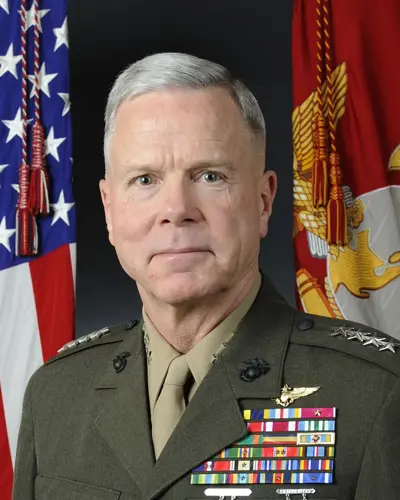
James F. "Jim" Amos is a retired United States Marine Corps four-star general who served as the 35th Commandant of the Marine Corps. As a naval aviator, Amos commanded the 3rd Marine Aircraft Wing during the Iraq War in 2003 and 2006. He served as the 31st Assistant Commandant of the Marine Corps from 2008 to 2010, and was the first Marine Corps aviator to serve as commandant.
