Isaac Brock Quotes
They are men; and have equal rights with all other men and to defend themselves and their property when invaded.
Americans General William Hull had crossed the Canadian border with 2500 men announcing his intention to invade. Fearing the military tactics of the Indians, he issued an edict stating that Indians (and whites fighting alongside Indians) would be shot rather than taken prisoner.
Isaac Brock, 1769-1812, British General and Governor of Canada, Statement in support of the Canadian Indian’s right of defense, July 22, 1812
Sourced by: Eigen's Political and Historical Quotations


This law governed the territories outside of the original 13 colonies. The intentions of the founding fathers and the first Congress to the Indians was fair and honorable. However, there was no practical way that the new Federal Government could enforce this principle in the territories. A single greedy land speculator or trader could abuse a group of Indians and start a small war. The vast cultural differences between Indians and whites tended to polarize all violent conflicts regardless of who was at fault. The different perceptions of cruelty and atrocities further pushed the government to defend whites violating national policy and there was sufficient corruption and money to be made on Indian land and trading and things went downhill fast.


This was the first named Civil Rights Act passed in the United States. It was passed over the veto of President Andrew Johnson, a Southerner, who tried to thwart Congress’s efforts at Reconstruction.


The invasion failed, Hull lost even Detroit and the Michigan territory and was later court-marshaled.

This quotation was a slight paraphrase from Article 14 of the Republican Party Platform which had been adopted unanimously at the Chicago Party Convention on May 17, 1860. This was the convention where Lincoln was nominated. It is not known who originally drafted Article 14, although Lincoln's agents were very active in the platform drafting process. In his later campaign speech, Lincoln ran on the Party Platform.


This was written and adopted by Vermont a decade before the United States Constitution the ideas for which were in existence in America before the Constitutional Convention in Philadelphia.

The United States was a new, militarily weak country. Many of its leaders believed that even if our interests were attacked or some citizens abused, it was not worth the United States going to war unless the attack were existential—threatened the very existence of the country. The split was clear during the War of 1812 where in general, New England was opposed to war with Britain, the Atlantic states were not firm on either side, and the South and West (Kentucky was then the West) were the war hawks. Mrs. Madison was a hawk—an unusual expression for a woman and her role as First Lady did not inhibit her from her own independent political opinions. On the War of 1812, Mr. Madison was in favor of war, but was not so unequovical and positive as his wife was.


The intentions of the Founding Fathers towards the Indians was decent, respectful, and well intentioned. However, there was not enough of a system of enforcement or the will to enforce when the greed of the average whites grew too great. Many settlers saw these vast lands and could not see any harm in using a few acres for their farm. And if there had been only a few, there would have been little trouble. However, the settlers kept coming and coming and soon the Indians began to push back. In a sense, it was a class problem. The members of the Continental Congress who wrote the Northwest Ordinance were educated, affluent men who had plenty of land. Most of the men who contested for the Indian lands had little land or were newly affluent and saw few limits to America.


It was drafted by John Adams. 9 Years later the French in their Revolution used the first clause in their Declaration of the Rights of Man and of the Citizen—See Quotation 602404 For an opposite point of view see Quotation 635927.


The American sailors had been captured and were being held for ransom by the Barbary Pirates in terrible conditions. The pirates stated that they were slaves and would be sold if the United States did not come up with enough ransom money. After much debate in America, a squadron of Naval Troops had been dispatched to the Mediterranean where they would “negotiate” with cannon—attacking the ports of the Barbary States.

The Seminole Wars were one of the low points in American military behavior. With the specific permission of Commanding General Jesup, the soldiers were to loot the homes and personal possessions of the enemy civilians as well as fighters, but he favored extermination and there were many atrocities. He even seized the Seminole Leaders who had been invited for Peace Talks.


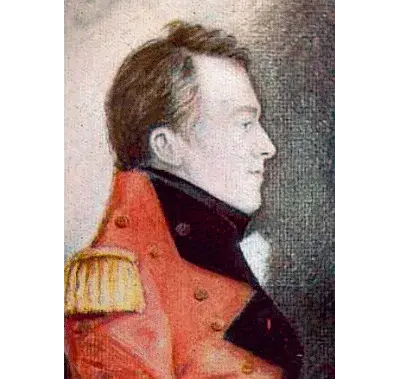
Major-General Sir Isaac Brock KB was a British Army officer and colonial administrator from Guernsey. Brock was assigned to Lower Canada in 1802. Despite facing desertions and near-mutinies, he commanded his regiment in Upper Canada (part of present-day Ontario) successfully for many years. He was promoted to major general, and became responsible for defending Upper Canada against the United States. While many in Canada and Britain believed war could be averted, Brock began to ready the army and militia for what was to come. When the War of 1812 broke out, the populace was prepared, and quick victories at Fort Mackinac and Detroit defeated American invasion efforts.
