Robert M. La Follette Quotes
Let no man think we can deny civil liberty to others and retain it for ourselves. When zealous agents of the Government arrest suspected "radicals" without warrant, hold them without prompt trial, deny them access to counsel and admission of bail....we have shorn the Bill of Rights of its sanctity.
La Follette, Robert M. Editorial. La Follette's Magazine, vol. 12, no. 1, Jan. 1920, p. 2.


Note the use of the phrase “against the government.” One of the unique aspects of the American Constitution and The Bill of Rights is that the government is considered a potential and even probable infringer on the liberties of the people. It is almost as though the government was the potential enemy. Modern libertarians state this very explicitly and it is ever present in the views of both the right and left wings of American politics. Most centrists recoil at the thought that some citizens see the government as the enemy, but even in America there have been times where the government has infringed on the rights of citizens only to have the courts or future administrations and Congresses correct the error.

See {587703} for a similar statement by a Supreme Court Justice.

In the aftermath of 9-11, a few government agencies violated the law and civil rights of a number of “Muslims” and/or “Middle Eastern looking” individuals and held them incommunicado with no charges and no warrants. The rationale of those agencies is that they “could not take a chance as lives were at stake. In most major wars in America, there has been an “overreaction” by some officials.


Note the use of the phrase “against the government.” One of the unique aspects of the American Constitution and The Bill of Rights is that the government is considered a potential and even probable infringer on the liberties of the people. It is almost as though the government was the potential enemy. Modern libertarians state this very explicitly and it is ever present in the views of both the right and left wings of American politics. Most centrists recoil at the thought that some citizens see the government as the enemy, but even in America there have been times where the government has infringed on the rights of citizens only to have the courts or future administrations and Congresses correct the error.

This is probably the first known use of the Bill of Rights phrase in the English language. For the earliest American use, see Edward Rutledge.


See George Mason for the contrary view. {606646}

Catherine II—the Great—appointed a commission to suggest model laws for Russia based on some of the principles of the European Enlightenment. The laws were never officially adopted but they are interesting in that they were the product of “liberal” thinking at the time. This particular definition of “liberty” is similar to that ruse in many country’s modern constitutions which will “guarantee” a right like freedom of speech so long as it does not violate any laws.

Hayward claimed that Wilson was the first American President who ever criticized the American Constitution. Many do not agree as Madison and Jefferson in part, along with most other Americans, found the Constitution so wanting that it was ratified only on condition of the passage of the Bill of Rights. Jackson, was distressed by the limitations on the President and many others had their objections, but Wilson, before he became a politician was a prominent academic political scientist and wrote voluminously and had an intellectual following so his criticism was not considered so “political” as others.

This was written during the George W. Bush Administration where the reaction to 9-11 was to curtail some civil rights and constitutional protections in favor of more national security. Bush was not the only President who eroded civil rights in a fear for National Security. FDR interned the Japanese Americans. Woodrow Wilson jailed pacifists who protested against the draft. John Adams passed the infamous Alien & Sedition Acts.

Johnson, fundamentally an inveterate racist, tried to kill all attempts at protecting Negro rights after the Civil War. Congress rewrote the Bill to obtain enough signatures and then passed it over the President’s Veto later in the year.

The Jury Trial was part of New York Law more than a century before the Constitution.

The choice is usually contrasted between guilty persons going free, rather an innocent one be adjudicated guilty. But here the justice tells us that the avoidance of an innocent person being subject to easy arrest is important enough to have a system where guilty people sometimes escape justice.
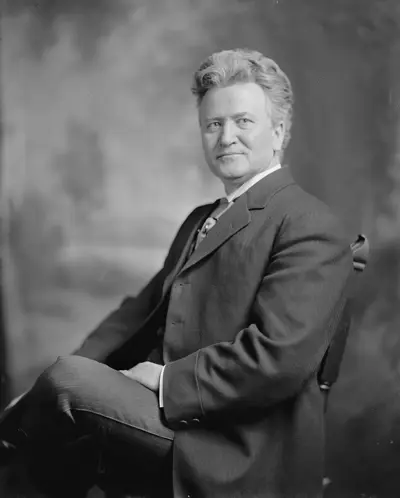
Robert Marion "Fighting Bob" La Follette Sr., was an American lawyer and politician. He represented Wisconsin in both chambers of Congress and served as the Governor of Wisconsin. A Republican for most of his career, he ran for President of the United States as the nominee of his own Progressive Party in the 1924 presidential election. Historian John D. Buenker describes La Follette as "the most celebrated figure in Wisconsin history."
