Andrew Johnson Quotes
unconstitutional, unnecessary, extrajudicial
Johnson, fundamentally an inveterate racist, tried to kill all attempts at protecting Negro rights after the Civil War. Congress rewrote the Bill to obtain enough signatures and then passed it over the President’s Veto later in the year.
Andrew Johnson, 1808-1875, 17th President of the United States (War Democrat), Adjectives used to Describe the Freedmen’s Bureau Bill which he vetoed, July 16, 1866
Sourced by: Eigen's Political and Historical Quotations


Actually it was Thomas Jefferson who had drafted most of the language. This attack was aimed at President John Adams, the big supporter of the unpopular Alien and Sedition laws, and the man Jefferson was intent on unseating at the end of his first term. He did and destroyed the Federalist Party in the process.


This was a terrible Supreme Court decision which placed slave owning whites against whites who opposed slavery in conflict over runaway slaves and free blacks throughout the country. It held that Blacks—even free Blacks had no Constitutional rights and was one of the major causes of the Civil War. See {623426}.

The first Civil Rights Act {587712} was passed a few months before and has some of the same language as Congress wanted to make the laws very clear. The Southern Rebels who insisted on their right to have guns during Reconstruction, viciously denied that same right to the newly freed slaves. Sickles tried to remedy this, but the KKK and other terrorists intimidated most of the Blacks into not using the right that they had. Later, they would do that with the right to vote. In January, the Commanding General in charge of South Carolina had issued an order protecting the rights of Blacks to have guns {629894}. This law applied that to the entire country. The Southerners have always supported the 2nd Amendment except when Blacks wanted to have arms.


Kahn had been arrested during the War on Terrorism and then released without any charges being filed.


Federal officials and commissioners issued laws, directives and orders that were very unpopular with the Mormons who were in the overwhelming majority of the Utah territory. The Mormon “government” was a type of theocracy but a very popular one. The Mormons tried to test the constitutionality and legality of the Federal laws and orders before they would obey. The government position was that they should obey and then could test the laws in the courts. The Mormons eventually lost in the courts anyway, but the principle of obedience to law until it can be tested and reversed has generally been the rule of U. S. Law. However, civil disobedience in which many religions have engaged in our history argues the obverse. Eventually Taylor had to go “underground” and rule the church from exile in which state he died.
Despite Ziglar’s and other officials pointing out the illegality, illegal sweeps and arrests were made without warrants or constitutional requirements.


This was written during the George W. Bush Administration where the reaction to 9-11 was to curtail some civil rights and constitutional protections in favor of more national security. Bush was not the only President who eroded civil rights in a fear for National Security. FDR interned the Japanese Americans. Woodrow Wilson jailed pacifists who protested against the draft. John Adams passed the infamous Alien & Sedition Acts.


In the aftermath of 9-11, a few government agencies violated the law and civil rights of a number of “Muslims” and/or “Middle Eastern looking” individuals and held them incommunicado with no charges and no warrants. The rationale of those agencies is that they “could not take a chance as lives were at stake. In most major wars in America, there has been an “overreaction” by some officials.


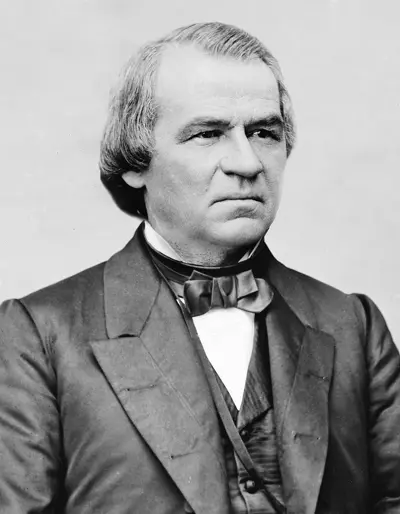
Andrew Johnson was the 17th president of the United States, serving from 1865 to 1869. He assumed the presidency as he was vice president at the time of the assassination of Abraham Lincoln. Johnson was a Democrat who ran with Lincoln on the National Union ticket, coming to office as the Civil War concluded. He favored quick restoration of the seceded states to the Union without protection for the former slaves. This led to conflict with the Republican-dominated Congress, culminating in his impeachment by the House of Representatives in 1868. He was acquitted in the Senate by one vote.
