John Marshall Quotes
The very essence of civil liberty, is the right of every individual to claim the protection of the laws, whenever he receives an injury.
John Marshall, 1755-1835, Chief Justice, U. S. Supreme Court (Federalist), Marbury v. Madison, 1803
Sourced by: Eigen's Political and Historical Quotations


See {587703} for a similar statement by a Supreme Court Justice.


Many New Yorkers and others felt that since the attack on the World Trade Center was made in the name of Islam, the mosque and commuity center should be built in another location further from Ground Zero. Ellison was debating someone who argued that the Mosque should not be built so that sensitivity can be shown for those New Yorkers who lost relatives and friends in the attack of September 11. Rather than insist on their Constitutional rights, the Muslim leadership of the project, moved the location somewhat further away from Ground Zero.


Note the use of the phrase “against the government.” One of the unique aspects of the American Constitution and The Bill of Rights is that the government is considered a potential and even probable infringer on the liberties of the people. It is almost as though the government was the potential enemy. Modern libertarians state this very explicitly and it is ever present in the views of both the right and left wings of American politics. Most centrists recoil at the thought that some citizens see the government as the enemy, but even in America there have been times where the government has infringed on the rights of citizens only to have the courts or future administrations and Congresses correct the error.


This quotation was a slight paraphrase from Article 14 of the Republican Party Platform which had been adopted unanimously at the Chicago Party Convention on May 17, 1860. This was the convention where Lincoln was nominated. It is not known who originally drafted Article 14, although Lincoln's agents were very active in the platform drafting process. In his later campaign speech, Lincoln ran on the Party Platform.

Catherine II—the Great—appointed a commission to suggest model laws for Russia based on some of the principles of the European Enlightenment. The laws were never officially adopted but they are interesting in that they were the product of “liberal” thinking at the time. This particular definition of “liberty” is similar to that ruse in many country’s modern constitutions which will “guarantee” a right like freedom of speech so long as it does not violate any laws.


The Grammar Curmudgeon. Almost every government action to protect rights impinges on the rights of some. For example, laws to protect minorities from discrimination in the workplace impinge on the right of employers to hire whomever they want. The Voting Rights Act eliminating the Poll Tax instituted to prevent Negroes from voting, impinged on the Southern States’ rights to determine the election rules and standards for their states. Laws requiring all pharmaceuticals to be approved by the Food and Drug Administration to protect the public from dangerous drugs interfere with the doctor’s and patient’s rights to determine the best treatment and the drug company’s right to sell whatever products they want.


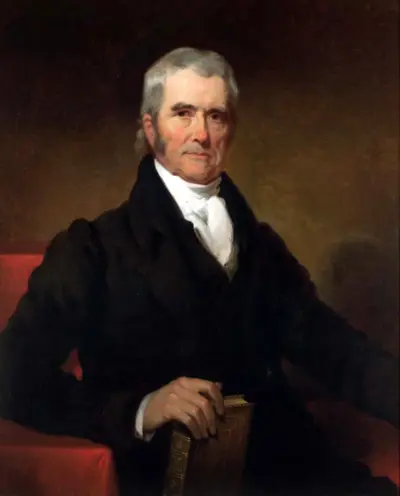
John Marshall was an American politician and lawyer who served as the fourth Chief Justice of the United States from 1801 to 1835. Marshall remains the longest-serving chief justice and fourth-longest serving justice in Supreme Court history, and he is widely regarded as one of the most influential justices to ever sit on the Supreme Court. Prior to joining the Supreme Court (and for one month simultaneous to his tenure as Chief Justice), Marshall served as the United States Secretary of State under President John Adams.
