Mahatma Gandhi Quotes
It was through the Hindu religion that I learnt to respect Christianity and Islam.


Most fundamentalist Muslims view advocacy of any religion other than Islam as an “aggression” against Islam. While Americans are used to evangelizing and very aggressive attempts to convert others to and from various religion, the lack of freedom in most Islamic societies makes this a foreign notion. Also, Muslims read the works of some Christian missionaries and generalize this view to the West in its entirety. For example, See {607979}


One of the great historical religious puzzles is how Islam evolved from its origin of respect for other religions, to one where a large number of Islamic leaders preach that not only is Islam the only true religion but all other religions are enemies of Islam, and the preaching of hatred for Christians, Jews, Bhai, Budhists and other religions.
The Prince had given $20 million to American Universities to establish Islamic Studies programs however. The Muslim religion requires believers to proselytize and spread the faith, while Saudi and Islamic law prohibits any other faith from being public or promoted. It is illegal, for example, to even bring a Christian Bible into the Kingdom. During the Gulf War, American soldiers defending Saudi Arabia were not allowed to bring in their religious texts unless they were Muslims.

In some countries political candidates run on religious platforms to convert the part of the population that is not of their religion and turn the nation into a theocracy.

Followers of the religious views of January Hus, 1369-1415 Hus was excommunicated and executed for his views that parts of the church were corrupt.

The Guru was then horribly tortured, and when he still would not convert, the Emperor had him beheaded. A new Indian Emperor, Aurangzeb, had ascended the throne of India by imprisoning his father and murdering his brothers. All the Emperors in those days were Muslims ever since the Islamic army had left Arabia and conquered most land to the East including most of India. Aurangzeb was worse than most and claimed he had a vision from God telling him that he should make everyone in the kingdom a Muslim. But about half the population was still Hindu. He decided to get the Sikh Guru to convert and then almost all would follow. The Sikhs were considered a Hindu sect at the time, and the Sikh Guru was respected by most Hindus. When the Emperor sent for the Guru, he explained that India should only have one religion, Islam, and offered the Guru much gold to convert, but if he did not do so, it would go badly for him. The Guru asked that a large pile of peppercorns be brought before them, and had it set on fire. When the fire burned out, the Guru went through the ashes and found three peppercorns intact.

Head of the Sikh Religion. His teaching was that deeds determined the man, not the professed belief and that the existing religions turned man against man.
Toleration is a relative term. The Muslim Moors made Christians (and Jews) pay a special tax. At times they were forced to wear special clothing so that they could be readily identified. And they could not build churches larger or taller than the smallest mosque in the community. At times, their occupations were restricted but at other times Christians and Jews were appointed to the highest positions like Vizier. The Inquisition, in contrast, forced all Muslims (and Jews) to leave the country without any of their property or money or be tortured and killed—usually by burning at the stake unless of course that they converted to Christianity.


In 1453 the Ottoman Turks shocked Christendom by capturing Constantinople, the capital of the Byzantine Eastern Christian Empire. It was always perceived as a religious conflict between Christians and Muslims but that is an over simplification of a very complex sociological, religious, and political historical period. As this quotation shows us there were many Christians aiding the Muslim side. There were also many Muslims fighting on the Christian side.
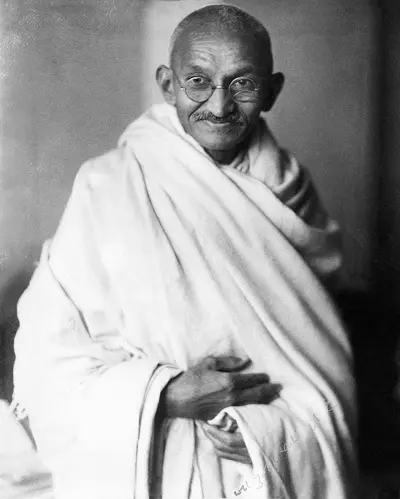
Mohandas Karamchand Gandhi was an Indian lawyer, anti-colonial nationalist, and political ethicist, who employed nonviolent resistance to lead the successful campaign for India's independence from British rule, and in turn inspired movements for civil rights and freedom across the world. The honorific Mahātmā (Sanskrit: "great-souled", "venerable"), first applied to him in 1914 in South Africa, is now used throughout the world.
