Muhammad Abduh Quotes
I hope to see the two great religions, Islam and Christianity, hand-in-hand, embracing each other. Then the Torah and the Bible and the Qur’an will become books supporting one another being read everywhere, and respected by every nation … [I am] looking forward to seeing Muslims read the Torah and the Bible.
Abduh, Muhammad. "Letter to Isaac Taylor." Al-A'mal al-Kamila li-l-Imam Muhammad 'Abduh, edited by Muhammad 'Amara, vol. 2, Al-Mu'assasa al-Arabiyya li-l-Dirasat wa-l-Nashr, 1972, pp. 358-361.


Islam was not very strong at this point and the followers of Muhammad were relatively few and the Medina area contained Arab Non-Believers, Jews as well as the new Muslims. Muhammad drew up this document and got the non Muslims to agree to it. Not only were Jews able to practice their religion freely (as were the non-Muslim Arabs) but there was not tax on the non Muslims that was imposed later when the Muslims were much stronger relative to others. Also, which surprises many Jews and Muslims alike, the Community – the Ulma – the People included the Jews and Arab Non Believers. Today it is only the Muslims.


The people of the Book refers to Jews and Muslims. This passage of the Koran is used to justify ecumenism with Muslims integrated with Jews and Christians. The Koran consists of Muhammed’s sayings, and he himself had opinions about Jews and Christians that differed from time to time. So although this passage signals a tolerant religion, in other places Muhammed preached violence against the people of the Book. At first Muhammed and his followers expected to see the people of the Book adopt Islam as their religion. When they did not, relations deteriorated somewhat.


At first this clause appears to be very enlightened and establishing freedom of conscience. This clause allowed Catholics to practice freely whereas in other colonies they could not. However, as one reads on, it becomes clear that the “tolerance” is limited to Christians only. Then if one examines the exception within the parentheses and refer to the rest of the act—see {611994}—, one finds that even Christians who have certain theological beliefs are to be put to death—those for example who deny the holiness of the Trinity such as Unitarians who were a major group in the New England Colonies. It was a significant step at the time however to protect Roman Catholics.

Muslims had engaged in violent demonstrations to insist on more Sharia law and the curtailment of behavior that the Muslim Mullahs determined to be contrary to Sharia and Islam. In Nigeria Muslim violence and intimidation had at the time already caused one of the Nigerian states to adopt Sharia instead of civil law. Many Muslims continued the violence in order to spread the adoption of Islamic law. In most counties, there were threats of law enforcement crackdowns to curtail the Muslim violence and attacks on Christians and other religions. In Nigeria however, the Christians under Akinola’s leadership made this not so subtle veiled threat to retaliate. It seems to have worked in the short run although the religious tensions remained very high and no one knew whether or not religious violence or even war would break out.


Anti Hindu prejudice has been a problem for Pakistan from the beginning of its founding.

Toleration is a relative term. The Muslim Moors made Christians (and Jews) pay a special tax. At times they were forced to wear special clothing so that they could be readily identified. And they could not build churches larger or taller than the smallest mosque in the community. At times, their occupations were restricted but at other times Christians and Jews were appointed to the highest positions like Vizier. The Inquisition, in contrast, forced all Muslims (and Jews) to leave the country without any of their property or money or be tortured and killed—usually by burning at the stake unless of course that they converted to Christianity.


He led an Islamic rebellion against the Quinn Dynasty which ended in his beheading in 1873. Since the Christians were also a minority, he tried to form an alliance with them. Hatred of Christians is not endemic to Islam—politics affect the situation also. His tomb is shown in the graphic.
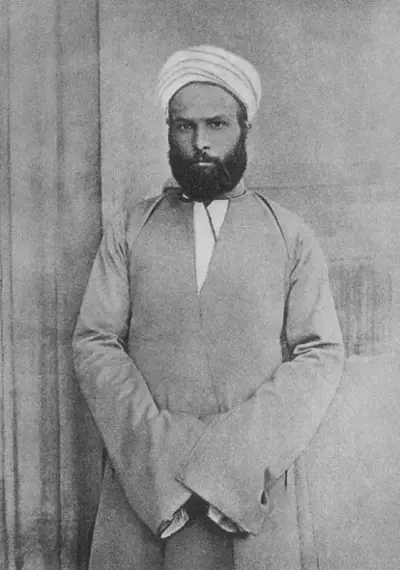
Muḥammad 'Abduh (also spelled Mohammed Abduh, Arabic: محمد عبده) was an Egyptian Islamic scholar, jurist, theologian, mujaddid, Freemason, and writer. He also wrote, among other things, "Treatise on the Oneness of God", and a commentary on the Quran. He briefly published, alongside Jamāl al-Dīn al-Afghānī, the Pan-Islamist anti-colonial journal Al-Urwah al-Wuthqa.
