William Morris Quotes
It should be remembered by those who shudder at the words of Marat, that at this very period, and for long after, the common law of England caused dozens of human beings to be hanged every week, for trivial offences, such as stealing a loaf of bread; and yet the supporters of these laws are not execrated as monsters, but are merely described as unnecessarily severe in their views of justice.
Marat was one of the leaders of the French Revolution who advocated the execution of so many people that became known as the “Reign of Terror.” His name is associated with massive bloody violence by the existing government. Morris observed that the English system executed far more people over the years, but was not looked upon as so heinous.
William Morris, 1834-1896, English Craftsman, Designer, Writer, Typographer, and Political Philosopher, Jean Paul Marat, 1871
Sourced by: Eigen's Political and Historical Quotations

The revolution turned on many of its initiators including Vergniaud. He was guillotined along with other Girondists.


1st Baron Macaulay


France was coming under great criticism from the rest of Europe for the bloodbath of executions that the Revolution had become. Many French thought that perhaps they were executing too many people. Saint-Just urged them to hold the course and they did.

This has been the case in EVERY jurisdiction that has had capital punishment. Capital punishment does provide vengeance for victims, relatives and society. And in many societies execution is less expensive than prison for life. But it has never curtailed crime despite the example. In London, they used to have public executions as examples to inhibit crime. While the crowd was watching a pickpocket be hung, other pickpockets were relieving many spectators of their wallets and watches.

The reference to “hanging the Irish” referred to the attempted French invasion of Ireland with Irish Roman Catholic complicity. The English went on a campaign of terror {639231} and there were many hangings such as {639272}.


William the Conqueror. This is one of the first if not the first nationwide abolition of capital punishment in history. Ironically, the two alternatives that the abolition law allowed would both be illegal and repugnant to us today even though we allow capital punishment.

Charles I had caused the death of his subjects with impunity and was called to account. However, the English Parliament did not know what specific crime the King had committed. Kings had executed people, guilty of crimes and otherwise, for centuries. For what could a king be accountable. Cooke developed the crime of Tyranny and drew up and presented the indictment for that. The King was found guilty and executed. This was the first time in legal history that a ruler was called to account for crimes committed against his own people. It became the foundation for many trials thereafter including that of Saddam Hussein in 2006.

Nathaniel Bacon had led a rebellion in Virginia and had routed the Governor’s troops and caused him to flee leaving control of Virginia to Bacon and his followers who were far more democratic and advanced. However Bacon succumbed to swamp fever, and his followers could not hold the colony together giving the Governor a chance to establish his authority. He then went on a vengeful reign of terror, executing all of Bacon’s followers he could get his hands on. With no danger to the authority of the Crown, King Charles felt that Berkeley had gone too far. The King’s father Charles I had been executed in the aftermath of the English Civil War, but he had executed far fewer than Berkely had done in Virginia.

The terror to which he referred was to the French Revolution’s executing former aristocrats and then including anyone suspected of monarchist sympathies. This quotation shows how fanatics can rationalize evil as justice.

In the quoted passage, it describes Diogenes as observing a thief being arrested in one of the religious temples by the officials of the temple. He had pilfered one of the temple treasures. Not unlike modern times, most religious organizations raised money be getting donations from the public. Some of the means of many of the religious groups are and have been of dubious morality and if used in commerce would generally be considered fraud. This quotation shows that this is not a new phenomenon nor was it limited to monotheistic religions.

In his early career, her supported capital punishment, but changed his mind as can be seen in this quotation.

“Catiff” is a Middle English term to describe a lowly, despicable person.


1st Marquees of Halifax. Even in the 18th century, it was realized that capital punishment was not a particularly good deterrent. Savile and others observed that there was a significant vengeance motive for state execution.

The most common example that capital punishment does not work as a deterrent is that while thieves were being hung for their crime, other thieves would circulate among the watching crowd at the scaffold and pickpocket the observers.

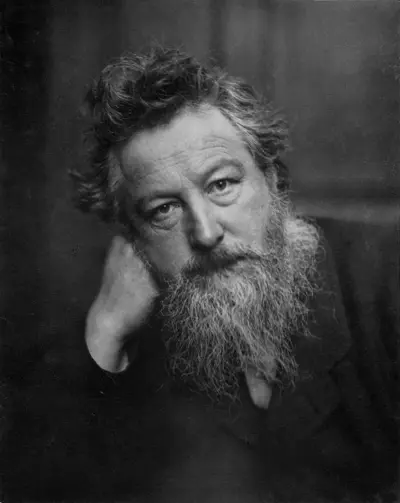
William Morris was a British textile designer, poet, novelist, translator and socialist activist associated with the British Arts and Crafts Movement. He was a major contributor to the revival of traditional British textile arts and methods of production. His literary contributions helped to establish the modern fantasy genre, while he helped win acceptance of socialism in fin de siècle Great Britain.
