Diogenes Quotes
The great thieves are leading away the little thief.
In the quoted passage, it describes Diogenes as observing a thief being arrested in one of the religious temples by the officials of the temple. He had pilfered one of the temple treasures. Not unlike modern times, most religious organizations raised money be getting donations from the public. Some of the means of many of the religious groups are and have been of dubious morality and if used in commerce would generally be considered fraud. This quotation shows that this is not a new phenomenon nor was it limited to monotheistic religions.
Diogenes, 412 BC-322 BC, Greek Philosopher, Quoted by Diogenes Laertius, Diogenes
Sourced by: Eigen's Political and Historical Quotations


Odo of Chatillon-Sur-Marne. The Pope was addressing officials of Christian counties throughout Europe. Crime control then seems to have been a hot political issue as it is today.


There were few if any consumer protection laws in those days and many wealthy aristocrats made their money by taking advantage of the poor. They were the landowners, bankers, financiers and often the industrialists. Shaw was a sarcastic social critic and this is a typical line he gave his upper class characters. Today, we have more controls on business and finance, and many wealthy business people have gotten that way by providing great value to the consumers and being honest. However, we still have large numbers of wealthy members of society who do make their money from the poor and middle class by unethical and often illegal means. In the aftermath of the Meltdown of 2008. hundreds of thousands of the homes of the working poor and middle class were foreclosed by the major banks forging the legal documentation for the foreclusures. Millions of consumer contracts are issued that even a PhD cannot understand the terms of without special legal and financial training. There is even a legal definition of a salesperson lying to make a sale which is so commonplace that our law excuses it and calls it "puffing". However, there has been over time, improvement over Shaw's era.


Ingersoll was considered to be the greatest orator and political thinker of his day, but his overt atheistic views curtailed his elected political career.

The “thieves” won in the sense that TR was the choice of the vast majority of the Republican voters of the time, yet the party bosses manipulated the convention to deny Roosevelt the nomination. Taft was nominated, and Roosevelt ran on the Bull Moose Party and outpolled Taft, but they split the Republican vote and lost to Democrat Woodrow Wilson.

The States sold bonds to finance the Revolutionary War. Some states had better prospects for redeeming their bonds than others. Georgia, South Carolina and North Carolina in particular had poorer prospects than most and their bonds were selling at about 25 cents on the dollar. Alexander Hamilton, then the Secretary of the Treasury, wanted the new Federal government to assume the state’s war debt and pay off the bonds. He made his proposal for how he would accomplish this on January 14, 1790. He delivered his report and proposal to Congress “Report on the Public Credit”. As soon as Hamilton’s proposal was read in Congress, sophisticated speculators set off for the Southern States to buy up as many bonds as they could before the owners found out that a Federal bail-out was under serious consideration. They could easily double, triple or even quadruple their money. To Jackson this was gross immorality. Other representatives had a different point of view. See {619928} & {619929}.


The United States was governing the Philippines after the Spanish American war. Most Filipinos were Roman Catholic and before the Americans even took over there were a large number of Catholic priests who were sexually active in different ways. Many had housekeepers/concubines, others had relations with women who they learned were vulnerable in the confessional. Still others were homosexuals and preferred young boys. Americans were much more prudish than many other countries where lecherous men of the cloth had a long history. The American authorities simply removed these priests not realizing that there was still with many countries laws and traditions that left the disciplining of clergy, even for criminal matters, to the religious authorities. The Catholic Church was then very defensive about sexually predatory priests. The Vatican made many protestations that the U. S. Government were interfering with the prerogative of the church to run its own religious affairs. American Catholics and Catholic leaders also complained about the religious “interference”. Roosevelt knew full well that the Church had done little or nothing about the Filipino lecherous priests before the Americans took over, and he had no confidence that they would do so in the future. And he was adamant that religious officials should be subject to the civil law and civil authorities for behavior of all citizens with no exemptions for clergy. When the Catholic church realized the poor PR that they were getting from the worst priestly offenders, it tended to back off overt confrontation, and came to a diplomatic agreement with America over the issue. Most countries resolved this issue the way Roosevelt and the Americans did. Clergy were subject to civil law in all things.


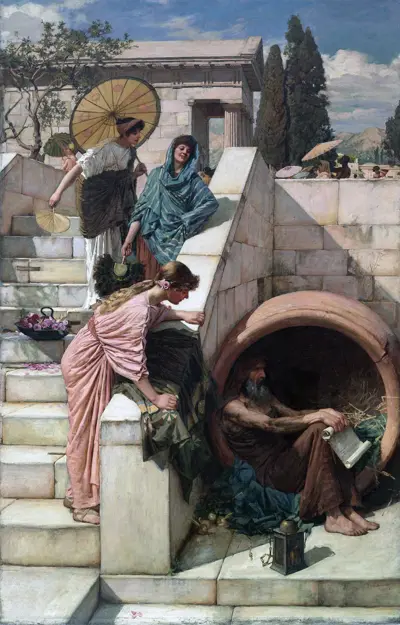
Diogenes (/daɪˈɒdʒɪniːz/ dy-OJ-in-eez; Ancient Greek: Διογένης, romanized: Diogénēs [di.oɡénɛ͜ɛs]), also known as Diogenes the Cynic (Διογένης ὁ Κυνικός, Diogénēs ho Kynikós), was a Greek philosopher and one of the founders of Cynic philosophy. He was born in Sinope, an Ionian colony on the Black Sea coast of modern-day Turkey, in 412 or 404 BC and died at Corinth in 323 BC.
