Benjamin Franklin Quotes
A man compounded of law and gospel is able to cheat a whole country with his religion and then destroy them under color of law.
Benjamin Franklin, 1706-1790, Governor of Pennsylvania, Member of the Continental Congress & the Constitutional Convention, Governor of Pennsylvania, President of the Pennsylvania Assembly, U.S. Minister to France, Postmaster General of the American Colonies, Quoted in Time, July 7, 2003
Sourced by: Eigen's Political and Historical Quotations


Ingersoll was considered to be the greatest orator and political thinker of his day, but his overt atheistic views curtailed his elected political career.


Al-Maarri’s quotations are not only meaningful in their own right, but they illustrate the openness and free thinking that was allowed in the early days of Islam before about 1100. If anyone wrote such things today in most Islamic countries he would at least be jailed if not executed for blasphemy.

Critics ask, “If legal authorities are so corrupted by making others suffer, why do they continue to do it, and why so much official corruption? Mises never provided an answer to this dilemma.


Some of the founding fathers were deeply religious men while others were not so. Some varied in their believes at different times of their lives, and a number were not very favorable towards orthodox religion. At the time, Roman Catholic and Protestant churches were persecuting other religions throughout Europe and people were still being killed for their heretical beliefs. Most important to some of them, kings and other monarchs whom they abhorred, all at the time claimed the Divine Right of Kings and the established churches were the most important support for monarchs. At the time most organized religions were opposed to freedom of conscience and certainly opponents of separation of church and state. American churches tended to take on American values but were never given the chance to dominate the American government they way many had in Europe and the rest of the world.

This is a common rejoinder of third world country leaders to accusations of Western democracies about corruption. And doubtless it is true. However temptation has never been a good defense of improper behavior.

In the quoted passage, it describes Diogenes as observing a thief being arrested in one of the religious temples by the officials of the temple. He had pilfered one of the temple treasures. Not unlike modern times, most religious organizations raised money be getting donations from the public. Some of the means of many of the religious groups are and have been of dubious morality and if used in commerce would generally be considered fraud. This quotation shows that this is not a new phenomenon nor was it limited to monotheistic religions.


Each of the original American colonies was established with a different charter and had different structures. Pennsylvania was unlike the other colonies not chartered to a company or some other structure but was given completely to William Penn as his personal property. So there was never a Royal Governor appointed by the King or a Company for Pennsylvania. Technically Penn was the "True and Absolute Proprietor" where all of Pennsylvania was treated the same as a person's personal estate in England. William Penn was a very tolerant Quaker with strong democratic, and egalitarian beliefs. He established his estate with a legislature that had the power of taxation and the making of civil laws, defense and development. He was one of the great figures in the history of America. Philadelphia was the largest city in the colonies and the center of American science and culture. However, Penn's son, Thomas Penn was everything his father despised. He was aristocratic, arrogant, power seeking, vain and greedy. However, he had inherited Pennsylvania and was the proprietor. He saw the Pennsylvania Legislature and Franklin, one of its leaders, as the people who were running his private property. So Thomas Penn at this meeting took the legal position that his father did not have the authority to establish a legislature that had power; it could only advise the proprietor. See {583431} for Thomas Penn's statement that produced this reply.


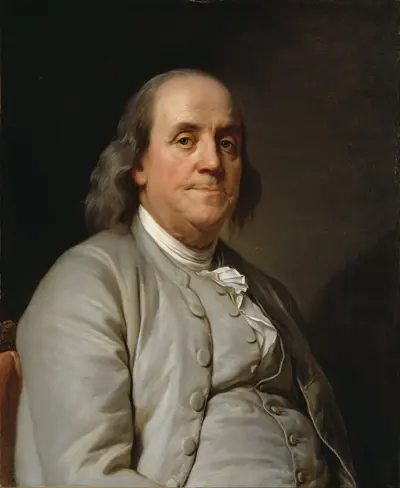
Benjamin Franklin FRS FRSA FRSE was one of the Founding Fathers of the United States. A polymath, he was a leading writer, printer, political philosopher, politician, Freemason, postmaster, scientist, inventor, humorist, civic activist, statesman, and diplomat. As a scientist, he was a major figure in the American Enlightenment and the history of physics for his discoveries and theories regarding electricity. As an inventor, he is known for the lightning rod, bifocals, and the Franklin stove, among other inventions. He founded many civic organizations, including the Library Company, Philadelphia's first fire department, and the University of Pennsylvania.
