Benjamin Franklin Quotes
If then your father had no right to grant the privileges he pretended to grant, and published all over Europe as granted, those who came to settle in the province ... were deceived, cheated, and betrayed.
Each of the original American colonies was established with a different charter and had different structures. Pennsylvania was unlike the other colonies not chartered to a company or some other structure but was given completely to William Penn as his personal property. So there was never a Royal Governor appointed by the King or a Company for Pennsylvania. Technically Penn was the "True and Absolute Proprietor" where all of Pennsylvania was treated the same as a person's personal estate in England. William Penn was a very tolerant Quaker with strong democratic, and egalitarian beliefs. He established his estate with a legislature that had the power of taxation and the making of civil laws, defense and development. He was one of the great figures in the history of America. Philadelphia was the largest city in the colonies and the center of American science and culture. However, Penn's son, Thomas Penn was everything his father despised. He was aristocratic, arrogant, power seeking, vain and greedy. However, he had inherited Pennsylvania and was the proprietor. He saw the Pennsylvania Legislature and Franklin, one of its leaders, as the people who were running his private property. So Thomas Penn at this meeting took the legal position that his father did not have the authority to establish a legislature that had power; it could only advise the proprietor. See {583431} for Thomas Penn's statement that produced this reply.
Benjamin Franklin, 1706-1790, Member of the Continental Congress & the Constitutional Convention, Governor of Pennsylvania, President of the Pennsylvania Assembly, U.S. Minister to France, Postmaster General of the American Colonies, Reply to Thomas Penn, London, August 1757
Sourced by: Eigen's Political and Historical Quotations

Each of the original American colonies was established with a different charter and had different structures. Pennsylvania was unlike the other colonies not chartered to a company or some other structure but was given completely to William Penn as his personal property. So there was never a Royal Governor appointed by the King or a Company for Pennsylvania. Technically Penn was the "True and Absolute Proprietor" where all of Pennsylvania was treated the same as a person's personal estate in England. William Penn was a very tolerant Quaker with strong democratic, and egalitarian beliefs. He established his estate with a legislature that had the power of taxation and the making of civil laws, defense and development. He was one of the great figures in the history of America. Philadelphia was the largest city in the colonies and the center of American science and culture. However, Penn's son, Thomas Penn was everything his father despised. He was aristocratic, arrogant, power seeking, vain and greedy. However, he had inherited Pennsylvania and was the proprietor. He saw the Pennsylvania Legislature and Franklin, one of its leaders, as the people who were running his private property. So Thomas Penn at this meeting took the legal position that his father did not have the authority to establish a legislature that had power; it could only advise the proprietor. See {583432} for Franklin's reply.


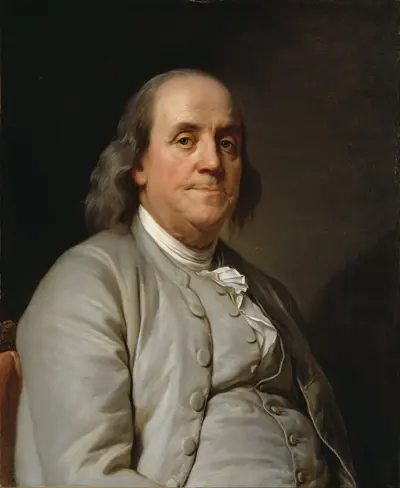
Benjamin Franklin FRS FRSA FRSE was one of the Founding Fathers of the United States. A polymath, he was a leading writer, printer, political philosopher, politician, Freemason, postmaster, scientist, inventor, humorist, civic activist, statesman, and diplomat. As a scientist, he was a major figure in the American Enlightenment and the history of physics for his discoveries and theories regarding electricity. As an inventor, he is known for the lightning rod, bifocals, and the Franklin stove, among other inventions. He founded many civic organizations, including the Library Company, Philadelphia's first fire department, and the University of Pennsylvania.
