Thomas Penn Quotes
If my father granted privileges, he was not by the royal charter empowered to grant, nothing can be claimed by such a grant.
Each of the original American colonies was established with a different charter and had different structures. Pennsylvania was unlike the other colonies not chartered to a company or some other structure but was given completely to William Penn as his personal property. So there was never a Royal Governor appointed by the King or a Company for Pennsylvania. Technically Penn was the "True and Absolute Proprietor" where all of Pennsylvania was treated the same as a person's personal estate in England. William Penn was a very tolerant Quaker with strong democratic, and egalitarian beliefs. He established his estate with a legislature that had the power of taxation and the making of civil laws, defense and development. He was one of the great figures in the history of America. Philadelphia was the largest city in the colonies and the center of American science and culture. However, Penn's son, Thomas Penn was everything his father despised. He was aristocratic, arrogant, power seeking, vain and greedy. However, he had inherited Pennsylvania and was the proprietor. He saw the Pennsylvania Legislature and Franklin, one of its leaders, as the people who were running his private property. So Thomas Penn at this meeting took the legal position that his father did not have the authority to establish a legislature that had power; it could only advise the proprietor. See {583432} for Franklin's reply.
Thomas Penn, Proprietor of Pennsylvania, Son of William Penn. Statement reneging on the authority and privileges of the Pennsylvania Legislature that William Penn as the original "Proprietor" had established, Meeting with Benjamin Franklin, London, August 1757
Sourced by: Eigen's Political and Historical Quotations

Each of the original American colonies was established with a different charter and had different structures. Pennsylvania was unlike the other colonies not chartered to a company or some other structure but was given completely to William Penn as his personal property. So there was never a Royal Governor appointed by the King or a Company for Pennsylvania. Technically Penn was the "True and Absolute Proprietor" where all of Pennsylvania was treated the same as a person's personal estate in England. William Penn was a very tolerant Quaker with strong democratic, and egalitarian beliefs. He established his estate with a legislature that had the power of taxation and the making of civil laws, defense and development. He was one of the great figures in the history of America. Philadelphia was the largest city in the colonies and the center of American science and culture. However, Penn's son, Thomas Penn was everything his father despised. He was aristocratic, arrogant, power seeking, vain and greedy. However, he had inherited Pennsylvania and was the proprietor. He saw the Pennsylvania Legislature and Franklin, one of its leaders, as the people who were running his private property. So Thomas Penn at this meeting took the legal position that his father did not have the authority to establish a legislature that had power; it could only advise the proprietor. See {583431} for Thomas Penn's statement that produced this reply.

Franklin and many Americans believed that the Colonial Legislatures were independent legislative bodies and need not follow the instructions of the Colonial Governors even though they came from the British Government in London. Franklin replied "This is new doctrine to me."" 1st Marquess of Stafford


The Massachusetts Bay Company


Many American colonists had relatives and friends in England, and Paine argued that American independence would help and not het the English people.

1st Earl of Beaconsfield. The last sentence some scholars think was originated by William Scott, a legal official of the British Navy.


Some of the Patriots of Early America realized that the oppressions of British rule were coming from Parliament and initially took the position that only the King could make laws for the colonies and not Parliament. Therefore, they were as Englishmen challenging illegal English laws. Most American hostility was directed at Parliament and not the King. However, once there was any physical resistance, King George came down with such a heavy hand that American hatred transferred to him. For related quotes on the King/Parliament issue, see {639145}, {639144}, {639143}, {639141}, {639140}, & {639137}

Some of the Patriots of Early America realized that the oppressions of British rule were coming from Parliament and initially took the position that only the King could make laws for the colonies and not Parliament. Therefore, they were as Englishmen challenging illegal English laws. Most American hostility was directed at Parliament and not the King. However, once there was any physical resistance, King George came down with such a heavy hand that American hatred transferred to him. For related quotes on the King/Parliament issue, see {639145}, {639144}, {639142}, {639141}, {639140}, & {639137}


Burke was one of the many members of the English Parliament who were opposed to a hard line in America in the beginning of the American Revolution and favored withdrawal after the hostilities began. The hard liners won un England and America was lost.

The did not listen to Pitt or others counseling moderation and ignoring the American acts of protest. Instead, the hawks sent armed troops and war broke out in earnest and the American Revolution reached the point of no return. Lord Chatham was furious at the incompetent handling of the situation by the government and he let them know it—see {641505} .
Earlier, his father had also castigated the ministers over their inept hard-line handling of the American Revolution. See {641505} .

Frederick the Great. He and many other Europeans thought that England had been so preoccupied with the American rebellion that she was ignoring Europe and other traditional foreign policy interests of theirs.
Howe had written Franklin attempting to stave off a American break with England. Franklin, with the approval of the Continental Congress, replied. This line was a veiled warning of a type of “domino effect” which indeed came to pass.
This was the first proposal for a united American government. It provided for a “President-General” and a unicameral “Grand Council” with representation proportional to population.
At the beginning of the dispute between America and England, the issue was the raising of internal American taxes by Parliament without any American representation in Parliament. The issue escalated and when the British began using force, independence then became the American objective.
_0_thumbnail_47x47.jpg)

The FBI had obtained a court order requiring apple to write software that could hack into a person's iPhone. Apple, with most other hi-tech companies in support, filed a motion with the court opposing the order. The FBI shortly thereafter withdrew its request for the order saying that they had found other solutions, when they had originally told the court that there were no other solutions.

Ministers refers to the Government Ministers, not to clergy.

It was repealed the next year, but much damage had been done to the relationship between the American Colonists and the mother country. It set the tone for American transition to a desire for independence. . Fox, a conservative on most issues was an absolute radical on the issue of America. To aggravate the hawks in parliament, he used to dress in the colors of George Washington’s uniform to show his support once the war broke out.
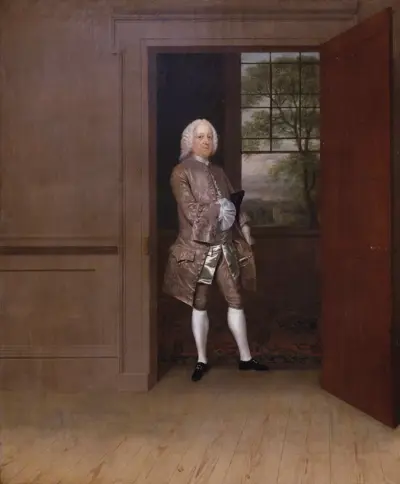
- Born: March 20, 1702
- Died: March 22, 1775
- Nationality:
- Profession:
Thomas Penn was a son of William Penn, founder of the Province of Pennsylvania, the English North American colony that became the U.S. state of Pennsylvania. Thomas Penn was born in Bristol, England after his father returned there in 1701 because of financial difficulties. Thomas Penn's mother was his father's second wife, Hannah Callowhill Penn (1671–1726), daughter of Thomas Callowhill.
