William Pitt the Younger Quotes
This country is little obliged to the framers and supporters of the tea tax. The Americans had almost forgot in their excess of gratitude for the repeal of the Stamp Act, any interest but that of the mother country. This temper would have continued, if not interrupted by your fruitless endeavors to tax them without their consent. I am an old man, and would advise the noble lords in office to adopt a more gentle method of governing America; proceedings like these will never meet with the wished-for success. Instead of these, pass an amnesty on all their youthful errors, clasp them once more to your fond and affectionate arms, and I will venture to affirm you will find them children worthy of their sire.
The did not listen to Pitt or others counseling moderation and ignoring the American acts of protest. Instead, the hawks sent armed troops and war broke out in earnest and the American Revolution reached the point of no return. Lord Chatham was furious at the incompetent handling of the situation by the government and he let them know it—see {641505} .
William Pitt, 1708-1778, 1st Earl of Chatham, British Prime Minister, Secretary of State, Lord Privy Seal & leader of the House of Commons, Advice to the leading members of the government, 1774
Sourced by: Eigen's Political and Historical Quotations

This quotation is interesting for two reasons. First, this is one of the most severe criticisms of a cabinet and ministers in English history. The second reason of interest is that it was these same ministers who made the policies and the decisions that would bring on the American Revolution. Were it not for the incompetence, there might not be a United States today. Pitt’s son later also castigated the ministers. See {641503}.

Ministers refers to the Government Ministers, not to clergy.

At the beginning of the dispute between America and England, the issue was the raising of internal American taxes by Parliament without any American representation in Parliament. The issue escalated and when the British began using force, independence then became the American objective.
The professor did not agree with these reasons and took the position that England was foolish in their use of military force. However, in America we rarely hear the English side of the dispute that led to war between England and her American colonies.

It was repealed the next year, but much damage had been done to the relationship between the American Colonists and the mother country. It set the tone for American transition to a desire for independence. . Fox, a conservative on most issues was an absolute radical on the issue of America. To aggravate the hawks in parliament, he used to dress in the colors of George Washington’s uniform to show his support once the war broke out.
See {641497} for a quote from the Grenville speech. Fox, a conservative on most issues was an absolute radical on the issue of America. To aggravate the hawks in parliament, he used to dress in the colors of George Washington’s uniform to show his support once the war broke out.

Americans were by no means united in wanting to take up arms against Britain. Relatively few of the loyalist quotations have come down to us, but here is one. It also illustrates why some Americans wanted complete independence: So that they could escape their debts to English merchants. Most however had more noble and unselfish motives. As a matter of fact, the American Revolution is unusual in the sense that there were so many men of substance who sacrificed much of their material wealth for the American ideal. There were also the rogues and opportunists as Galloway describes.

Dickinson was one of the “moderates” of the day who tried to find middle ground in the dispute with England over the American Colonies. However, most people were already polarized and soon everyone was forced to choose one side or the other.

This resolution was the trigger that began the debate which became the Declaration of Independence.
The Parliament was debating the reaction to the Stamp Act by the American Colonies. One of the members, reflecting a majority view, asked sarcastically when the American Colonies had been emancipated so that they could make their own independent decisions. Pitt then hit this one out of the park by reversing the question.

He was acting as French Foreign Secretary at the time.


This was written more than a year before the American Revolution Battles began. It took time to ship the men and supplies to America and the British did not handle that task with much efficiency. See {636926} for another of the King’s statements.

This is the same man who introduced the Stamp Act 12 years before which started the whole problem in America. See {74956}.
Earlier, his father had also castigated the ministers over their inept hard-line handling of the American Revolution. See {641505} .
Some of the Patriots of Early America realized that the oppressions of British rule were coming from Parliament and initially took the position that only the King could make laws for the colonies and not Parliament. Therefore, they were as Englishmen challenging illegal English laws. Most American hostility was directed at Parliament and not the King. However, once there was any physical resistance, King George came down with such a heavy hand that American hatred transferred to him. For related quotes on the King/Parliament issue, see {639145}, {639144}, {639142}, {639141}, {639140}, & {639137}

The message was conveyed by the Secretary of State, Sir George Calvert (Lord Baltimore). Parliament and the British King were jockeying for position in their relative powers. King James took the position that Parliament could NOT make laws that affected the American Colonies. Parliament disagreed. Later, some of the American patriots would use this quotation to claim that they were only subject to the King and not to Parliament. For related quotes on the King/Parliament issue, see {639144}, {639143}, {639142}, {639141}, {639140}, & {639137}


Burke was one of the many members of the English Parliament who were opposed to a hard line in America in the beginning of the American Revolution and favored withdrawal after the hostilities began. The hard liners won un England and America was lost.
Howe had written Franklin attempting to stave off a American break with England. Franklin, with the approval of the Continental Congress, replied. This line was a veiled warning of a type of “domino effect” which indeed came to pass.


Frederick the Great. He and many other Europeans thought that England had been so preoccupied with the American rebellion that she was ignoring Europe and other traditional foreign policy interests of theirs.

While the official battles of the American Revolution did not begin until 1776, parts of the American colonies were in a de facto state of rebellion and the British could not enforce their laws. See {636925} for another of the King’s statements.
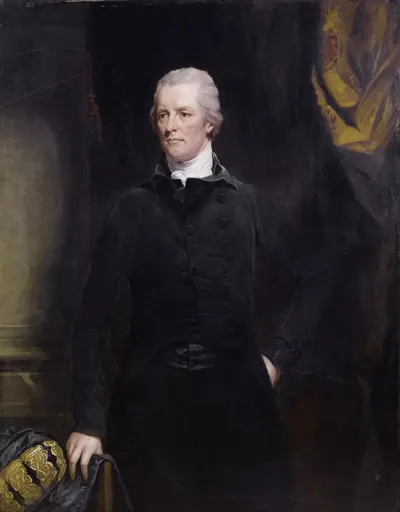
- Born: May 28, 1759
- Died: January 23, 1806
- Nationality: British
- Profession: Leader
William Pitt the Younger was a prominent British Tory statesman of the late eighteenth and early nineteenth centuries. He became the youngest prime minister of Great Britain in 1783 at the age of 24 and the first prime minister of the United Kingdom of Great Britain and Ireland as of January 1801. He left office in March 1801, but served as prime minister again from 1804 until his death in 1806. He was also Chancellor of the Exchequer for all of his time as prime minister. He is known as "the Younger" to distinguish him from his father, William Pitt, 1st Earl of Chatham, who is customarily referred to as "William Pitt the Elder" (or less commonly, simply "Chatham") and had previously served as prime minister.
