Muhammad Abduh Quotes
Islam will have no truck with traditionalism, against which it campaigns relentlessly, to break its power over men's minds and eradicate its deep-seated influence.
He was one of the first Islamic thinker to distinguish between the Koran and the requirements of Islam on the one hand and the traditions of the cultures of the Arabian Peninsula on the other. For example, there is no justification anywhere in Islamic theology for the “Honor Killing” of women; it was a long standing tradition of some of the cultures. But many Muslims and non-Muslims believe that the practice is a part of Islam. There are hundreds of other examples and Abduh tried to eradicate the influence of these traditions. He had traditional and extremist opponents in his lifetime as well as today.
Muhammad Abduh, 1849-1905, Egyptian jurist, historian, political scientist, religious scholar and liberal reformer, Mufti of the Egyptian Realm, Editor and Chief of al-Waqāʾiʿ al-Miṣriyya (The Eyptian State Newspaper), Known as “The founder of Islamic Modernism”, Theology of Unity
Sourced by: Eigen's Political and Historical Quotations

In the last centuries, Egypt has been intellectually more advanced than the other Arab countries. It has a significant number of modernists who oppose religious influences on Government. During the Arab Spring when the old regime was ousted, the modernists had hopes that a modern democracy would be formed that was not controlled of even significantly influences by religious leaders and where women would have equal rights. However, the first election the Muslim Brotherhood, a religious party won, and then tried to institute Islamic law—Sharia. A coup ousted the Muslim Brotherhood, and then many dreamed again of a modern, non-sexist, secular democracy. Professor Ajami tried to give them a more realistic view.

He was out of office and speaking as an individual. The then President was spewing hate and barbaric fundamentalism which represented the views of the Mullahs who control Iran. (The President has very little power and he can be overridden by the religious authorities whenever those authorities feel that Islam is being compromised.

At the time, Muslim clerics had a great deal of influence and in many cases legal control over all facets of Turkish society much as exists in other Islamic societies today. They even controlled what was taught in the schools. Remarkably, without bloodshed, Ataturk broke both the power and the influence of the clerics on all official and public activities. Many Turkish Muslims even developed a type of reformed Islam with the relationship between the individual and the clerics one of parity much like Protestant churches in the West. At the same time there was a more orthodox part of the population and while they sent their children to religious schools, they also attended public schools so even the orthodox Muslims in Turkey learned science and modern subjects which are still not taught in most Islamic schools and madrassas.

This is a very Jeffersonian type statement.

All modern legal systems conflict in some respects with a literal interpretation of the Koran which is the basis for the traditionalists view of Sharia—Islamic law. Therefore a student of modern law is learning things which go against Sharia as interpreted by fundamentalists. There was a time when Jewish and Christian American religious families were uncomfortable with studding modern law as there were contradictions with Biblical law. There are still a few.


Huqqani was specifically referring to Muslim religious scholars, but his point is more general and applies equally to some religious scholars and clerics of Christian, Jewish, Buddhist and other persuasions.

Traditionally Islam was a religion of faith and since it was spread to illiterate and uneducated people, it was dogmatic and literal. Reason and logic was not a part of the theology originally. As Islamic societies developed intellectually, the theology matured and reason and logic was overlaid from the science and the technology to the religion. There were many very sophisticated philosophers and theologians until Islam closed intellectually and went into its decline. Just as there were few Islamic scientists and philosophers during the Enlightenment there were few theologians who appreciated the role of logic. Those few, like Abduh, had to become reformers and modernists and return to the era when Islam was as more modern than Christianity and most other religions.
10 centuries ago was a time when the Arabs were far more advanced and modern than other cultures including the Christian West that was in the Dark Ages. However, in the 12th century there was a “closing”—a narrowing of allowable Islamic thinking, and since then, Islamic people have had great difficulty with change or modernity. Not all Muslim nations are equally rigid but the Arabs are at the extreme among Islamic counties.

His views are a mix of modernism and fundamentalism. He favors democracy and elections but also favored the Taliban destroying the great ancient Buddha statues when he was called an idol worshipper for urging the preservation of art.

Turkey had become a modern, secular nation under the leadership of Ataturk. At the time of this interview, a religious party had won a plurality of seats in the Parliament and while not rolling back the secular nature of the Turkish state which is enshrined in the Turkish Constitution, has tried to stem the tide of secularism.


Turks and Arabs tend to blame each other for the stagnation of Islam.

Islamic modernists like Serageldin are many among the educated Muslims but their views are often drowned out by the violence and extremist statements of the fundamentalists. Ironically, the necessary intellectual freedom existed in the Islamic world one thousand years ago and Islamic science and other learning was as advanced as any and superior to most including the Christians.
Islamic modernists like Serageldin are many among the educated Muslims but their views are often drowned out by the violence and extremist statements of the fundamentalists. Even in England it is difficult to expose corruption because of the libel laws. In most countries, it is almost impossible which is one of the reasons corruption is so widespread. American law says that it is better to mistakenly hurt some public figures’ reputation than suppress the ability of citizens to criticize and expose corruption.
Islamic modernists like Serageldin are many among the educated Muslims but their views are often drowned out by the violence and extremist statements of the fundamentalists. This quotation is similar to statements by American Supreme Court Justices but surprises us when coming from a Muslim. But there are many who are as much committed to freedom of speech as most Americans. Even in America, some politicians have tried to make incitement a crime. John Adams’ Alien & Sedition Acts and laws of WWi are examples. However, in no Islamic nation have reformers had incitement removed as a crime as of 2011.
There are other religious groups that also fear modern secular invasion, so they tend to wall themselves off as do the Amish or have their own schools as many Catholics do. However, the Muslims believe that the danger calls for a jihad and the killing and intimidation of those who advocate, create, defend or spread the secularism. Notice also that Al-Qaradhawi refers to Communism as having destroyed “Muslim countries in Asia and Eurupe.” Many countries of Europe and Asia were fought over by Christians and Ottoman Turks with one side or the other gaining control, only to be displaced by the other in subsequent years. Fundamentalist Muslims therefore think of Albania, Yugoslavia, Crimea, Croatia, and Azerbaijan, for example as Islamic countries because at one point in history they were controlled by a Muslim empire. But that was years ago. When they were invaded by the Russians, Christians, Jews, Muslims, atheists all suffered and not a single country was then controlled by Islam.
The prohibition of anything new has been one of the reasons for the decadence of Islam over the years. When originated, it was the most modern religion in the world. However as other religions grew and reformed, Islam has not and resists all new things. Christianity which was in the Dark Ages when Islam began, did change including the Protest Reformation so by the end of the 17th century the Christian world was more advanced scientifically, politically, and economically.

This was a remarkable public statement for its time. No other political leader of an Islamic country would dare claim that people have a right to be atheists. Very few would even suggest that people should be free to choose their own religion.
This quotation illustrated the extreme polarization between the current fundamentalist Muslims, and the Muslim modernists and the West. Kamal Ataturk, the great leader and stateman who is the father of modern Turkey, is castigated by the author for leading the new Turkish parliament to depose the Caliph – the civil and religious autocrat, one of whom reigned from after the death of Muhammad till his abolishment in 1924. Most of the rest of the world credits Ataturk with being one of the great leaders of all time—one who led a democratic revolution which transformed Turkey into the only Muslim secular democracy, requiring pubic secular European type education for all children, giving women the right to vote (before the U. S. even), adopting a European alphabet and dress, and outlook on life—creating most remarkably a total cultural revolution with virtually no loss of life. No revolutionary leader, before or since has led so extensive a political and cultural revolution, and it was a bloodless revolution. Turkey, into the 21st century, was by far the most powerful, industrialized, scientific and modern nation of Muslims in the world and others were far behind. Yet many Islamic theologian still castigate Atatork for his great achievements as being against the will of God.

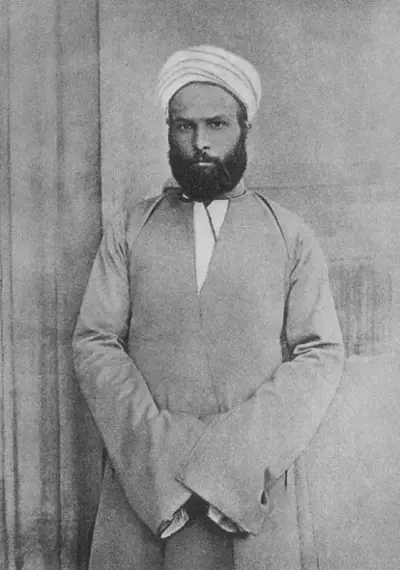
Muḥammad 'Abduh (also spelled Mohammed Abduh, Arabic: محمد عبده) was an Egyptian Islamic scholar, jurist, theologian, mujaddid, Freemason, and writer. He also wrote, among other things, "Treatise on the Oneness of God", and a commentary on the Quran. He briefly published, alongside Jamāl al-Dīn al-Afghānī, the Pan-Islamist anti-colonial journal Al-Urwah al-Wuthqa.
