Earl Old Person Quotes
In the past 190 years, the U.S. government has tried every possible way to get rid of the troublesome Indian problem he feels he has on his hands. First the government tried extinction through destruction – where money was paid for the scalps of every dead Indian. Then the government tried mass relocation… Then the government tried assimilation… The termination was tried by issuing forced patents in fee to Indian land owners – land was taken out of the trust relationship with the U.S. government and an unrestricted patent in fee was issued to the Indian whether he wanted it or not or whether he understood it or not.
Earl Old Person, Blackfoot Indian Chief, 1966
Sourced by: Eigen's Political and Historical Quotations

Published 100 years after it was written. This is the first known written statement of what became a de facto policy regarding the American Indian.

Jackson’s policies regarding Indians set back all the work of the earlier Presidents and created facts on the ground and attitudes that vex us to this day. In this occasion he said very forthrightly that it was his intention to deny Indians title to ANY land in the then United States. His idea was to send all the Indians to the Oklahoma Indian Territory and establish reservations for them there. Of course, as the Western states joined the Union, the Whites wanted those Indian Lands as well. See {643150} for other Jackson views on Indian policy.

Gold had been discovered in the Black Hills lands that were sacred to the Lakota Sioux and were reserved for exclusive use of the Indians by the Fort Laramie Treaty. Greedy whites, ignoring the treaty provisions not only entered the Black Hills to pan and mine for the gold, but killed many Indians they ran across Sherman was angry and wrote to his old friend President Grant. Grant, now a political, had to contend with public opinion that thought it absurd that gold should not be mined because a few Indians regarded the land as sacred. Meanwhile Grant was working with a few others to portray minor clashes between whites and Indians in the Black Hills as violent and dangerous Indians breaking the treaty.

He was a brutal officer who by modern standards committed various war crimes.
This quotation is often used as the greatest evidence the white usurpation of Indian land and the dubious value of all the treaties that had been made with the Indians guaranteeing them specific lands. Jackson, however, was not completely accurate. The Iroquois who fought on the American side in the Revolution were still on their lands in New York State. However, the Iriquois had their dealings with the State and local governments, and fared better than those tribes that depended in the Federal Government—especially with racists like Jackson in the Presidency.


The Indians did not have the wheel when the whites came, but soon there were wagons, stage coaches and railroads.


The century to which he was referring was the 19th century---1800-1899.

At the time, Jefferson was the Governor of Virginia and the Indians and white settlers in the Western part of the state were coming into increasing conflict. This rather heartless and blood thirsty quotation of Jefferson’s surprises many of his great admirers. Especially because of his historical sophisticated and empathetic way he treated Indians. See {589102}, {589103}, {589113}, {589125}, and {605068}. Jefferson saw Indians much like he saw whites—differentially. Some were friends, some neutral, and some dangerous enemies. His wish to exterminate or ethnically cleanse these Indians was limited to these Indians—not to Indians in general. Nonetheless, it shows a violent side of Jefferson that was in play with enemies. As President, he was aggressive against the Muslim Pirates (see {623707} and {617123}).


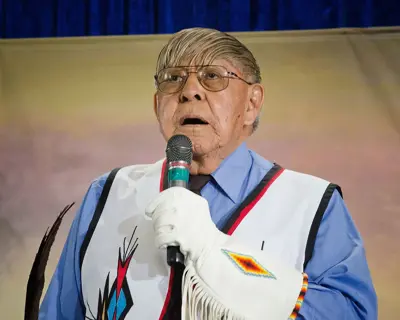
Earl Old Person, Blackfeet name - Cold Wind (Stu Sapoo) and Cold Wind or Charging Home (Ahka Pa Ka Pee), is an American Indian political leader and the chief of the Blackfeet tribe in Montana, United States. Old Person became a member of the Blackfeet Tribal Business Council in 1954 and served as tribal chairman from 1964 to 2008. He has also served as president of the National Congress of American Indians.
