John Wesley Quotes
In returning I read a very different book, published by an honest Quaker , on that execrable sum of all villanies, commonly called the Slave-trade.
Wesley, John. The Works of the Rev. John Wesley, A. M., edited by Thomas Jackson, vol. 3, John Mason, 1829, p. 453.


Brown was the richest man in Rhode Island and made much of his money in the slave trade. This quotation shows that slavery was not completely a North verses South split. Northerners like Brown for whose family Brown University was named, was as virulent supporter of slavery as the most ardent Southerner.


The Dutch Reformed Church was ambivalent regarding slavery. In this case the religion served as the moral basis for opposition. However, in the Dutch colonies of South Africa and Asia most of the Dutch Reformed ministers went along with slavery and found no religious moral imperative as Hondius did. In a sense, it was like Ameriica in the Slavery era. Many Christian and Jewish clerics—especially from the North—castigated slavery, while most in the South either ignored the moral issue or used the Bible and God to justify slavery.
As a British Loyalist officer, he and his men were dispatched to Savannah, Georgia. There he saw the Southern version of slavery for the first time and was shocked at the cruelty. At the end of the Revolutionary war, he and many other loyalists fled to Canada and began his political career, then representing Britain in the Caribbean. See also {591379}.


Observation of the other fugitives in Canada
The Republican Party condemned polygamy and slavery in its party platform of 1856


Although English, Cobett spent time in America and published a newspaper, The Porcupine Gazette, in Philadelphia. We was very conservative but on the issue of slavery his resembled a liberal point of view. He never used sugar, coffee, or rum because slave labor produced them. However, he advocated legally enslaving lazy people, blacks and whites, who would not work.
Duchess of Bedford. In 1853, during a visit to England, Harriet Beecher Stowe was presented with a petition containing the signatures of over a half million British women asking for an end to American Slavery. It was in 26 bound volumes. The backing of the prestigious Duchess and so many other English women had a profound effect on American Women and the growing strength of the Abolition movement.

This moral statement from a New jersey Quaker abolitionist is not particularly noteworthy, However what makes this quote important is that Woolman traveled throughout the South preaching this as his main theme. At that time — before the American Revolution — he did so and was not attacked or intimidated; he was mostly ignored by the Southern authorities. At the time, the South was very confident of its ability to continue slavery. Years later, when the abolition movement grew larger and stronger, a Northern Quaker Preacher doing this not not escape with his life.

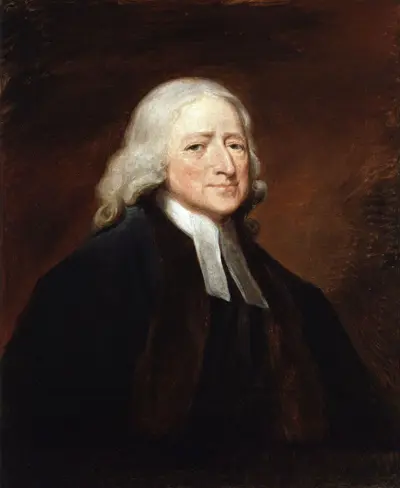
John Wesley was an English cleric, theologian, and evangelist, who was a leader of a revival movement within the Church of England known as Methodism. The societies he founded became the dominant form of the independent Methodist movement that continues to this day.
