John F. Kennedy Quotes
If I should lose on the real issues, I shall return to my seat in the Senate satisfied that I tried my best and was fairly judged. But if this election was decided on the basis that forty million Americans lost their chance of being President on the day they were baptized, then it is the whole nation that will be the loser in the eyes of Catholics and non-Catholics around the world, in the eyes of history and in the eyes of our own people.
A videotape of this response was used by Kennedy as a campaign TV ad. American history had been full of anti-Catholic prejudice and it was responsible for the Presidential loss of Al Smith. Kennedy hit the issue directly betting that America had become more tolerant. He was right but he still lost several states because of religious bigotry.
John F. Kennedy, 1917-1963, 35th President of the United States (Democrat, MA), Response to question from Protestant Ministers, 1960
Sourced by: Eigen's Political and Historical Quotations

Kennedy was a Roman Catholic and there was a great deal of anti-Catholic prejudice in the country then. Al Smith, the only Catholic who had run for the Presidency, was defeated with almost all his opposition coming from anti-Catholic forces appealing to the then popular prejudice that if a Catholic became President, the Pope and the Vatican would be running America. Richard Nixon, a master politician with few scruples, cleverly kept raising the religious question in the voters minds by saying that he would not make Kennedy’s religion and issue of the campaign. Kennedy barely won.

Smith was the first Catholic to run for the Presidency. There were many who opposed him who were anti-Catholic bigots. Were it not for this religious discrimination Smith would almost certainly have been President.


It was not until 1780 that Catholics were allowed to even be members of Town Corporations.


It took only 10 days after the First Continental Congress met for religious bigotry to arise. After hundreds of years of Catholic/Protestant strife, each sect looked upon the other, not only as theologically wrong, but dangerous to the liberty of the other. Unfortunately, the organied religions had acted so badly towards other religions, that everyone was justified in fearing the other religions. This quotation illustrates a then typical attitude of many American Protestants that the Catholic Church was a threat to national security. Ironically, in modern times, anti-Catholic bigots use this quotation to demonstrate that the United States was founded as a Christian Protestant nation—not a general Christian nation. A small, vicious anti-Catholic sentiment still exists, usually by a minority of right wing Protestant religious fundamentalists. Protestant England had just repealed the laws making Catholicism illegal, but this was regarded at that time as intolerable for the new America. This was one of the disputes which that the Founding Fathers were faced with later and one of the reasons that they were so absolute in the need for the 1st Amendment.

Barton and some other Christian Fundamentalists did not believe that a prayer should be offered by a religion that was not monotheistic. Some actually disrupted the Senate prayer in protest. See {583752}.


The term “gentile” was used in the Old Testament to indicate someone who was not of God’s Chosen People—one who was not a Jew. But the Mormon’s used the Biblical term to refer to people who were outside the Mormon faith. When Bamburger ran for the Governorship, there had been only one other Jewish governor in America. At a campaign rally a Mormon anti-Semite called him a “Damned Gentile.” This reply was typical of his humor, and the majority of the state voters and the Mormons voted for him making Bamburger the second Jewish Governor in America.


This quotation was used by the Lyndon B. Johnson 1964 Campaign as: “We represent the majority of the people in Alabama who hate niggerism, Catholicism, Judaism, and all the isms of the whole world.” So said Robert Creel of the Alabama Ku Klux Klan. He also said, “I like Barry Goldwater. He needs our help.” The second statement was made at a different time.


See Justice Richard Cox for a similar view.


What the historian did not know was how similarly the Protestants would behave against the Catholics when they had the power. Since the Catholics were the established church, and the Protestants the new “heretics” the Protestants were on the receiving end of most of the atrocities at the beginning. However, as if they had been scholled by their horrible experiences, they repeated them just exchanging the perpetrators and the victims.


In the middle of 2010, this organization was running public utility bus ads in major American cities.
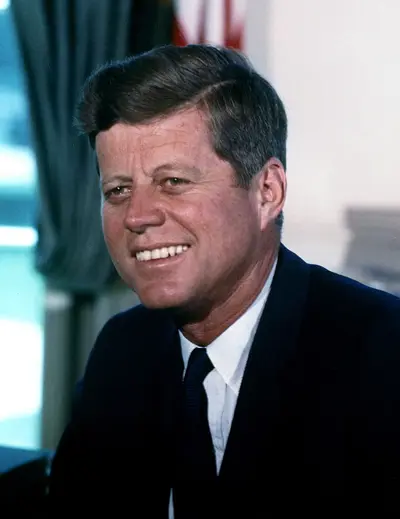
John Fitzgerald Kennedy, often referred to by his initials JFK, was an American politician who served as the 35th president of the United States from 1961 until his assassination in 1963. Kennedy served at the height of the Cold War, and the majority of his work as president concerned relations with the Soviet Union and Cuba. A Democrat, Kennedy represented Massachusetts in both houses of the U.S. Congress prior to becoming president.
