Thomas Paine Quotes
I wish most anxiously to see my much loved America - it is the Country from whence all reformations must originally spring - I despair of seeing an Abolition of the infernal trafic in Negroes - we must push that matter further on your side the water - I wish that a few well instructed Negroes could be sent among their Brethren in Bondage, for until they are enabled to take their own part nothing will be done.
Paine, Thomas. Letter to Benjamin Rush. 16 Mar. 1790.

One of the many complaints that many people made at the time about Smith and his Mormons was that they opposed slavery. In fact, Smith not only opposed it be had a plan for compensating the slave owner and a method for paying for it. Smith was not advocating the kinds of personal lifestyle issues of his church the way modern religious leaders do, but was concerned with the much larger issues of expansionism, corruption of the courts and judiciary, and land distribution. He was a classic reform candidate in that sense. Smith had written to most of the then likely Presidential candidates of both major parties asking for their position on the Mormons who were facing persecution wherever they went. None of the politicians would make any satisfactory commitments. Smith took Direct Action and became the only major religious official to have run for the Presidency of the United States until Pat Robertson tried and failed in 2000. Smith’s assassination shortly thereafter cut his run for the Presidency short before it made much headway and politically he had no chance to affect the race.


These lines were quoted by W. E. B. Dubois in his The Souls of Black Folk, 1905

This is an important quotation because it shows that slavery was the principle reason that the South succeeded and began their rebellion. In the early 20th century, there was a movement to make the Confederacy and the rebellion more noble by promoting the idea that the Civil War was fought by the South for more lofty reasons such as States Rights, Original Construction, different economic philosophies and the like. This was a more noble cause then the right to deny other human beings their rights, to own other human beings who they could beat, torture, sexually use and even murder them was a pretty selfish and demeaning reason to have started a rebellion that would then cost more Americans their lives than any other American conflict. The succession documents and others of the Southern States and the Confederacy make it clear that slavery was THE issue and fleeting references to any of the others were only made to complain about the potential effect on abolition and the refusal of the abolitionist states to cease aiding and protecting fugitive slaves.


Parker and other escaped slaves in Christiana fought off slave catchers and killed the slave owner leading them. Charged with treason, he escaped to Canada with his family and lived there the rest of his life. While not a polished writer, after he himself had escaped and went to Christiana and leaned to read and write. He wrote this narrative of his life as a slave—one of the few written works we have from slaves.

As an entertainer she had toured much of the world and seen American slavery and that of some other nations. She became a staunch abolitionist and like entertainers in the 20th and 21st centuries she used her celebrity to give anti-slavery lectures and perform for audiences where she donated the proceeds of the event to the abolition cause. She is a particularly interesting political figure in that she seems to be one of the first entertainers to perform for a social cause and become an activist.

It, would automatically emancipate all children born to slaves thereafter. It did not pass. The quote is given as evidence of Jefferson’s attempts to eliminate slavery but is in marked contrast to the fact that he never freed his own slaves nor emancipated slave children (including possibly his own child with his slave Sally Hemmings). In addition, compare this with {629765} and {630991}.


In early New England the General Court served as both a legislature and a judiciary before separation of powers was introduced. 5 years later the Court banned importing African slaves at all. While slavery was not common in Rhode Island, the laws was not seriously enforced on those who would defy them. It does represent a public anti-slavery sentiment that existed in Early America. It would take 200 years for Rhode Island to finally eliminate all forms of slavery.


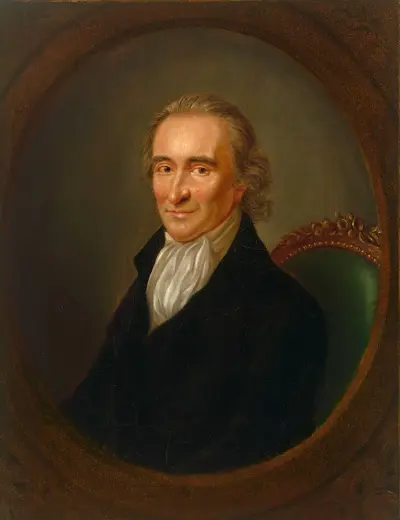
Thomas Paine was an English-born American political activist, philosopher, political theorist, and revolutionary. He authored Common Sense (1776) and The American Crisis (1776–1783), the two most influential pamphlets at the start of the American Revolution, and helped inspire the patriots in 1776 to declare independence from Great Britain. His ideas reflected Enlightenment-era ideals of transnational human rights. Historian Saul K. Padover described him as "a corsetmaker by trade, a journalist by profession, and a propagandist by inclination".
