Robert Toombs Quotes
There were thousands of abolitionists who were free traders.
Toombs, Robert. Speech of Hon. Robert Toombs, Delivered in Milledgeville, on Tuesday Evening, November 13, 1860, Before the Legislature of Georgia. Boughton, Nisbet & Barnes, State Printers, 1860.


Lincoln, just before the Civil War, quoted Jefferson that if slavery were not ended in America the results would be disastrous. But Lincoln at the time probably did not imagine how right Jefferson was, and Jefferson himself probably 1 how terrible the Civil War would be.

It was in fact, the following year when the South rebelled to prevent a “settlement”, but the irony was that the Civil War brought the settlement—emancipation-- faster and on less favorable terms than had they not rebelled and let the political process end slavery gradually as the majority of the nation wanted and morality dictated.


Lincoln later changed his mind about Colonization when some Black leaders pointed out that the Blacks had built a large part of America and also survived slavery, it they were given fair opportunity, there was no reason that they would not be able to compete and thrive.


Lincoln presciently wrote this statement in 1858, for he would be assassinated on April 14, 1865, eight months prior to the final ratification of the 13th Amendment.


These lines were quoted by W. E. B. Dubois in his The Souls of Black Folk, 1905

This was not an original notion with Abraham Lincoln. Seward and most of the “Radical Republicans” believed that the slavery issue had to be resolved and attempts to compromise were futile.


Under the pre-Civil War Southern economic system the poor whites had little chance of upward mobility and were in many wars as poorly off as slaves. Johnson saw this reform as much more important than the emancipation of the Negro.


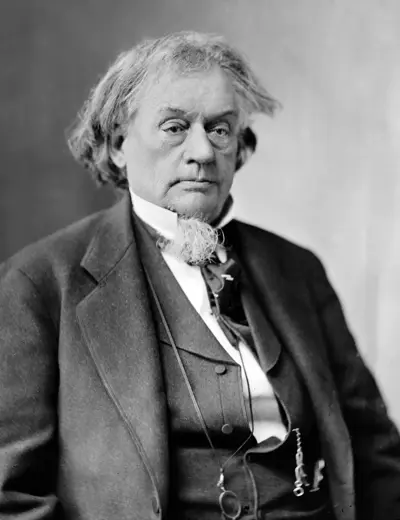
Robert Augustus Toombs was an American lawyer, planter, and national politician from Georgia who became one of the organizers of the Confederacy and served as its first Secretary of State under President Jefferson Davis. He also served in the Confederate States Army, but later became one of Davis' critics. After the Confederate defeat, Toombs fled the United States. He did not return until 1867, after his daughter's death. He regained political power in Georgia as Congressional Reconstruction ended in 1877.
