Muhammadu Buhari Quotes
I will continue to show openly and inside me the total commitment to the Sharia movement that is sweeping all over Nigeria God willing, we will not stop the agitation for the total implementation of the Sharia in the country.
Buhari, Muhammadu. Address at the Supreme Council of Sharia in Nigeria Seminar. 27 Aug. 2001, Kaduna, Nigeria.


The notion that Islam would be practiced by individuals was in the Ayatollah’s view insufficient. Islam must also control the government—the head.

This is one of the early calls for a partition of India which was to be so disastrous after the Second World War. The “free Muslim state of states” turned out to be Pakistan where they have been fighting amongst themselves about how much Sharia would prevail.

Gabriel exaggerates in the sense that while the quotation is correct for many Muslims, it is by no means true of all. Iran for example is an Islamic theocracy, but Turkey is a 99 percent Muslim nation which is totally secular and in some ways is much more restrictive of Islamic teaching and practice than most secular democracies. The fundamentalist Muslim view of the state and religion is essentially the same as the ultra orthodox Jews and Christians. It is true that a greater proportion of Muslims believe in the merging of civil and religious law than Jews and Christians, but by no means all. The non Arab Muslims are much less likely to see the unity of state and religion.


The doctor argues that the problem of public health in the Islamic world is in large part due to the fact that health care is not organized any more under the control and governance of an Islamic institution—one which is guided by the Koran and Islamic tradition. Other physicians and public health experts believe one central obstacle to public health in Muslim nations is the strong influence that the Mullahs have over the behavior of the population and the medical and health practices that are acceptable and desirable to them are those of the Arabian Desert of the 7th Century or in some more modern interpretations, the medicine of the Islamic world of the 12th century when Islamic Medicine was the best in the World.

Perhaps this quotation gives the best insight to the major difference between an Islamic perspective of law and the Western. The latter places the rights of the individual on a par with or even superior to that of the society as a whole. The former is more concerned with the effect and result on society as a whole than concern with the individual rights of single individuals.

“Disbelievers” are non Muslims. The “Ummah” is the Arabic term for the Muslim Community as a whole. Note that this fundamentalist religious party is not only against the non-Muslim West, but it also opposes most of the leaders of the Muslim countries of the world on the grounds that they are nationalist and do not represent the Ummah of the Muslim world. So ironically, this party is not only opposed by the democracies of the world (Islamic and not) but also the Muslim Dictatorships such as Syria who arrest all members of the party periodically.

Ummah is the community of Muslims. There is historical reluctance to engage in civil war even if rulers are terrible. The unwillingness to depose the Taliban in Afghanistan or Sadam Hussein in Iraq is more comprehensible to those of the Islamic tradition than to Westerners who are more accustomed to and comfortable with revolutions, impeachments, and regime changes. Many Muslims feel that it is their religious duty to put up with a poor leader rather than bring instability and produce conflict amongst Muslims. The only exception is the case where the leader does not fulfill his religious obligations and follow the laws of God and the Prophet. This is great part explains the extreme efforts of dictatorial regimes like Saudi Arabia to support its religious establishment. As long as they do not offend the clerics, their regime is safe regardless of how undemocratic or how unfair. An-Nawawi was not just a Muslim scholar stating his own views, but he compiled his 40 Hadiths which are the views of the Prophet and carry great religious and cultural weight.
Theological & Legal Expert. The Sunnah, like the Koran, has statements of the Prophet, Mohammad. A fatwa is a religious legal ruling. This particular Fatwa shows the great difference between the Islamic State and a Republic or Democracy. In the latter forms, any religious practices must be consistent with the Constitution. Even though blasphemy might be prohibited by a religion, the United States Constitution for example protects anyone’s right to be blasphemous. In the Islamic system any constitution or law is subservient to and must be consistent with, the sayings of the Prophet Muhammad. In that sense, unless the Muslim populated nation is secular like Turkey, then the governments are partial or total theocracies.


Here Khomeini takes the classic Islamic view of the Koran that leaders should be obeyed unless they do not follow Islam. To the leaders of Islamic nations, this means that even if the state is not a theocracy, the Muslim clergy has the final say as to whether a ruler may justly remain in power since they are the ones who determine if a ruler is properly following Islam.

While the author represents the views of most Islamic Fundamentalists, a similar view is held by many ulta-orthodox Jews and fundamentalist Christians also.

The Muslim Brotherhood had won the Presidency in the first Egyptian democratic election shortly after the ouster of Mubarak when they were the only party that was organized. However, after one year of government, their performance was so bad that critics like El Baradei offered strong public criticism—especially of the preoccupation with Islam with little government attention given to freedom, human rights, and the economy which was in terrible shape. This was the focus of the pointed article title. A few days after this article was published there was an insurrection of huge crowds of Egyptians and the Muslim Brotherhood President Morsi was forced to resign.

They are so different that most people in the West think of what Khamenei describes as “religious democracy” as not even close to democracy—almost the antithesis of democracy, and Islamic fundamentalists perceive Western democracy as sinful and evil.
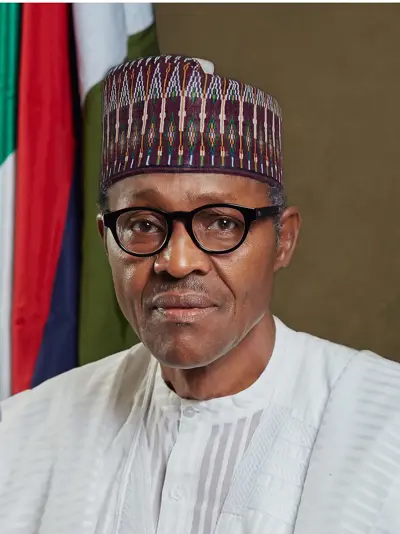
Muhammadu Buhari GCFR is a Nigerian politician who has been president of Nigeria since 2015. Buhari is a retired Major General of the Nigerian Army and served as military head of state from 1983 to 1985, after taking power in a military coup d'état.
