John Esposito Quotes
The United States should not, in principle, object to the implementation of Islamic law or involvement of Islamic activists in government. Islamically oriented political actors and groups should be evaluated by the same criteria that are applied to any other potential leaders or opposition party.
John Esposito, Director and Founder of the Center for Muslim-Christian Understanding at Georgetown University, President of the Middle East Studies Association of North America and the American Council for the Study of Islamic Societies, Quoted by Srdja Trifkovic, Islamic Terrorism and Islamic Immigration: Fifth Column Within Fortress America, Special Report From The Rockford Institute Center For International Affairs
Sourced by: Eigen's Political and Historical Quotations

Gabriel exaggerates in the sense that while the quotation is correct for many Muslims, it is by no means true of all. Iran for example is an Islamic theocracy, but Turkey is a 99 percent Muslim nation which is totally secular and in some ways is much more restrictive of Islamic teaching and practice than most secular democracies. The fundamentalist Muslim view of the state and religion is essentially the same as the ultra orthodox Jews and Christians. It is true that a greater proportion of Muslims believe in the merging of civil and religious law than Jews and Christians, but by no means all. The non Arab Muslims are much less likely to see the unity of state and religion.


Theological & Legal Expert. The Sunnah, like the Koran, has statements of the Prophet, Mohammad. A fatwa is a religious legal ruling. This particular Fatwa shows the great difference between the Islamic State and a Republic or Democracy. In the latter forms, any religious practices must be consistent with the Constitution. Even though blasphemy might be prohibited by a religion, the United States Constitution for example protects anyone’s right to be blasphemous. In the Islamic system any constitution or law is subservient to and must be consistent with, the sayings of the Prophet Muhammad. In that sense, unless the Muslim populated nation is secular like Turkey, then the governments are partial or total theocracies.

Here Khomeini takes the classic Islamic view of the Koran that leaders should be obeyed unless they do not follow Islam. To the leaders of Islamic nations, this means that even if the state is not a theocracy, the Muslim clergy has the final say as to whether a ruler may justly remain in power since they are the ones who determine if a ruler is properly following Islam.

The notion that Islam would be practiced by individuals was in the Ayatollah’s view insufficient. Islam must also control the government—the head.

This principle explains why so many Islamic governments are monarchies and dictatorships. Islamic legitimacy requires the ruler to be sure that the society functions according to Sharia (Islamic Law). It is better if the ruler is selected by the senior and responsible members of society but that is not required. He could be a king or a dictator. And it is irrelevant how he comes to power under this interpretation so long as he rules following Islamic law. Saudi Arabia is an excellent example of a dictatorial monarchy which is considered legitimate since it follows Islamic law. Some modern Muslims do not support this traditional view and believe that a legitimate ruler must be selected by the will of the people.
The doctor argues that the problem of public health in the Islamic world is in large part due to the fact that health care is not organized any more under the control and governance of an Islamic institution—one which is guided by the Koran and Islamic tradition. Other physicians and public health experts believe one central obstacle to public health in Muslim nations is the strong influence that the Mullahs have over the behavior of the population and the medical and health practices that are acceptable and desirable to them are those of the Arabian Desert of the 7th Century or in some more modern interpretations, the medicine of the Islamic world of the 12th century when Islamic Medicine was the best in the World.


This is one of the early calls for a partition of India which was to be so disastrous after the Second World War. The “free Muslim state of states” turned out to be Pakistan where they have been fighting amongst themselves about how much Sharia would prevail.
This quotation illustrates one interesting difference between Muslim fundamentalists and the Jewish and Christian fundamentalists. All three insist that whenever the world of God has appeared in holy scripture, it must be followed and not be eroded by time and modernity. However, the Islamic fundamentalists also believe that no other laws, regulations or norms are needed to cope with change and modernity while the fundamentalist Christians and Jews do allow for additional legislation to govern areas on which holy scripture is silent.
Turkey under its great leader, Ataturk, underwent a major cultural revolution. Although Turkey is overwhelmingly Muslim, its constitution provides that it be a secular state with compulsory public non-sectarian education. They adopted a European style law and prohibited Sharia (Islamic law). The nation thrived as no other Muslim country has. Muslims, the world over, are divided on Turkey. For this Sheikh its secular government is an insult to Islam because there is complete separation of mosque and state. For others it is the model which all Muslim countries should emulate.
A fatwa is a religious legal ruling.

They are so different that most people in the West think of what Khamenei describes as “religious democracy” as not even close to democracy—almost the antithesis of democracy, and Islamic fundamentalists perceive Western democracy as sinful and evil.

While the author represents the views of most Islamic Fundamentalists, a similar view is held by many ulta-orthodox Jews and fundamentalist Christians also.

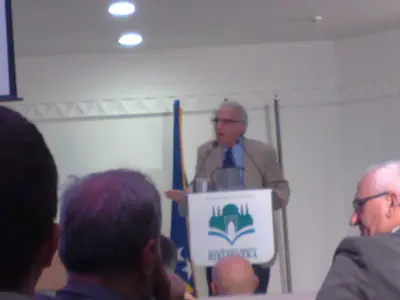
John Louis Esposito is an Italian American professor of Middle Eastern studies, Religious studies, and scholar of Islam, who serves as Professor of Religion & International Affairs and Islamic Studies at Georgetown University in Washington, D.C. He was also the Founding Director of the Prince Alwaleed Center for Muslim–Christian Understanding at Georgetown.
