Yusuf Al-Qaradawi Quotes
There are those who maintain that democracy is the rule of the people, but we want the rule of Allah.
While the author represents the views of most Islamic Fundamentalists, a similar view is held by many ulta-orthodox Jews and fundamentalist Christians also.
Sheikh Yusuf Al-Qaradawi, Qatar Moslem Cleric & Scholar, Spiritual Advisor to the Muslim Brotherhood, Quoted in Shaker Al-Nabulsi, Criticism of Sheikh Al-Qaradhawi's 'Islamist Democracy' Doctrine, June 2004
Sourced by: Eigen's Political and Historical Quotations


Gabriel exaggerates in the sense that while the quotation is correct for many Muslims, it is by no means true of all. Iran for example is an Islamic theocracy, but Turkey is a 99 percent Muslim nation which is totally secular and in some ways is much more restrictive of Islamic teaching and practice than most secular democracies. The fundamentalist Muslim view of the state and religion is essentially the same as the ultra orthodox Jews and Christians. It is true that a greater proportion of Muslims believe in the merging of civil and religious law than Jews and Christians, but by no means all. The non Arab Muslims are much less likely to see the unity of state and religion.


This quotation illustrated the extreme polarization between the current fundamentalist Muslims, and the Muslim modernists and the West. Kamal Ataturk, the great leader and stateman who is the father of modern Turkey, is castigated by the author for leading the new Turkish parliament to depose the Caliph – the civil and religious autocrat, one of whom reigned from after the death of Muhammad till his abolishment in 1924. Most of the rest of the world credits Ataturk with being one of the great leaders of all time—one who led a democratic revolution which transformed Turkey into the only Muslim secular democracy, requiring pubic secular European type education for all children, giving women the right to vote (before the U. S. even), adopting a European alphabet and dress, and outlook on life—creating most remarkably a total cultural revolution with virtually no loss of life. No revolutionary leader, before or since has led so extensive a political and cultural revolution, and it was a bloodless revolution. Turkey, into the 21st century, was by far the most powerful, industrialized, scientific and modern nation of Muslims in the world and others were far behind. Yet many Islamic theologian still castigate Atatork for his great achievements as being against the will of God.


The notion that Islam would be practiced by individuals was in the Ayatollah’s view insufficient. Islam must also control the government—the head.

Fundamentalist Christians and Jews believe that the Bible is the revealed word of God. In Islam, not only is the same position taken, but it is specifically forbidden to even think about or have a personal opinion about a matter which appears in the Koran—decided by Allah and revealed to the Prophet Muhammed.


The doctor argues that the problem of public health in the Islamic world is in large part due to the fact that health care is not organized any more under the control and governance of an Islamic institution—one which is guided by the Koran and Islamic tradition. Other physicians and public health experts believe one central obstacle to public health in Muslim nations is the strong influence that the Mullahs have over the behavior of the population and the medical and health practices that are acceptable and desirable to them are those of the Arabian Desert of the 7th Century or in some more modern interpretations, the medicine of the Islamic world of the 12th century when Islamic Medicine was the best in the World.

This verse has been one of the bases of Muslim theocratic states like Iran’s claim to legitimacy.

This quotation of a very popular Muslim cleric illustrates the wide range of political views of Islamic leaders and authorities. Whereas most shun democracy as placing public opinion over the word of God, there are many like al-Qaradawi who have a modernist interpretation of Islam.


While this view is shared today by many fundamentalist Muslims, the exact same argument has been made in the past and is currently made by some fundamentalist Christians and ultra Orthodox Jews.
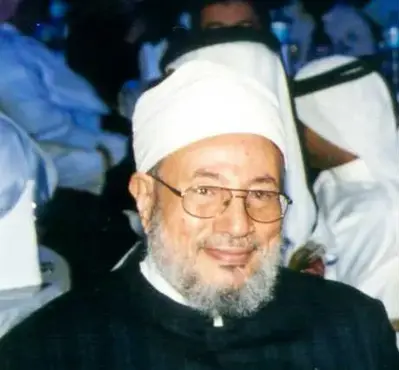
Yusuf al-Qaradawi is an Egyptian Islamic scholar based in Doha, Qatar, and chairman of the International Union of Muslim Scholars. His influences include Hassan al-Banna, Abul A'la Maududi and Naeem Siddiqui. He is best known for his programme al-Sharīʿa wa al-Ḥayāh ("Sharia and Life"), broadcast on Al Jazeera, which has an estimated audience of 40–60 million worldwide. He is also known for IslamOnline, a website he helped to found in 1997 and for which he serves as chief religious scholar.
