Recep Tayyip Erdogan Quotes
I should like to repeat what I stated recently in the Jeddah Economic Forum in Saudi Arabia: It won't be the religion, but rather the world-view of some of its followers that shall be made current.
Erdoğan, Recep Tayyip. "Democracy in the Middle East, Pluralism in Europe: Turkish View." Turkish Policy Quarterly, vol. 3, no. 1, 2004, pp. 51-56.

While not in the Koran, this attributed statement is the basis for the ban on non-Muslims going on a Hajj and going to the most holy Muslim places—Mecca, Mina, Muzdalifa, and Arafat as well as the anti-religious hostility to all religions but Islam which is present in some Muslim countries.

Many, if not most, non-Muslim scholars and thinkers very much disagree with Hamid on this point. The great exceptions of Islam are almost 1,000 years in the past. Current Islam, they argue, is not more exceptional than the beliefs of modern Mongolia which dominated most of the known world centuries ago, but has little that deserves special respect in the 21st country beyond the general respect which is owed to all religions and nationalities. With the exception of Turkey, Islamic nations are for the most part, backward, and virtually no other non-Muslim nations try to emulate them in any way.

This quotation illustrates that a narrow orthodox view of Islam is not the only one in Arab nations. Khaled is not an obscure cleric, but a popular television personality. While his views are considered heresy by many orthodox Muslims, the narrow view is by no means universal. Orthodox Islamists believe that God has commanded that all mankind be Muslims and the ones who are not are either ignorant so need to be “educated”, or evil and therefore should be killed. However, Muhammad ordained that an exception should be made for “Children of the Book”—Jews and Christians who revere the Old Testament. This was at a time when Christians would not allow any other form of worship but Christianity. Christianity, Judaism and most other religions have become tolerant of other religions and allow open alternative worship. Islam which early on led the way to tolerance, has in many countries gone back to the intolerance that existed amongst many Christians at the time of Muhammad.

He was out of office and speaking as an individual. The then President was spewing hate and barbaric fundamentalism which represented the views of the Mullahs who control Iran. (The President has very little power and he can be overridden by the religious authorities whenever those authorities feel that Islam is being compromised.

al-Mansur Abu Ali. Even though the Caliph was trying to return to Muslim Fundamentalism, there was a general tolerance that was far in advance of Christian societies at the time. It is dramatically at variance with many of the more rigorous Islamic countries today.
In some countries political candidates run on religious platforms to convert the part of the population that is not of their religion and turn the nation into a theocracy.

One remarkable aspect of this quote is that most Western nations have the exact same perception he claims the Islamic word does of what the West is doing. While the Western nations think the defense is necessary and desirable, the Muslim nations fundamentally believe that Christianity and Judaism should and will be supplanted by Islam. To the Islamic fundamentalist religion is a zero sum game. Every person in the world who is not a Muslim is an attack on Islam in that God wants all to follow Islam and wants the faithful to make it so.


Ahmad denied saying this although the reporter who wrote the original story insists that he did and she wrote it down at the time. Ahmad did not deny the statement when it first appeared in the Fremont Argus, but only did so several years later.


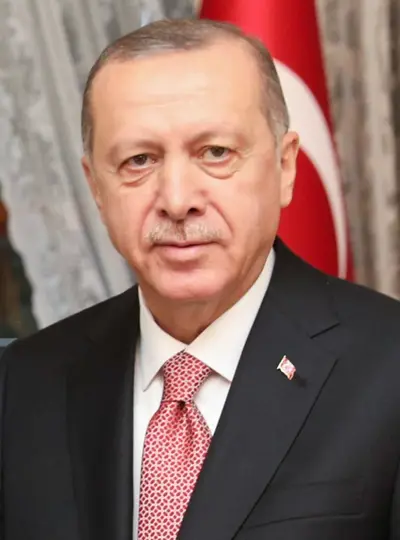
Recep Tayyip Erdoğan is a Turkish politician serving as the current President of Turkey. He previously served as Prime Minister of Turkey from 2003 to 2014 and as Mayor of Istanbul from 1994 to 1998. He founded the Justice and Development Party (AKP) in 2001, leading it to election victories in 2002, 2007, and 2011 before being required to stand down upon his election as President in 2014. He later returned to the AKP leadership in 2017 following the constitutional referendum that year. Coming from an Islamist political background and self-describing as a conservative democrat, he has promoted socially conservative and populist policies during his administration.
