John Kenneth Galbraith Quotes
I sent the President [JFK] a telegram marked SECRET to be sure that it had wide distribution.
John Kenneth Galbraith, 1908–2006, Professor of Economics, Harvard University, U. S. Ambassador to India, PBS Firing Line, June 5, 1999
Sourced by: Eigen's Political and Historical Quotations

The “gentleman” was a member of Congress. This is an issue between the Congress and the Executive Branch which has existed as long as our Republic: Whether all members of Congress should have access to all classified secret information of the Government. Mrs. Roosevelt who was usually an advocate of transparency, on this issue tended to side with the argument of the executive branch. Note that the arguments made in 1939 are still fought over today.


At the time “publicity” as a field had not been invented. The word meant “transparency” of “openness”.


_0_thumbnail_47x47.jpg "Statue of Robert Hall in Leicester.")
For many people the implication of this quotation is that there should be no government secrets withheld from the citizens who have the right to examine. Others argue that government may have temporary secrets to protect against foreign enemies for example, but that these must be declassified very promptly so that the citizens can examine the actions of their government in time to replace the government if they are not satisfied. Almost all government officials tend to reject the first implication out of hand, and grudgingly accept the second with their discretion controlling when declassification should take place. The problem of America is twofold. There is much over-classification (material kept secret that should not be at all), and the time till declassification is long in general and truly absurd in many cases. For example, there are documents from WWII that by 2013 had still not been declassified. See {591444}, {641317}, and {589105} for exemplar views. William Jennings Bryan introduced this principle into the American political dialogue. See {641027}.

The leaks not only did not stop, but they became worse than ever.

He was the Chairman of the Senate Judiciary Committee.


Helms had very bad experience even in hinting at unfavorable news about the Vietnam War. See {634520}. He didn’t even send copies to his own executives, the White House Chief of Staff or the other White House staff like the National Security Advisor who would normally receive copies of top secret memos.


He believes that the best way to achieve that is to achieve that is to increased of eliminate campaign contribution limits. Bopp however is at odds with many leading Republicans over transparency which he supports. Others want secret and anonymous contributions.
When discussing and planning redistricting What makes this quotation so noteworthy is the fact that to the expert at redistricting, security is so important and E-mail an anathema. The reason is that most redistricting by a majority in a state legislature has little to do with fairness and protecting the meaning of peoples’ votes. It is very often motivated by something that is illegal (eg diluting Black’s voting impact) or untoward, embarrassing and scandalous (eg getting rid of a Congressman the party leaders do not care for—not being ideological enough. Very often, courts or the Justice Department overturn redistricting schemes or the media embarrasses the party who controlled the redistricting. In almost all these cases, the “smoking gun” is the statements or writings of the redistricting leaders. (For an example, see {634844} .)Therefore some redistrictors behave in methods similar to the Mafia, foreign spies, or an illegal monopoly conspiracy.

In the modern media age, there is intense pressure on peace negotiators to reveal progress, problems, reactions, suggestions that are made by the parties to the peace talks. Rumors and premature public knowledge of the details of peace talks often can undermine and sometimes destroy and progress that was being made.

The Secretary of State had obtained an agreement of Israel and the Palestinians to open Peace Talks. The press immediately wanted to know who was saying what to whom and what positions the parties had. However, this was a classic example where transparency would make successful negotiations impossible—it would end the negotiations before the parties could even discuss possible alternatives.

Nixon was the ultimate pragmatist and used secrecy wherever he felt it might give him an advantage. His logic was that in the American system, the Judicial Branch was the only set of people who could pronounce something illegal. If the issue were secret, the judges could not see it, and therefore could never declare it illegal.
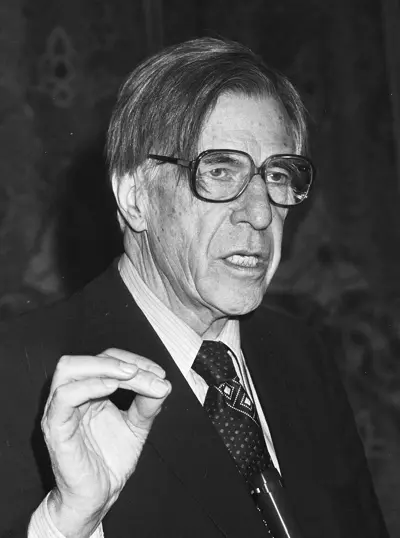
John Kenneth Galbraith OC, also known as Ken Galbraith, was a Canadian-American economist, diplomat, public official and intellectual. A leading proponent of 20th-century American liberalism, his books on economic topics were bestsellers from the 1950s through the 2000s. As an economist, he leaned toward post-Keynesian economics from an institutionalist perspective.
