Johann Wolfgang von Goethe Quotes
No limit, no definition, may restrict the range or depth of the human spirit's passage into its own secrets or the world's.
Johann Wolfgang von Goethe, 1749-1832, German poet & dramatist Scientific Studies
Sourced by: Eigen's Political and Historical Quotations


The Scientific Project that developed the Atomic Bomb. Oppenheimer was the great physicist who directed the successful development of the atomic bomb so as to build the weapon before Hitler did in World War II. However, as the technology evolved, he had doubts as to the wisdom of creating even more powerful hydrogen weapons. His viewpoint was hurting the administration’s policy of rapid unlimited nuclear weapons development, and he was the victim of a character assassination whereby his security clearance was withdrawn. The “father” of the atomic bomb was the first American casualty of atomic weapons development.


See Louis D. Brandeis for an earlier phraseology.

While many people hold that view today, in the 17th century this was truly a radical notion. There were NO democracies at the time and this philosopher argued that the citizens had a need to know that might supersede the need for the state to maintain secrets from enemies. Spinoza was one of the most feared intellectuals in human history-feared that is by the established power structures. He is the only known person who was excommunicated by the Catholics, the Jews and the Muslims-all were forbidden to read his works. He was the enemy of authority and advocated personal reason as the guide for men.


As hard as it is for us to imagine today, while her husband was President of the United States, the First Lady wrote a nationally syndicated newspaper column every single day with politics frequently the subject. While she usually agreed with the President, there were occasions where they seemed to not see things exactly the same. She tended to be more liberal than he. However, there were those who believed that when she criticized politicians, it was with FDR’s knowledge and blessing and she sometimes did his “dirty work.” Eleanor Roosevelt was one of the most influential people in the country—certainly more-so than any First Lady before and since.


At the time Holland was a republic and a confederation of different states. There was an assembly of delegations from each of the States but most important decisions tended to be made by the Prince and a few of the representatives in his sway. Mathenesse was the delegate of the largest and wealthiest state but even others in his state delegation were out of the loop. Others claimed that the necessity of secrecy was just a pretext for a small group to dominate the republic. See {620069}. This battle goes on in almost every country including the United States where there are many matters in which only a few members of Congress and the President make decisions with national security given as the reason. In many cases there has been such a reason, but it is very easily corrupted into a pretext as only the people on the inside who get to make the decision know what the secret material was.


Wikileaks obtained hundreds of thousands of classified, secret State Department Cables. Assange opened up everything to public view including material that made little or no difference in policies and affected nothing but named and exposed people whose lives could be in danger as a result of the revelations. He left Wikileaks over his differences with Assange.
_0_thumbnail_47x47.jpg "Statue of Robert Hall in Leicester.")
For many people the implication of this quotation is that there should be no government secrets withheld from the citizens who have the right to examine. Others argue that government may have temporary secrets to protect against foreign enemies for example, but that these must be declassified very promptly so that the citizens can examine the actions of their government in time to replace the government if they are not satisfied. Almost all government officials tend to reject the first implication out of hand, and grudgingly accept the second with their discretion controlling when declassification should take place. The problem of America is twofold. There is much over-classification (material kept secret that should not be at all), and the time till declassification is long in general and truly absurd in many cases. For example, there are documents from WWII that by 2013 had still not been declassified. See {591444}, {641317}, and {589105} for exemplar views. William Jennings Bryan introduced this principle into the American political dialogue. See {641027}.
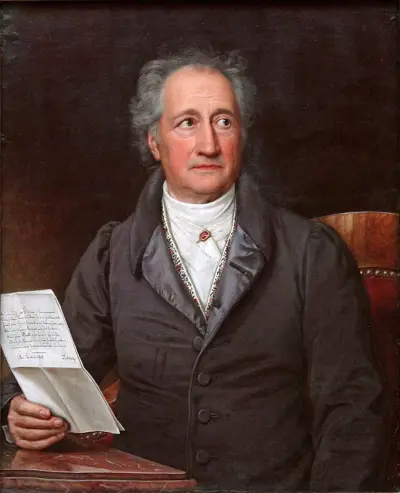
Johann Wolfgang von Goethe was a German poet, playwright, novelist, scientist, statesman, theatre director, critic, and amateur artist. His works include: four novels; epic and lyric poetry; prose and verse dramas; memoirs; an autobiography; literary and aesthetic criticism; and treatises on botany, anatomy, and colour. He is considered to be the greatest German literary figure of the modern era.
