Richard Helms Quotes
The attached paper is sensitive, particularly if its existence were to leak. It has not been given, and will not be given to any other official of the government. Title: Implications of an Unfavorable Outcome in Vietnam.
Helms had very bad experience even in hinting at unfavorable news about the Vietnam War. See {634520}. He didn’t even send copies to his own executives, the White House Chief of Staff or the other White House staff like the National Security Advisor who would normally receive copies of top secret memos.
Richard Helms, 1913-2002, Director, U. S. Central Intelligence Agency, U. S. Ambassador to Iran, Memorandum sent with report to President Lyndon Baines Johnson, September 11, 1967
Sourced by: Eigen's Political and Historical Quotations

The CIA was uncovering evidence that the military (and one of their key operative in Saigon) were lying about the success of the war effort. See {634521}. As the CIA sent their data to the White House, Rostow and others grew very distressed because it cast doubt on the wisdom of the administration’s Vietnam policy, the President would have to admit that his report to the people were wrong, and the anti-war movement would even be more galvanized in their aggressive protests. It is very hard for politicians to face the truth when it contradicts statement and policies they have been making previously. This quotation also illustrates a human frailty—that in a war or other conflict, the bearer of bad news is perceived as being disloyal. In war in a democracy, bad news, strengthens the enemy’s resolve, and weakens public support for the war. So in a bizarre sense, he who carries bad news is hurting the war effort. However, when the truth is not known or is suppressed, the result is even worse as with Vietnam. Telling truth to power is the highest form of loyalty.


War and international conflict had become very complicated in modern times. Americans and most other people associated victory in war with unconditional surrender. However, since the unconditional surrender is of WWII, no conflict has ended with an unconditional surrender.

even though in this case the objective The State Department, the Defense Department and most important President Kennedy had decided to get rid of Diem. Most of the Central Intelligence Agency thought that this was a very unwise policy, because Diem was a known risk, and the people who would replace him and their talents and policies were unknown. The negatives of Diem—the facts that he, a Christian, was persecuting the majority Buddhists, was totally corrupt, and not a very good leader was less distressful to the CIA than to the President and the other agencies as the intelligence agency frequently not only tolerated “offensive” allies, but actually employed them including war criminals. Another importance of this quotation is that it shows that it was by no means certain that the CIA would always follow the orders of the President and the government policy makers. Colby, who was not the agency director at that time but was the head of the South East Bureau, was one high level official who argued that the policies should always be followed even if they were unwise or foolish. Another importance of this quotation is that it illustrate a common error that administrations are frequently forced to make: making a policy decision to eliminate a problem while not having much of an idea of what the alternative or consequence would be when the policy is implemented. The Syrian Civil War in 2013 was a good example. The Government side appeared to have used Chemical Warfare on Civilians and public opinion demanded that we do something. However, having a no-fly zone or any of the alternatives to prevent (punish) the government for the Chemical Warfare would strengthen the rebel side which was made up of numerous factions—some of which were known Islamic fundamentalist terrorists and jihadists. If the balance of power were tipped toward the rebels, the consequence for the American national interests were unknown—just as the consequence of ousting Diem was unknown and turned out to also be bad and was probably worse.


The argument here is that secret intelligence, comes from sources and people whose views and claims are not subject to the test of public scrutiny representing a narrow information sample. Publicly available information, while it does not include secrets that the enemy wants to keep secret, does represent vetted and processed information with challenges and contradictions also publicly available. Proponents argue that it is more reliable. Secret intelligence has produced some of America’s worst debacles. An example is the Bay of Pigs. Secret intelligence assured Presidents Eisenhower and Kennedy that the majority of Cuban people was hostile to the Fidel Castro government. If freedom fighters would land in Cuba, the vast majority of Cubans would join them. When the invaders landed, most Cubans were so outraged that their country was being invaded that there was massive public support for Castro’s troops who quickly captured the invaders who were waiting for the popular uprising.
Podharetz was citing the Vietnam war. The two American occasions where the plausibility seemed to fade were the Vietnam War and The Irag war. Both Presidents Lyndon Baines Johnson and George W. Bush as Bismarck predicted, had much political trouble over the wars.


Agree resigned from the CIA in protest to its political position.

The Solicitor General had asked the Supreme Court in 1971 to prohibit the New York Times from publishing The Pentagon Papers on the grounds of national security. Later he wrote:


When Bob Casey was the CIA Director, he the declassification of all the operational files of the WWII Office of Strategic Service. The huge collection is referred to as Record Book 2.6

Ford was then a member of Congress. This was known as the “Domino Theory” and was the strategic reason that sending troops to Vietnam was in America’s vital Interest. However, the Domino Theory was incorrect. Vietnam did fall to the Communists, and yet NONE of the countries became communist. Actually, they became even more democratic.

Early in the year the President asked his most experienced political strategist what was likely to happen in the Presidential election that was upcoming later that year. The Vietnam War was tearing the country apart. He had lost the South because of the Civil Rights laws he has passed. For the rest of the country, the war hardliners wanted someone more aggressive than him, and the Doves wanted us out of Vietnam. Johnson, in a great political tragedy, even though he thought the war was unwinnable, could not bring himself to be the first American President to lose a war. He soon would decide to withdraw from the race but not pull out of Vietnam. See {637677} and {637678}.

Lindbergh, a great aviator, was a Fascist who was a great admirer and supporter of Hitler and Mussolini. By this time, even Lindbergh had seen much of the German aggression, and his opposition to the war was on the pragmatic ground that we could not win. He thought that democracy was too unsuited to a country being a major power.

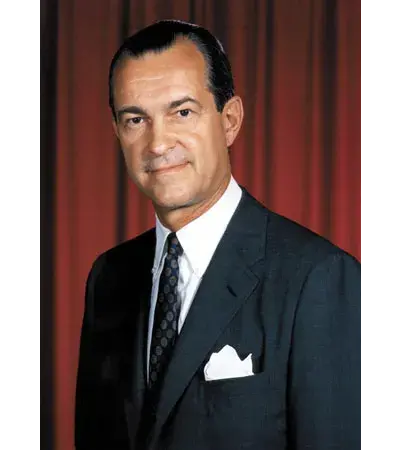
- Born: March 30, 1913
- Died: October 23, 2002
- Nationality: American
- Profession: Diplomat, CIA Director
Richard McGarrah Helms was an American government official and diplomat who served as Director of Central Intelligence (DCI) from 1966 to 1973. Helms began intelligence work with the Office of Strategic Services during World War II. Following the 1947 creation of the Central Intelligence Agency (CIA) he rose in its ranks during the presidencies of Truman, Eisenhower and Kennedy. Helms then was DCI under Presidents Johnson and Nixon.
