Stansfield Turner Quotes
Are there topics of sufficient import to the nation's well-being to replace the Soviets as the focus of U.S. intelligence?
Stansfield Turner, CIA Director, “Intelligence for a New World Order”, Foreign Affairs, Fall 1991
Sourced by: Eigen's Political and Historical Quotations


The argument here is that secret intelligence, comes from sources and people whose views and claims are not subject to the test of public scrutiny representing a narrow information sample. Publicly available information, while it does not include secrets that the enemy wants to keep secret, does represent vetted and processed information with challenges and contradictions also publicly available. Proponents argue that it is more reliable. Secret intelligence has produced some of America’s worst debacles. An example is the Bay of Pigs. Secret intelligence assured Presidents Eisenhower and Kennedy that the majority of Cuban people was hostile to the Fidel Castro government. If freedom fighters would land in Cuba, the vast majority of Cubans would join them. When the invaders landed, most Cubans were so outraged that their country was being invaded that there was massive public support for Castro’s troops who quickly captured the invaders who were waiting for the popular uprising.


The scandals of the past of CIA lies to Congress and the President, mistakes they had made, and a raft of illegal activities, had eroded support for the agency. The reason for the minimal funding was that, and not the lack of interests. We still had the NSA and the Military Intelligence Agencies which had not been involved in the CIA scandals


Expressing concern over President Obama extending some of the American citizen entitled privacy rights to foreigners. He was concerned that this might inhibit our spying efforts.

Actually the United States has a long history in interfering with foreign elections throughtout Latin American Countries, Europe, Asia,, and Africa. Russia also has been trying to tilt elections recently in Eastern Europe and befroe the COld War the International Communist Party was involved trying to swing elections since shortly after the Russin Revolution. Before that the Czars agents were involved in many foreign elections. But the United States and Russia historically are relative newcomers and rank amateurs in interering with foireign elections when compared with Germany and France and the Champion--Great Britain who controlled much of the world and very often promoting democratic values like elections throughtout the world and then workign to manipulate those elections. Japan and Chine did much less of this historically. Instead they just conquored other counties and placed their puppets in charge. What was new in teh 2016 Russian interference in the American Election was the fact that it was done by hacking computers. Putin had accused Hillary Clinton of Interfering with the Russian election when he last ran for President by funing Russian organziations that oppo


Agree resigned from the CIA in protest to its political positions.

When he became a candidate, he modified this position and stated that he would abolish both agencies spying on Americans activities but not necessarily abolish all the functions of the agency.

He made this statement even before 9-11.

He was the Chairman of the Senate Judiciary Committee. The NSA had hacked into the servers of these firms and others that were located out of the country. (They would need to have a warrant if inside the country.) The companies had never known it until Edward Snowden made this practice public. The result was, the public was learning that there was no privacy in any of their e-mail, social media activity, exchange of photos or videos or anything else. The companies feared that this would then harm their business, and that the techniques NSA used to hack there servers would then be discovered and used by others to steal identities, credit cards and do such other damage to customers. Even if the particular hacking methods were not leaked to the bad guys, they, knowing that the servers were vulnerable, would be encouraged to work to figure it out.


even though in this case the objective The State Department, the Defense Department and most important President Kennedy had decided to get rid of Diem. Most of the Central Intelligence Agency thought that this was a very unwise policy, because Diem was a known risk, and the people who would replace him and their talents and policies were unknown. The negatives of Diem—the facts that he, a Christian, was persecuting the majority Buddhists, was totally corrupt, and not a very good leader was less distressful to the CIA than to the President and the other agencies as the intelligence agency frequently not only tolerated “offensive” allies, but actually employed them including war criminals. Another importance of this quotation is that it shows that it was by no means certain that the CIA would always follow the orders of the President and the government policy makers. Colby, who was not the agency director at that time but was the head of the South East Bureau, was one high level official who argued that the policies should always be followed even if they were unwise or foolish. Another importance of this quotation is that it illustrate a common error that administrations are frequently forced to make: making a policy decision to eliminate a problem while not having much of an idea of what the alternative or consequence would be when the policy is implemented. The Syrian Civil War in 2013 was a good example. The Government side appeared to have used Chemical Warfare on Civilians and public opinion demanded that we do something. However, having a no-fly zone or any of the alternatives to prevent (punish) the government for the Chemical Warfare would strengthen the rebel side which was made up of numerous factions—some of which were known Islamic fundamentalist terrorists and jihadists. If the balance of power were tipped toward the rebels, the consequence for the American national interests were unknown—just as the consequence of ousting Diem was unknown and turned out to also be bad and was probably worse.
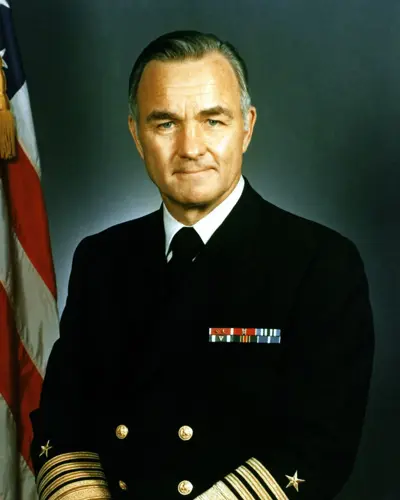
Stansfield Turner was an admiral in the United States Navy who served as President of the Naval War College (1972–1974), commander of the United States Second Fleet (1974–1975), Supreme Allied Commander NATO Southern Europe (1975–1977), and was Director of Central Intelligence (1977–1981) under the Carter administration. A graduate of University of Oxford and the United States Naval Academy, Turner served for more than 30 years in the Navy, commanding warships, a carrier group, and NATO's military forces in southern Europe, among other commands.
