Tammy Baldwin Quotes
I don’t think that Wall Street should write its own rules.
At the time, the financial industry spent more money for lobbyists and campaign contributions than any other sector of the economy. The result is that they had extraordinary access to and influence upon members of Congress and their staffs, that more often than not, the actually drafted the language for laws, amendments and regulations and then les the strategy to pass the legislation or finalize the rule. Moreso than any other industry, they wrote their own rules. Even after the Meltdown of 2008 and the Great Recession where there was a public outcry for reform, the Dodd Frank legislation was influenced by the industry and after passage most of the rules and interpretations were written by the industry or greatly influenced by them.
Tammy Baldwin, U.S. Congressman & Senator (Democrat, WI), Quoted in The Progressive, November 2012
Sourced by: Eigen's Political and Historical Quotations


Greenspan accepted this as many other economists and financial regulators did. What they did not take into account was the incredible greed of many of the financial executive who were betting with their customers money, If the bet was right they, the shareholders and the customers all made out very well as they were highly leveraged. If the bet was wrong, the shareholders and customers lost a lot, and the financial executives only made their multimillion dollar salaries and bonuses (Many were actually were guaranteed their bonuses even if they put the company into bankruptcy.) Worse, they earned their money when they made their sales or earnings targets, but when the securities they bought went sour, even if the company had no funds left, the. It was “heads we all win and tails only I win.” The vested interests between the financial company executives, the shareholders, and the clients were divergent, and the customer was at the bottom of the money pole.


The then attorney general had begun a series of investigation which discovered that most of the major Wall Street brokerage houses were engaged in systematic frauds to cheat small investors. One dramatic fraud he uncovered was that the research expert analysts of major firms would recommend the stock of businesses that their firm was doing investment banking for even when they knew that the companies were not doing well or were even in deep financial trouble. See {627544}.

The representative was opposing currency and monetary reform that would have given Wall Street too much power. His son, the famous aviator, was a Fascist who was a great admirer and supporter of Hitler and Mussolini. The father however was generally liberal as this quotation and {609656} illustrate.


The result was regulation of the banks and the creation of the SEC to regulate the stock market, However, over the years, the regulations were not able to keep up with the sophisticated development of new forms of investments and financial instruments and the financial industry were able to speculate with other people’s money in ways that FDR and his reformers never imagined. Finally, even the regulation that did exist was weakened by the policies of the George W. Bush administration and the combination brought about the Great Recession of 2008 where the profits from excess speculation were privatized and the losses, socialized with the taxpayer and the American worker bearing the brunt while most of the speculators were bailed out and made more money than ever. The Obama administration tried to reform the situation, but was unable to put an end to the legal speculation with other people’s money or of having institutions that were “too big to fail.”


For many general government regulations—labor, environment, non discrimination—the small business has a proportionately heavier burden of compliance. So large businesses have always been able to count on small business to lobby against regulation and for deregulation. However, when it comes to financial regulation such as the Dodd-Frank regulations essentially apply to large businesses. As a matter of fact, small businesses were on many ways the most frequent victims of the large banks and investment bank excesses in the Meltdown of 2008. Before most of the regulations could even take effect, the financial industry was already trying to get small business to lobby to roll back the protective regulations preventing future meltdowns and bank failure resulting from loose regulation and greedy irresponsible financial industry behavior. The President campaigned to convince the small business not to support the finance industry over their usual “knee jerk” reaction to any regulation.
the largest economic and banking reform in decades The Dodd-Frank reform legislation was very complicated. It was extensively debated including attacks against provisions that were not even in the bill (See {632833}.) Few of the supporters and fewer of the opponents understood the bill. Many members on both sides had not even read the entire bill. It passed.

Between the politicians and the financial industry lobbyists the laws are written so that there is sufficient room for enough self dealing so that members of Congress can get rich using methods that are questionable but have been legislated as legal and the Congressional rules have been written so that they are “not unethical”. Many members of Congress leave the institution much wealthier than when they entered but have received salaries that are insufficient to build that kind of wealth. Many then accept lobbying or other jobs at very high pay representing the people and corporations who have been the subjects of their legislative efforts. Other members do not avail themselves of the “legal” self dealing as the practice is not universal.


This was a very important quotation because Cox was a strong advocate of deregulation and voluntary regulation, and that is why he was appointed to head the SEC by George W. Bush. He was the leading Republican expert on Regulation of the Stock Markets and sale of public securities. However when the Meltdown of 2008 hit, it was clear to all but the extreme ideologues that some Federal regulation was necessary. Nonetheless, it took several years to reform the regulations for the financial industry with the Banks and Wall Street fighting it all the way and by that time the Republican Party had been so dominated by ideological conservatives that the views of Cox and others no longer had much influence. They fought the Dodd-Frank reforms to go preserve self regulation to a great extent.
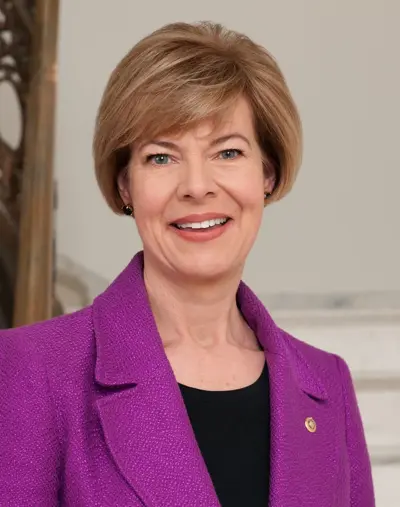
Tammy Suzanne Green Baldwin is an American lawyer and politician serving as the junior United States Senator from Wisconsin since January 2013. A member of the Democratic Party, she served three terms in the Wisconsin State Assembly, representing the 78th district, and from 1999 to 2013 represented Wisconsin's 2nd congressional district in the United States House of Representatives.
