Charles A. Lindbergh Sr. Quotes
We need reform, but not at the hands of Wall Street.
The representative was opposing currency and monetary reform that would have given Wall Street too much power. His son, the famous aviator, was a Fascist who was a great admirer and supporter of Hitler and Mussolini. The father however was generally liberal as this quotation and {609656} illustrate.
Charles A. Lindbergh Sr., 1859-1924, U. S. Congressman (Republican, MN), Congressional debate, July 1911
Sourced by: Eigen's Political and Historical Quotations

His son, the famous aviator, was a Fascist who was a great admirer and supporter of Hitler and Mussolini. The father however was generally liberal as this quotation and {609657} illustrate.


At the time, the financial industry spent more money for lobbyists and campaign contributions than any other sector of the economy. The result is that they had extraordinary access to and influence upon members of Congress and their staffs, that more often than not, the actually drafted the language for laws, amendments and regulations and then les the strategy to pass the legislation or finalize the rule. Moreso than any other industry, they wrote their own rules. Even after the Meltdown of 2008 and the Great Recession where there was a public outcry for reform, the Dodd Frank legislation was influenced by the industry and after passage most of the rules and interpretations were written by the industry or greatly influenced by them.


She had done a monumental exposé of the Standard Oil Company illegal and immoral activities. The public was so aroused that many reforms were instituted and the Standard Oil Company Trust was broken up into many smaller companies. Tarbell was then, in the words of S. S. McClure, “the most famous woman in America.”

The “rebate agony” referred to a corrupt practice of the Railroads and the Large Monopolies. The railroads charged a very high rate for the transportation of important products like beef and oil. However, secretly they gave back a large percentage of the transportation rate charged to the trusts. They in turn could cut their prices and undersell all the smaller competitors who were paying “full freight” and could not afford to match the lower price. As soon as the smaller competitors were driven out of business in an area, the trust raised its rates even higher than they charged originally. The Railroad had made a small but reasonable profit on the freight of the trusts but they were guaranteed all their business. They also made huge profits on the higher rates that the small companies paid until those companies were driven out of business. Journalists like Ray Baker and Ida Tarbell had uncovered the rebate scheme which enabled the trusts to steal high amounts from the general public through unreasonably high prices. President Theodore Roosevelt was committed to try and regulate the railroads and not allow rebates but charge the same public rate to all with no rebates. Socialists like Sinclair, thought that this attempt would be hopeless—that the damage had already been done, and the trusts now had so much money that they could buy state legislatures and many in Congress to preserve their dominance.


[The metaphor of the stone tablets revers to Moses coming down the mountain and his interaction with God, carrying the 10 Commandments carved in stone tablets.]


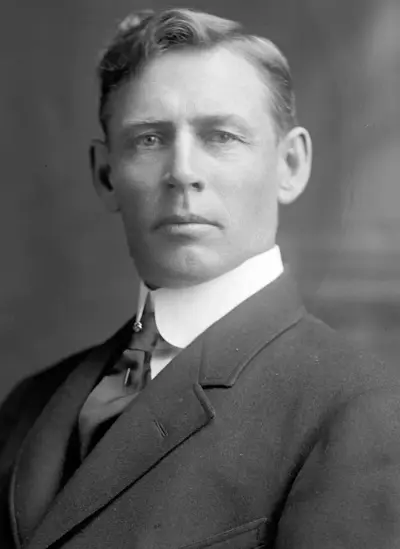
- Born: January 20, 1859
- Died: May 24, 1924
- Nationality:
- Profession:
Charles August Lindbergh (born Carl Månsson; January 20, 1859 – May 24, 1924) was a United States Congressman from Minnesota's 6th congressional district from 1907 to 1917. He opposed American entry into World War I as well as the 1913 Federal Reserve Act. Lindbergh is best known as the father of famed aviator Charles Lindbergh.
