Ngozi Okonjo-Iweala Quotes
In every developing country, even developed ones, vested interests prevent sectors from being reformed.
Ngozi Okonjo-Iweala, Nigerian Finance Minister, Interview, Foreign Affairs, March/April, 2014
Sourced by: Eigen's Political and Historical Quotations


Trump often used the phrase "Drain the swamp" in his campaigning to mean get ride of the establishment figures who had, for the most part, dominated politics, for decades. When he was elected, he had to appoint a cabinet, but when he did so, it was almost exclusivly made up of people who had been a part of the political and corporate establishment -- the swamp.


The representative was opposing currency and monetary reform that would have given Wall Street too much power. His son, the famous aviator, was a Fascist who was a great admirer and supporter of Hitler and Mussolini. The father however was generally liberal as this quotation and {609656} illustrate.

Rove had bridged the traditional gap between the right wing Religious fundamentalists and large business, industrial, heavy donors to the party. These groups usually diverged on economic policy and cultural values however Rove had convinced both that they should tolerate the other for the sake of maintaining power for President George W. Bush who delivered enough to each to hold them in coalition. Rove’s style tended to moralize everything for the religious right including their cooperation with major exploiters of economic self-interest. Rove’s religious tactics which were so successful was a subject of great interest and analysis, especially since Rove himself was an agnostic.


The best examples are Social Security and Medicare.

The “rebate agony” referred to a corrupt practice of the Railroads and the Large Monopolies. The railroads charged a very high rate for the transportation of important products like beef and oil. However, secretly they gave back a large percentage of the transportation rate charged to the trusts. They in turn could cut their prices and undersell all the smaller competitors who were paying “full freight” and could not afford to match the lower price. As soon as the smaller competitors were driven out of business in an area, the trust raised its rates even higher than they charged originally. The Railroad had made a small but reasonable profit on the freight of the trusts but they were guaranteed all their business. They also made huge profits on the higher rates that the small companies paid until those companies were driven out of business. Journalists like Ray Baker and Ida Tarbell had uncovered the rebate scheme which enabled the trusts to steal high amounts from the general public through unreasonably high prices. President Theodore Roosevelt was committed to try and regulate the railroads and not allow rebates but charge the same public rate to all with no rebates. Socialists like Sinclair, thought that this attempt would be hopeless—that the damage had already been done, and the trusts now had so much money that they could buy state legislatures and many in Congress to preserve their dominance.


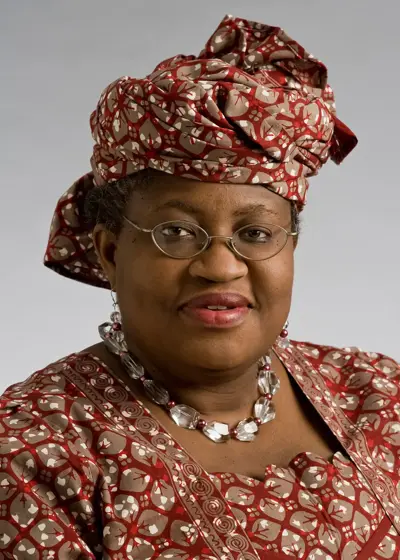
Ngozi Okonjo-Iweala is a Nigerian-American economist and international development expert who has served since March 2021 as Director-General of the World Trade Organization. She is the first woman and the first African to hold the office. She sits on the boards of Standard Chartered Bank, Twitter, Global Alliance for Vaccines and Immunization, and the African Risk Capacity (ARC).
