Nassim Nicholas Taleb Quotes
What we do today has nothing to do with capitalism or socialism. It is a crony type of system that transfers money to the coffers of bureaucrats.
Taleb, Nassim Nicholas. Skin in the Game: Hidden Asymmetries in Daily Life. Random House, 2018.


Rove had bridged the traditional gap between the right wing Religious fundamentalists and large business, industrial, heavy donors to the party. These groups usually diverged on economic policy and cultural values however Rove had convinced both that they should tolerate the other for the sake of maintaining power for President George W. Bush who delivered enough to each to hold them in coalition. Rove’s style tended to moralize everything for the religious right including their cooperation with major exploiters of economic self-interest. Rove’s religious tactics which were so successful was a subject of great interest and analysis, especially since Rove himself was an agnostic.

While this is a common complaint in the American political dialogue at the beginning of the 21st century, it is interesting that this was the conclusion of a foreign political scholar studying that period—one who was generally a great admirer of America.


While New York City and a few other jurisdictions—states and local—have more stringent laws and ethical standards for politicians than does Congress and Federal Officials, but most have lower standards. In some of the jurisdictions judges can try cases and rule in favor of a company or wealthy individual who gave the judge the money to campaign with and get elected.


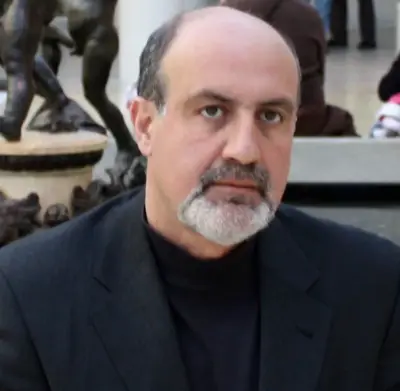
Nassim Nicholas Taleb (/ˈtɑːləb/; alternatively Nessim or Nissim; born 1960) is a Lebanese-American essayist, scholar, mathematical statistician, and former option trader and risk analyst, whose work concerns problems of randomness, probability, and uncertainty. His 2007 book The Black Swan has been described by The Sunday Times as one of the twelve most influential books since World War II.
