Kishore Mahbubani Quotes
When Congress opens the government’s purse, the benefits flow to special interests rather than the public interest.
While this is a common complaint in the American political dialogue at the beginning of the 21st century, it is interesting that this was the conclusion of a foreign political scholar studying that period—one who was generally a great admirer of America.
Kishore Mahbubani, Singaporean Permanent Representative to the United Nations, Dean, School of Public Policy, National University of Singapore, “Can America Fail?”, The Wilson Quarterly, Spring 2009
Sourced by: Eigen's Political and Historical Quotations

She was the first Black woman to be elected to Congress and was the first Black woman to actively campaign for the Presidency


Many corporations getting corporate welfare in the form of subsidies and tax breaks often to not even perceive that they are taking something from the government. They sometimes think that they create jobs and the workers in turn pay taxes to the governments so the subsidies or other benefits that they are getting from government is an "investment" by government. Of course that usually do not perceive it to be a government investment to pay for training for an unemployed worker, or heath care for the poor who in good health might be working. That is welfare.

As a candidate for the Republican Presidential Nomination, Trump was very forthright about the fact that when he was a business tycoon, he gave money to many politicians not for any ideological reasons but he considered the money an investment which paid off handsomely. Almost all large campaign donors believe that they are making an investment and most have continued to be satisfied with the results so they continue to donate. See {583282} as an example of Trump's candid view.


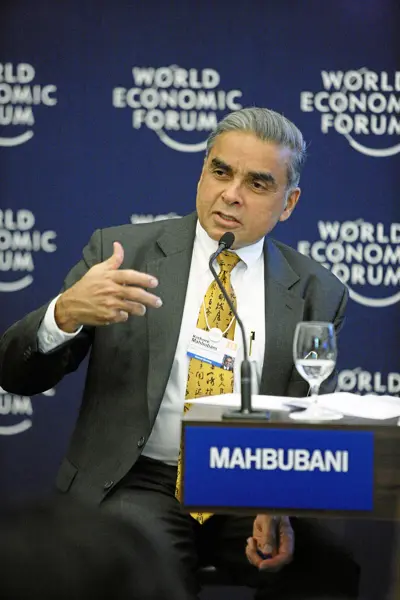
Kishore Mahbubani is a Singaporean civil servant, a career diplomat and an academic. During his stint at the Ministry of Foreign Affairs from 1971 to 2004, he served as Singapore's Permanent Representative to the United Nations and held the position of President of the United Nations Security Council between January 2001 and May 2002. Between 2004 and 2017, he served as Dean of the Lee Kuan Yew School of Public Policy at National University of Singapore.
