Ron Paul Quotes
When one gets in bed with government, one must expect the diseases it spreads.
Ronald E. Paul, U.S. Congressman (Republican, TX), Libertarian Nominee for President, 1988
Sourced by: Eigen's Political and Historical Quotations


The George W. Bush administration had a strong penchant for loyalty and would not fire Republican officials who had proved incompetent or unethical. In the midst of a disastrous Iraq War, there was a sex scandal in the House of Representatives whereby a Republican member was making homosexual advances to young pages. The House Republican leadership had tried to cover it up rather than protect the pages. Yet no one was fired even after the Congressman resigned and admitted it.

While this is a common complaint in the American political dialogue at the beginning of the 21st century, it is interesting that this was the conclusion of a foreign political scholar studying that period—one who was generally a great admirer of America.


This seeming non-sequitur actually has a logic behind it. Flake argues that if the Federal government were much smaller, and spent much less money, rich individuals and companies could not be able to get as much out of government and therefore would not invest large sums of money in lobbyists who, in turn, would then not have the money with which to tempt and bribe congressmen and women.

Begala was commenting on a newspaper expose that President Bush had appointed over 100 lobbyists to administrative government posts in the area for which they had previously lobbied.


While New York City and a few other jurisdictions—states and local—have more stringent laws and ethical standards for politicians than does Congress and Federal Officials, but most have lower standards. In some of the jurisdictions judges can try cases and rule in favor of a company or wealthy individual who gave the judge the money to campaign with and get elected.


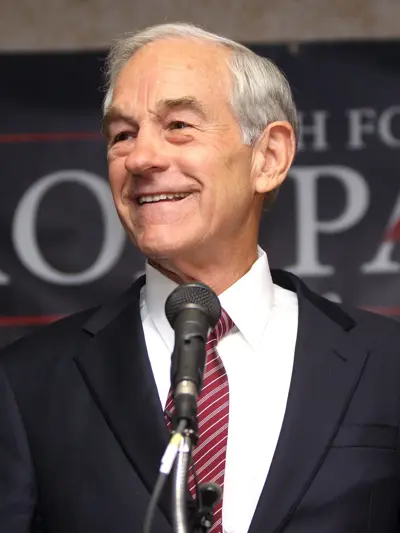
Ronald Ernest Paul is an American author, physician, and retired politician who served as the U.S. Representative for Texas's 22nd congressional district from 1976 to 1977 and again from 1979 to 1985, and for Texas's 14th congressional district from 1997 to 2013. On three occasions, he sought the presidency of the United States: as the Libertarian Party nominee in 1988 and as a candidate for the Republican Party in 2008 and 2012. A self-described constitutionalist, Paul is a critic of the federal government's fiscal policies, especially the existence of the Federal Reserve and the tax policy, as well as the military–industrial complex, the war on drugs, and the war on terror. He has also been a vocal critic of mass surveillance policies such as the USA PATRIOT Act and the NSA surveillance programs. He was the first chairman of the conservative PAC Citizens for a Sound Economy, a free-market group focused on limited government, and has been characterized as the "intellectual godfather" of the Tea Party movement, a fiscally conservative political movement that is largely against most matters of interventionism.
