Che Guevara Quotes
Our enemy, and the enemy of all America, is the monopolistic government of the United States of America
Che Guevara, 1928-1967, Argentine Revolutionary, On Revolutionary Medicine, 1960
Sourced by: Eigen's Political and Historical Quotations


The Governor was campaigning in the Republican Presidential Primary. He was a very candid, conservative who was anxious to reform the party and make it less big business oriented. Publicly admitting to this fact was resented by many in the party who thought the association with big business was a good thing for both the party and the country.


The “rebate agony” referred to a corrupt practice of the Railroads and the Large Monopolies. The railroads charged a very high rate for the transportation of important products like beef and oil. However, secretly they gave back a large percentage of the transportation rate charged to the trusts. They in turn could cut their prices and undersell all the smaller competitors who were paying “full freight” and could not afford to match the lower price. As soon as the smaller competitors were driven out of business in an area, the trust raised its rates even higher than they charged originally. The Railroad had made a small but reasonable profit on the freight of the trusts but they were guaranteed all their business. They also made huge profits on the higher rates that the small companies paid until those companies were driven out of business. Journalists like Ray Baker and Ida Tarbell had uncovered the rebate scheme which enabled the trusts to steal high amounts from the general public through unreasonably high prices. President Theodore Roosevelt was committed to try and regulate the railroads and not allow rebates but charge the same public rate to all with no rebates. Socialists like Sinclair, thought that this attempt would be hopeless—that the damage had already been done, and the trusts now had so much money that they could buy state legislatures and many in Congress to preserve their dominance.

The commercial special interests, together with the banks had become a very dominant force in society just as before the Great Depression in 1929 and the Great Recession in 2008.

Rove had bridged the traditional gap between the right wing Religious fundamentalists and large business, industrial, heavy donors to the party. These groups usually diverged on economic policy and cultural values however Rove had convinced both that they should tolerate the other for the sake of maintaining power for President George W. Bush who delivered enough to each to hold them in coalition. Rove’s style tended to moralize everything for the religious right including their cooperation with major exploiters of economic self-interest. Rove’s religious tactics which were so successful was a subject of great interest and analysis, especially since Rove himself was an agnostic.


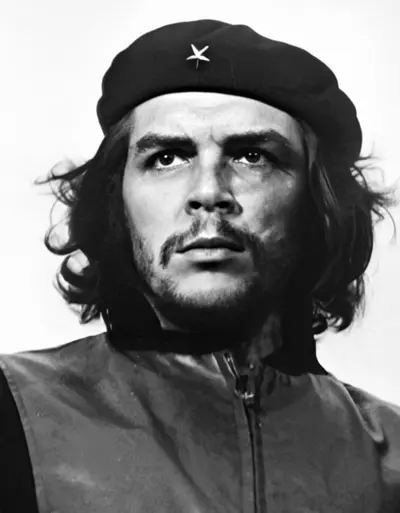
Ernesto "Che" Guevara was an Argentine Marxist revolutionary, physician, author, guerrilla leader, diplomat, and military theorist. A major figure of the Cuban Revolution, his stylized visage has become a ubiquitous countercultural symbol of rebellion and global insignia in popular culture.
