Gregory of Nazianzus Quotes
I desire to learn what is this fashion of innovation in things concerning the Church, which allows anyone who likes, or the passerby,… to tear asunder the flock that has been well led, and to plunder it by larcenous attacks, or rather by piratical and fallacious teachings.
From what is now Turkey. Once the Christians had become established, critics or reformers, were hard to understand as the Christians were a few hundred years earlier.
Gregory of Nazianzus, ~330-389, Saint and Eastern Theologian Letter to Cledonious
Sourced by: Eigen's Political and Historical Quotations


Innovator in this sense refers to one who innovates within Islam—who tries to change or reform the religion departing from the original message of the Prophet. Unfortunately there are many Muslims who believe and argue that the everything that is important or necessary for life is in the Koran. Therefore any idea or statement that is innovative is at best useless and unnecessary and at worst blasphemous. Therefore all innovation is to be discouraged and this is the main reason for the Islamic stagnation since innovation was encouraged during the first 300 years of Islam and Islam far surpassed the Christian world which itself was suspicious of anything innovative them,

The King, a religious fanatic, was a great supporter of the Inquisition whose excesses were even more horrible during his reign than others.


At the time Islam was quite conflicted about the role of innovation, science and reform. Innovators were to many theologians as dangerous to society as heretics and had to be refuted. Al-Ashari’s school of thought has prevailed in much of the Muslim world to this day.


The church was in constant roil with the Bishops, the Pope and the Holy Roman Emperor each striving for superiority over the other two, almost like branches of government fighting for power. This was the bishops attempt to “impeach” the Holy Roman Emperor who was never charged or given an opportunity to face or refute the charges. He was not even present at the Council. See {611260} for his reply.

Lotario de' Conti

Michael Servetus, 1511-1553, a Spanish theologian, was tried and burned at the stake in Switzerland. John Calvin drew up the charges and pronounced the sentence. However his ill health prevented him from personally officially reading the charges. De la Fontaine did it in his stead. Most people are familiar with the charges of questioning the doctrine of the Trinity. However, before those there were a series of more civilly oriented charges of which sever are given herein. Note the emphasis on his book. It was found do offensive that it was burned along with Servetus. See related quote.
At the time of the writing she was an ex-queen. See {618099} for Frederick’s own view of the Greeks. The Crusades were going badly for the Christians at this point. The Greek Emperor had, after promising to be a part of the Christian alliance, made a separate treaty with Saladin and the Muslims, making him an outcast and sewing the seeds of the schism between the Eastern and Western Christian Churches. In a year, the Western Christians would sack Constantinople, and murder and plunder their fellow Eastern Christians. The two previous Greek Emperors were suspect from the Western point of view, but the treaty with Saladin “proved” what had been suspected about the Greeks who were now allied with the hated Muslims.

Luther’s attitude toward the Catholic mass was the main reason the Protestant churches abolished the mass.
Toleration is a relative term. The Muslim Moors made Christians (and Jews) pay a special tax. At times they were forced to wear special clothing so that they could be readily identified. And they could not build churches larger or taller than the smallest mosque in the community. At times, their occupations were restricted but at other times Christians and Jews were appointed to the highest positions like Vizier. The Inquisition, in contrast, forced all Muslims (and Jews) to leave the country without any of their property or money or be tortured and killed—usually by burning at the stake unless of course that they converted to Christianity.


Of all the Western Colonial Powers, Spain was the worst. They took the most from their possessions and contributed the least. Worst, they killed off almost all the indigenous people.
In this speech, and in {634756}, he argued against unification to a public that was mostly opposed. The leadership was interested because they were facing the Muslim Ottoman Turks who were getting more powerful each day. The Eastern Emperor, Constantine XI, more of a soldier and politician than a cleric, wanted the military strength of the Franks and other Western European Christian armies to help protect the Eastern Empire and Byzantium and were willing to reunite under the Pope to get it. Gennadios and his faction were not. They prevailed and the next year, the Muslims conquered Byzantium which had little help from the armies of the Western Roman Empire.


His intolerance and bigotry not only is of Muslims and Hindus, but extends to some Protestant denominations as well. See {643060} for additional examples of bias on the part of this erstwhile Presidential aspirant. To him, religions, unless they agree with his religious beliefs, are evil and dangerous to society.

Reading this quotation, one would think that it was uttered in the early 21st century when the Christian Fundamentalists drove Christian liberals out of many of the evangelical churches and out of the Republican Party. However, this process and conflict has been ongoing for almost a century. This quotation was made in 1922.

While Aquinas brought much wisdom and good to the Church, this statement and others laid a foundation for murdering non-believers and organizing the Inquisition.

The following year India was partitioned and millions of Hindus were slaughtered by Muslims and vice-a-versa.

The Inquisition had tortured De Molay and his fellow Templars forcing them to confess to blasphemy, homosexuality and other capital crimes. Finally De Molay was sentenced to be burned at the stake. At the last moment he confessed to having lied under torture.
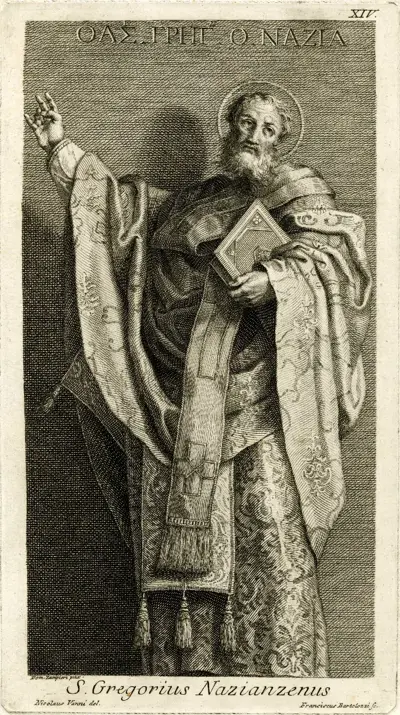
Gregory of Nazianzus, also known as Gregory the Theologian or Gregory Nazianzen, was a 4th-century Archbishop of Constantinople and theologian. He is widely considered the most accomplished rhetorical stylist of the patristic age.[6] As a classically trained orator and philosopher, he infused Hellenism into the early church, establishing the paradigm of Byzantine theologians and church officials.
