Nathaniel Ward Quotes
There is talk of an universall Toleration, I would talke as loud as I could against it … Toleration of all hellish Errors, or how they shall make an universall Reformation, but by making Christ's Academy the Devil's University
Nathaniel Ward, ~1578-1652, Puritan Leader & Codifier, Against Toleration, 1647
Sourced by: Eigen's Political and Historical Quotations

The King, a religious exremist fanatic, was a great supporter of the Inquisition whose excesses were horrible during his reign.


Official List of groups which were prohibited from religiously criticizing the Catholic Church—the established church of Maryland. One interesting observation is that the Jesuits—a Catholic order were on this list. Catholic orders did not then subject their representatives to the authority of the local bishops and took direction only from the Pope. In the case of the Jesuits at the time, there were many who believed the Jesuits were beyond the de facto control of the Papacy and some Jesuits thought they should be—thus the two designations of Jesuits. This makes clear the fundamental intolerance that was common on many parts of Colonial America, that criticism of and heresy to the Established Church was not to be permitted. To the orthodox Catholics of Maryland, they were as concerned with the potential criticisms of Catholic Jesuits as they were with those of Puritans or Anabaptists. Compare Maryland, a Catholic colony with a huge antipathy towards Puritans, with Massachusetts, a Puritan Colony, and its strong antipathy and intolerance for Catholics. It is almost impossible to imagine a union of the American colonies without a 1st Amendment.

He was too ill to read the speech himself and it was read by James Wilson for him.

His intolerance and bigotry not only is of Muslims and Hindus, but extends to some Protestant denominations as well. See {643060} for additional examples of bias on the part of this erstwhile Presidential aspirant. To him, religions, unless they agree with his religious beliefs, are evil and dangerous to society.


From what is now Turkey. Once the Christians had become established, critics or reformers, were hard to understand as the Christians were a few hundred years earlier.
The King, a religious fanatic, was a great supporter of the Inquisition whose excesses were even more horrible during his reign than others.

Whoever teaches differently from what I have taught, … condemns God and must remain a child of hell.
Humility and doubt were not characteristics of Martin Luther.


Ingersoll was considered to be the greatest orator and political thinker of his day, but his overt atheistic views curtailed his elected political career.

This began the Church's most notorious attack on any dissent or disagreement and it was the start of the Inquisition.

Toleration is a relative term. The Muslim Moors made Christians (and Jews) pay a special tax. At times they were forced to wear special clothing so that they could be readily identified. And they could not build churches larger or taller than the smallest mosque in the community. At times, their occupations were restricted but at other times Christians and Jews were appointed to the highest positions like Vizier. The Inquisition, in contrast, forced all Muslims (and Jews) to leave the country without any of their property or money or be tortured and killed—usually by burning at the stake unless of course that they converted to Christianity.

The “talk” was some Protestants concerned that JFK, a Catholic, was a candidate for the presidency.


While Aquinas brought much wisdom and good to the Church, this statement and others laid a foundation for murdering non-believers and organizing the Inquisition.


This was early in his career. As he got older, he was very frustrated with the Jews who would not convert to Christianity even after he had “purified” the religion and freed Christians from the “evils” of the Papacy. He became a virulent anti-Semite. See {617773}.


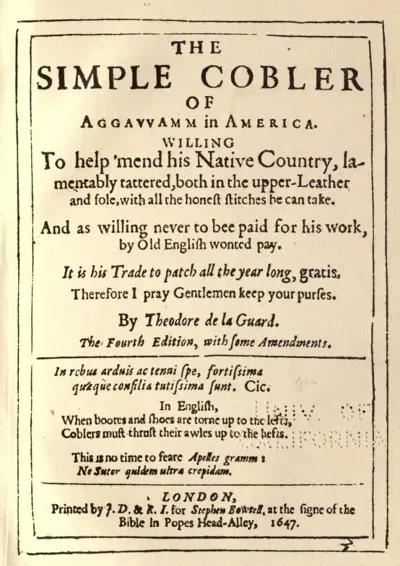
Nathaniel Ward was a Puritan clergyman and pamphleteer in England and Massachusetts. He wrote the first constitution in North America in 1641.
