Mahatma Gandhi Quotes
I can not give you the reference of Ram Chandar or Krishna, because they were not historical figures. I can not help it but to present to you the names of (Hazrat) Abu Bakar (RA) and (Hazrat) Umar Farooq (RA). They were leaders of a vast Empire, yet they lived a life of austerity.
Gandhi, Mahatma. The Collected Works of Mahatma Gandhi. Publications Division, Ministry of Information and Broadcasting, Government of India, 1958-1994.


Ummah is the community of Muslims. There is historical reluctance to engage in civil war even if rulers are terrible. The unwillingness to depose the Taliban in Afghanistan or Sadam Hussein in Iraq is more comprehensible to those of the Islamic tradition than to Westerners who are more accustomed to and comfortable with revolutions, impeachments, and regime changes. Many Muslims feel that it is their religious duty to put up with a poor leader rather than bring instability and produce conflict amongst Muslims. The only exception is the case where the leader does not fulfill his religious obligations and follow the laws of God and the Prophet. This is great part explains the extreme efforts of dictatorial regimes like Saudi Arabia to support its religious establishment. As long as they do not offend the clerics, their regime is safe regardless of how undemocratic or how unfair. An-Nawawi was not just a Muslim scholar stating his own views, but he compiled his 40 Hadiths which are the views of the Prophet and carry great religious and cultural weight.

Theological & Legal Expert. The Sunnah, like the Koran, has statements of the Prophet, Mohammad. A fatwa is a religious legal ruling. This particular Fatwa shows the great difference between the Islamic State and a Republic or Democracy. In the latter forms, any religious practices must be consistent with the Constitution. Even though blasphemy might be prohibited by a religion, the United States Constitution for example protects anyone’s right to be blasphemous. In the Islamic system any constitution or law is subservient to and must be consistent with, the sayings of the Prophet Muhammad. In that sense, unless the Muslim populated nation is secular like Turkey, then the governments are partial or total theocracies.
The last Caliph of the Muslims was removed in 1924 as part of the Turkish Reform. The position has had attraction for many Muslim leaders who saw themselves in the role, but since 1924, nationalism and modernism and the lack of an effective international Muslim leader has precluded it. This anti-revolutionary sentiment of the Islamic political state that is so traditional, may in part account for the Islamic tolerance of autocratic regimes. Note that the distinction between religious responsibilities and civil are important. Tyranny must be tolerated but not blasphemy or heresy. Traditional Muslims provide more tolerance and forbearance for a leader’s civil failings than religious. But Muslims were not the only people to do this. A British prime minister had a view with the same conservative logic. See {639130}. The ancient Jewish Macabean revolt against the Jewish king was all based on failure to perform required religious duties of sacrifice as opposed to tyranny and poor government which also existed. Popes excommunicated Kings for religious reasons, not because of their civil failures at governing. Holding rulers accountable for civil performance is a relatively new concept yet is indispensible in a modern democracy.
The last Caliph of the Muslims was removed in 1924 as part of the Turkish Reform. The position has had attraction for many Muslim leaders who saw themselves in the role, but since 1924, nationalism and modernism and the lack of an effective international Muslim leader has precluded it.

The Caliph was both the religious authority and the civil authority. Islam traditionally sees no desirable separation between church and state.

Here Khomeini takes the classic Islamic view of the Koran that leaders should be obeyed unless they do not follow Islam. To the leaders of Islamic nations, this means that even if the state is not a theocracy, the Muslim clergy has the final say as to whether a ruler may justly remain in power since they are the ones who determine if a ruler is properly following Islam.


The “Caliphate” is the Islamic concept of a single leader of all Muslims in the world who has both Religious and Political power at the same time. After the death of the Prophet Mohammed, there were a succession of Caliphs and Baghdad was considered the seat of the Caliphate for much of that time. For fanatic Muslims who want to bring back the Caliphate, Baghdad has an importance that is almost on a par with Mecca and Jerusalem. The George W, Bush administration did not recognize the importance of Baghdad and Iraq to non-Iraqi Muslims and the importance of driving infidels (Christians) our of their “seat of government,” This was one of the motivations that brought so many “foreign fighters” into Iraq who would not stop at anything in order to get the infidels out.


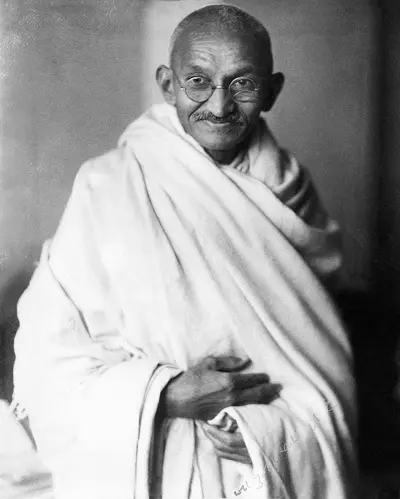
Mohandas Karamchand Gandhi was an Indian lawyer, anti-colonial nationalist, and political ethicist, who employed nonviolent resistance to lead the successful campaign for India's independence from British rule, and in turn inspired movements for civil rights and freedom across the world. The honorific Mahātmā (Sanskrit: "great-souled", "venerable"), first applied to him in 1914 in South Africa, is now used throughout the world.
