Osama bin Laden Quotes
Baghdad is the capital of the Caliphate
The “Caliphate” is the Islamic concept of a single leader of all Muslims in the world who has both Religious and Political power at the same time. After the death of the Prophet Mohammed, there were a succession of Caliphs and Baghdad was considered the seat of the Caliphate for much of that time. For fanatic Muslims who want to bring back the Caliphate, Baghdad has an importance that is almost on a par with Mecca and Jerusalem. The George W, Bush administration did not recognize the importance of Baghdad and Iraq to non-Iraqi Muslims and the importance of driving infidels (Christians) our of their “seat of government,” This was one of the motivations that brought so many “foreign fighters” into Iraq who would not stop at anything in order to get the infidels out.
Osama bin Laden, 1957-2011, Saudi Arabian Terrorist, Founder of Al Qaeda
Sourced by: Eigen's Political and Historical Quotations


Note that Khomeini realized that America assisted Saddam Hussein. We ended up being the enemy of both.

a political party. In the early days of the Muslim religion, the entire Middle East was under the authority of the Caliph who had both religious and civil authority—very much like the Pope did in Europe. However, corruption, independent tribes, feuds, and civil wars destroyed the Caliphate and there has been no common Islamic leader since. Some Muslims want to eradicate the individual countries and restore the Caliphate.


The Caliph in the past was the religious and secular leader of all Muslims. Many of the fundamentalist terrorists have as their objective, the reestablishment of the Caliphate which will unite all Islamic countries under one leader who is both the secular and religious supreme authority—a religious and a civil dictatorship. Most Muslims, like most people of all religions, are not terrorists and believe that much of terrorist activity violates many basic tenets of Islam. However, in order to function, the terrorist must have the tacit support of sufficient numbers of people so that they can function without being exposed. That is an important objective for Al-Qaeda: to enlist sufficient numbers of ordinary people who although they will not commit the terrorist acts, will support the objectives of the terrorists and provide money, shelter, and other services.


Joseph ben Matthias. The term was coined by Josephus to refer to the fundamentalist, orthodox Jewish view of a proper state, as opposed to a secular government. The Jewish fundamentalist dream of a theocracy came down through modern times. There were ultra-orthodox Jewish groups who opposed the creation of the State of Israel on the grounds that it is not a theocracy and there are some who still want to see Israel transformed. The term became generalized and is applied to any state where the religion is the state and religious leaders dominate and control the state. The ultra orthodox Muslims, as in Iran, are generally the only religious group who have created theocracies or semi-theocracies as Islamic states. See {638106} for the context in which the term was first used.

This is a very important quotation as it focused on one critical difference between historical Islam and all the other major religions and fundamentally on the separation between church and state. In Islam there was a Caliph who was both the political ruler and the religious ruler. In comparison at the time, the Christians had a Holy Roman Emperor who was theoretically the overlord of all the Christian Kings but in reality he really could not exercise total or even much authority over all the other kings. At the same time, there was the Pope who was the religious leader of all the Christians. Since the distinction between Church and state was constantly in flux, the Christian Pope and Holy Roman Emperor were often at odds. The third Abrahamic religion, Judaism, had neither a secular leader or a religious one and no hierarchy other than local. Khaldun observed the theoretical advantage of Theocracy as a model, however he did not analyze the disadvantages among which were the assassination of many Caliphs and the laces. Even the Muslim Arabic states abandoned the idea of a Caliph in modern times until Iran adopted a Theocracy with a single Leader all powerful. However, all the other Arab nations wanted no part of a singular leader for all Muslim nations or even a single civil and religious leader within any other country. Al Qaeda however claimed to be fighting for a return to a Caliphate not only for the current Islamic Nations but for all nations which must be subservient to Islam.
Modern versions are “practice what you preach”. Hypocrisy was always recognized if leaders did not set an example. The Caliph was both the civil ruler and the religious ruler as well. Therefore he made rules for the clergy as well as civil officials.
After years of minority Sunni Muslim rule of Iraq, the U. S. invasion gave the majority Shiite Muslims political control. The Sunnis and Shiites have been at each others throats for centuries despite the fact that they are both Muslims. Saudi Arabia is the center of Sunni Islam and many of its religious extremists issue edicts advocating the suicide bombing of Shiite mosques and other facilities and assuring martyrdom for the suicide bombers.

Historically, this quotation shows that the negative relationship between the West and Islam and negative views of Islam was not a new phenomenon at the beginning of the 21st century. It existed long before, and as with the 21st century concerns, violence and war were the major concerns.

He was referring to the religious extremists in the Middle East.

the home of the British Prime Minister

In the Asymmetric Warfare the insurgent “wins” a battle by surviving even if the insurgent takes massive casualties. As long as some exist—they can recruit and expand.


Although a clergyman, he has his own army, stores arms and soldiers in his Mosques, and acts more like a warlord than a member of the clergy.
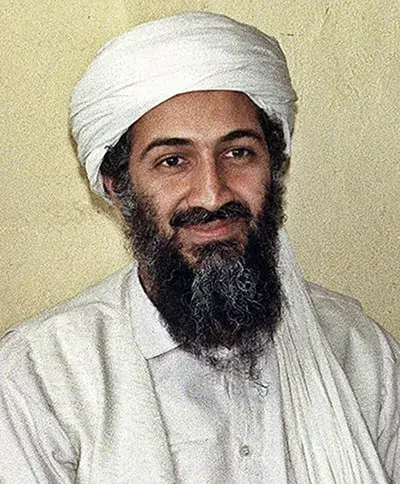
Osama bin Mohammed bin Awad bin Laden /oʊˈsɑːmə bɪn ˈlɑːdən/, also rendered Usama bin Ladin, was a founder of the pan-Islamic militant organization al-Qaeda. The group is designated as a terrorist group by the United Nations Security Council, the North Atlantic Treaty Organization (NATO), the European Union, and various countries.
